

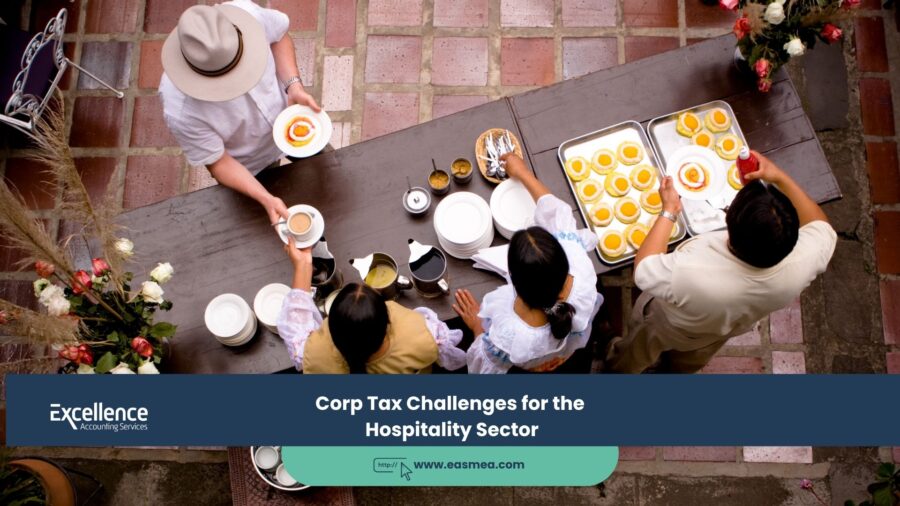
Corp Tax Challenges for the Hospitality Sector: A Comprehensive Guide
The UAE’s hospitality sector is the vibrant heart of its non-oil economy, a world-class ecosystem of luxury hotels, innovative restaurants, and global tourist attractions. For decades, the financial focus for operators in this sector has been on operational efficiency, revenue per available room (RevPAR), and delivering exceptional guest experiences. The introduction of the UAE Corporate Tax regime marks a paradigm shift, introducing a new layer of financial complexity that permeates every aspect of a hospitality business, from the cost of a client dinner to the structure of an international hotel management agreement.
- Corp Tax Challenges for the Hospitality Sector: A Comprehensive Guide
- Part 1: The Entertainment Expense Conundrum - The 50% Rule
- Part 2: Mixed-Use Properties and Cost Allocation
- Part 3: Transfer Pricing for Internationally Branded Hotels
- Part 4: The Qualifying Free Zone Person (QFZP) Maze
- Part 5: The Foundational Requirement - A Robust Accounting System
- Specialized Tax & Financial Advisory for the Hospitality Sector
- Frequently Asked Questions (FAQs) for the Hospitality Sector
- Is Your Hospitality Business Ready for the New Tax Landscape?
Unlike many other industries, hospitality businesses are characterized by high-volume, diverse revenue streams, significant fixed assets, and complex operational structures. This unique profile gives rise to a specific and challenging set of tax issues. The rules on the deductibility of entertainment expenses, the allocation of costs across mixed-use properties, the complexities of operating within a Free Zone, and the need to justify management fees to international brands are now critical boardroom topics. Navigating this new landscape requires more than just compliance; it demands a strategic, proactive approach to tax management. This guide will explore the most pressing Corporate Tax challenges facing the UAE’s hospitality sector and provide a framework for building a robust and resilient tax strategy.
Key Tax Challenges for the Hospitality Sector
- Entertainment Expense Limitation: Costs for entertaining clients or potential clients (e.g., dinners, events) are only 50% deductible for Corporate Tax purposes.
- Mixed-Use Asset Allocation: Hotels are complex, mixed-use assets. Overheads and shared costs must be allocated on a logical basis between different functions (e.g., rooms, F&B, spa), which is critical for Free Zone entities.
- Transfer Pricing for Branded Hotels: Management fees, franchise fees, marketing contributions, and loyalty program fees paid to international hotel brands are subject to the arm’s length principle and require robust transfer pricing documentation.
- Qualifying Free Zone Person (QFZP) Complexity: A hotel in a Free Zone faces significant challenges in meeting the QFZP requirements, especially the *de minimis* rule, due to revenue from local UAE residents and guests.
- Capital Allowances (Depreciation): The industry’s high investment in property and equipment makes managing the tax depreciation of these assets a critical component of calculating taxable income.
- Pre-Opening Expenses: Costs incurred before a hotel or restaurant opens must be capitalized and are typically amortized over a period, impacting tax deductions in the initial years of operation.
Part 1: The Entertainment Expense Conundrum – The 50% Rule
Perhaps the most direct and immediate challenge for the hospitality sector is the rule on the deductibility of entertainment expenses. Article 28 of the Corporate Tax Law limits the deduction for expenses incurred for “entertainment, amusement, or recreation” to 50% of the amount incurred.
What Qualifies as “Entertainment”?
This is a broad category that includes any expenditure on hospitality provided to customers, shareholders, suppliers, or other business partners. For a hotel or restaurant, this includes:
- Hosting a potential corporate client for dinner.
- Providing a complimentary stay for a travel agent or journalist to promote the hotel.
- Organizing a networking event for business partners.
- Costs of food, accommodation, and admission to shows or events.
Example: A hotel sales manager takes a potential client out for dinner at the hotel’s fine-dining restaurant. The bill is AED 1,000. For Corporate Tax purposes, the hotel can only deduct AED 500 (50% of AED 1,000) from its taxable income.
Crucial Distinctions: What is 100% Deductible?
It’s vital to distinguish entertainment from other fully deductible expenses:
- Staff Entertainment: Expenses for staff parties, team-building events, or annual dinners are generally 100% deductible as they are considered an employee-related cost.
- Simple Hospitality for Staff: Providing tea, coffee, and snacks for employees in the workplace is 100% deductible.
- Travel Expenses: The cost of a hotel room for an employee traveling for business is fully deductible. It only becomes a 50% deductible entertainment expense if the purpose is to host a client.
This rule necessitates meticulous record-keeping. The accounting system must be configured to segregate 50% deductible entertainment costs from 100% deductible staff costs or other operational expenses.
Part 2: Mixed-Use Properties and Cost Allocation
A hotel is the quintessential mixed-use asset. A single building contains multiple business lines: accommodation (rooms), food and beverage (restaurants, bars, room service), leisure (spa, pool, gym), retail, and conference facilities. While these are all part of the same business, they often have different operational models and, crucially, can have different tax treatments, especially if the hotel is in a Free Zone.
The Allocation Challenge
Many significant costs are incurred for the benefit of the entire property. These “overheads” or “shared costs” include:
- Rent or depreciation on the building itself.
- Utilities (electricity, water).
- Salaries of general management, finance, and HR teams.
- Central marketing and branding expenses.
For calculating taxable income accurately, these costs must be allocated between the different departments on a fair and reasonable basis. This is not just good practice; it’s a legal requirement, particularly for a QFZP that needs to separate costs related to Qualifying Income from those related to non-qualifying income.
Acceptable Allocation Methods:
- Floor Area: A common and logical method for allocating building-related costs like rent, depreciation, and utilities.
- Revenue Share: Allocating central marketing or management costs based on the revenue generated by each department.
- Headcount: Allocating central HR and administrative costs based on the number of employees in each department.
- Specific Identification: Where a cost can be directly tied to a department (e.g., the salary of a restaurant chef), it should be directly allocated.
The chosen methodology must be documented in a formal cost allocation policy and applied consistently from year to year.
Part 3: Transfer Pricing for Internationally Branded Hotels
A significant portion of the UAE’s hotel market operates under management or franchise agreements with major international brands (e.g., Marriott, Hilton, Accor, IHG). These arrangements involve a variety of payments from the UAE hotel-owning company to the foreign brand owner, all of which are transactions with a “Related Party.”
Common Intercompany Charges:
- Management/Franchise Fees: Typically a percentage of revenue or gross operating profit.
- Marketing and Advertising Contributions: Fees paid into a global fund for brand promotion.
- Loyalty Program Fees: Charges for participation in programs like Marriott Bonvoy or Hilton Honors.
- Centralized Services Fees: Charges for using the brand’s global reservation system, IT platforms, or procurement services.
Under the Corporate Tax Law, all these payments must comply with the arm’s length principle. The UAE hotel must be able to prove that the fees it is paying are no higher than what would have been paid between two independent companies for the same services. This requires a comprehensive transfer pricing analysis and robust documentation, a key area covered by our Corporate Tax advisory services.
Part 4: The Qualifying Free Zone Person (QFZP) Maze
For hotels located within one of the UAE’s many Free Zones, the prospect of achieving QFZP status and a 0% tax rate on “Qualifying Income” is attractive. However, for a hospitality business, this is one of the most complex areas to navigate.
The Core Problem: Mixed Customer Base
Qualifying Income is generally derived from transactions with other Free Zone persons or from businesses outside the UAE. The challenge for a hotel is that its customer base is inherently mixed:
- International Tourists: Revenue from these guests could potentially be Qualifying Income.
- Local UAE Residents: Revenue from mainland UAE residents staying at the hotel or dining at its restaurants is generally considered non-qualifying “Taxable Income.”
The *De Minimis* Trap
A QFZP will lose its 0% status for all its income if its non-qualifying revenue exceeds the *de minimis* threshold. This is the lower of AED 5 million or 5% of the entity’s total revenue. For a large hotel with popular restaurants and event spaces that attract local clientele, it is very easy to breach this threshold. A single large wedding or corporate event for a mainland company could be enough to tip the balance, making the hotel’s entire profit for the year subject to 9% tax.
Part 5: The Foundational Requirement – A Robust Accounting System
Given these complexities, trying to manage a hospitality business’s tax compliance on spreadsheets is an impossible task. A modern, robust accounting system is the bedrock of compliance.
A system like Zoho Books is essential for:
- Detailed Revenue Tracking: Creating separate revenue streams to monitor income from different customer types (e.g., local vs. international) for QFZP analysis.
- Expense Segregation: Using tags or separate expense accounts to distinguish between 50% deductible entertainment and 100% deductible business expenses.
- Fixed Asset Management: Maintaining a detailed fixed asset register to accurately calculate tax depreciation on property, furniture, and equipment.
- Departmental Accounting: Setting up cost centers for each department (Rooms, F&B, Spa) to facilitate the cost allocation process.
Specialized Tax & Financial Advisory for the Hospitality Sector
The unique challenges of the hospitality industry demand specialized expertise. Excellence Accounting Services (EAS) provides a suite of services tailored to hotels, restaurants, and tourism companies.
- Hospitality-Focused Tax Advisory: We provide strategic advice on the most complex issues, from achieving and maintaining QFZP status to structuring management agreements, leveraging our deep Corporate Tax expertise.
- Transfer Pricing & Business Valuation: Our experts conduct benchmark studies and valuations to ensure your intercompany charges for brand fees and management services are fully defensible.
- Feasibility Studies for New Ventures: Planning a new hotel or restaurant? Our feasibility studies incorporate detailed tax modeling to ensure your project is financially viable from day one.
- Accounting System Implementation: We are experts in deploying systems like Zoho Books, configuring them specifically for the needs of a hospitality business, a core part of our accounting system implementation service.
- Outsourced CFO Services: Our CFO services provide high-level strategic financial leadership to help you navigate the complexities of tax, financing, and operational efficiency.
Frequently Asked Questions (FAQs) for the Hospitality Sector
Yes, but likely only 50% deductible. This is a form of marketing and promotion that falls under the category of entertainment and hospitality provided to a business partner. The cost of the stay (e.g., cost of cleaning, amenities, and any food provided) would be subject to the 50% limitation.
Yes. These are considered employee-related expenses incurred wholly and exclusively for the purpose of the business and are 100% deductible. They do not fall under the client entertainment category.
Pre-opening expenses (e.g., recruitment, marketing, and administrative costs incurred before the hotel opens for business) are not immediately deductible. They are considered capital expenditure. These costs must be capitalized and can then be amortized (deducted in equal installments) over a period, typically 3 to 5 years, starting from the date the business commences.
This depends on the nature of the work. If you are simply repainting and replacing worn-out furniture (a repair/maintenance), the cost is generally deductible in the year it’s incurred. If you are significantly changing the layout, upgrading the structure, or substantially enhancing the value of the lobby (an improvement), the cost must be capitalized and depreciated over its useful life.
Yes. Revenue from cancellation fees and “no-shows” is considered part of your business income and is fully subject to Corporate Tax. Similarly, any retained deposits are also taxable.
This depends on how they are handled. If the company collects the service charge and retains it as revenue, it is taxable. If the company collects tips and service charges and distributes 100% of them to the staff as part of their remuneration, it is typically treated as a “pass-through” and would not be revenue. The payments to staff would then be part of their deductible payroll cost.
Yes. Commissions paid to Online Travel Agencies (OTAs) are a normal and necessary cost of doing business and are 100% deductible. This is a third-party transaction and is not subject to the entertainment limitation.
Even if you don’t charge a customer for a stay, it may be considered a “deemed supply” for VAT purposes if you have already recovered input VAT on the costs related to that room. In such cases, you would be required to account for output VAT on the cost of providing the service. This is a separate consideration from Corporate Tax deductibility.
Yes. The costs associated with providing a service to your guests, such as airport transfers (fuel, driver salaries, vehicle depreciation), are considered operational expenses and are 100% deductible. They are not client entertainment.
Under IFRS 15, when a customer earns points, a portion of the initial revenue they paid must be deferred and recognized only when the points are redeemed. This accounting treatment is generally followed for Corporate Tax purposes. It’s a complex area that requires careful alignment between your accounting and tax policies.
Conclusion: A New Era of Financial Strategy for Hospitality
The arrival of Corporate Tax has ushered in a new era for the UAE hospitality industry. Financial management must now evolve beyond operational metrics to encompass a sophisticated and strategic approach to tax. Success will depend on the ability to integrate tax considerations into every decision, from marketing and client relations to asset management and brand affiliations. By investing in robust systems, developing clear policies, and seeking expert guidance, hospitality businesses can not only navigate the challenges of the new tax regime but also turn proactive compliance into a source of sustainable financial health and competitive advantage.