
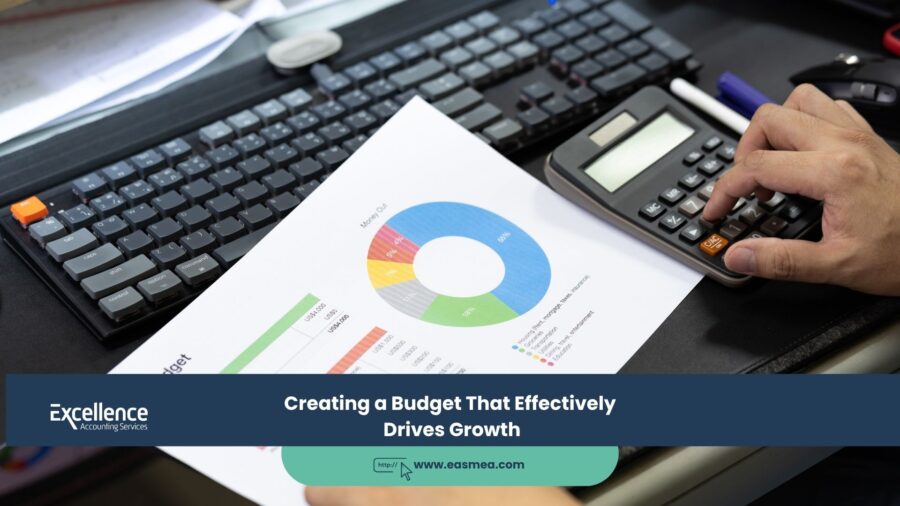
Creating a Budget That Effectively Drives Growth: A Strategic Guide for UAE Businesses
For many business leaders, the word “budget” evokes a sense of restriction. It’s often viewed as a rigid, top-down financial straitjacket designed to control spending and enforce discipline. This traditional perception of a budget—as a static, backward-looking, cost-containment tool—is one of the biggest impediments to corporate growth. A budget that is merely a list of spending limits is a missed opportunity. In the ambitious and fast-paced economy of the UAE, a budget should not be an anchor holding you back; it should be the strategic engine that propels you forward.
- Creating a Budget That Effectively Drives Growth: A Strategic Guide for UAE Businesses
- Part 1: The Flaw of the Traditional Budget
- Part 2: The Methodologies of a Strategic Growth Budget
- Part 3: Architecting Your Budget for Growth
- Part 4: The Technology That Powers a Dynamic Budget
- From Cost Control to Growth Engine: Let EAS Architect Your Budget
- Frequently Asked Questions (FAQs) on Growth-Oriented Budgeting
- Is Your Budget a Roadmap to Growth or a Relic of the Past?
A growth-oriented budget is a dynamic, forward-looking financial plan that translates your company’s strategic vision into a clear, actionable roadmap. It’s a tool for resource allocation, not just resource restriction. It answers the most critical business questions: Where should we invest our capital to achieve the highest returns? How can we fund our marketing and sales efforts to accelerate customer acquisition? What is the financial plan to support our expansion into new markets? This guide is designed to help UAE business leaders transform their budgeting process from a painful annual exercise in cost-cutting into a powerful, continuous strategic discipline that fuels innovation, empowers teams, and drives sustainable, profitable growth.
Key Takeaways on Growth-Oriented Budgeting
- A Budget is a Plan for Growth, Not Just a Limit on Spending: It should be a strategic tool for allocating resources to high-impact initiatives.
- Ditch the Static Annual Budget: Adopt a dynamic approach with rolling forecasts that adapt to changing market conditions.
- Move Beyond Incrementalism: Use methods like Zero-Based Budgeting to force a strategic justification for every dollar spent.
- Budget Based on Drivers, Not History: Link your financial plan to the key operational drivers (KPIs) of your business, such as customer acquisition cost and lifetime value.
- Empower, Don’t Restrict: A good budget provides department heads with the resources and autonomy they need to achieve their goals.
- The vCFO is the Budget Architect: A strategic financial leader is essential for designing, implementing, and managing a growth-focused budget.
Part 1: The Flaw of the Traditional Budget
Before building a better model, it’s crucial to understand why the conventional approach to budgeting so often fails as a strategic tool.
The Traditional Budgeting Process:
- Look at last year’s actual spending.
- Add a small percentage (e.g., 3-5%) for inflation.
- Engage in a political “horse-trading” exercise where departments fight to protect their turf.
- Lock the numbers into a spreadsheet for the next 12 months.
Why This Fails to Drive Growth:
- It’s Backward-Looking: It assumes the future will be a simple extension of the past, which is rarely true in a market like Dubai.
- It Discourages Innovation: It provides no mechanism for funding new, high-potential initiatives that weren’t in last year’s plan.
- It Becomes Obsolete Quickly: A budget set in December is often irrelevant by March due to unforeseen market shifts or new opportunities.
- It Encourages Wasteful Spending: It leads to the “use it or lose it” mentality, where managers spend their entire budget at year-end to ensure they get the same amount next year.
Part 2: The Methodologies of a Strategic Growth Budget
A growth budget is built on a foundation of more sophisticated and forward-looking methodologies.
A. Zero-Based Budgeting (ZBB)
Zero-Based Budgeting is a method where all expenses must be justified for each new period. Every function is analyzed for its needs and costs, and the budget is built from a “zero base.”
Instead of starting with last year’s budget, ZBB starts with a blank slate. Every department manager must justify their entire budget request from the ground up, explaining how each dollar will contribute to the company’s strategic goals. While more time-consuming, ZBB is incredibly powerful for:
- Eliminating legacy costs that no longer serve a purpose.
- Forcing a strategic conversation about priorities.
- Reallocating capital from low-impact activities to high-growth initiatives.
B. Rolling Forecasts
A rolling forecast is a dynamic model that is continuously updated. For example, at the end of each quarter, you review and revise the forecast for the next 4-6 quarters. This approach keeps the financial plan perpetually current and relevant.
Benefits:
- Agility: Allows the business to quickly pivot and reallocate resources in response to new opportunities or threats.
- Accuracy: Forecasts are inherently more accurate because they are based on more recent information.
- Reduces Year-End Panic: It turns budgeting into a continuous, manageable process rather than a massive annual scramble.
C. Driver-Based Budgeting
This approach links the financial budget directly to the operational drivers of the business. Instead of simply budgeting for “AED X in marketing,” a driver-based approach models the inputs:
- Target: We want to acquire 500 new customers this year.
- Key Driver (KPI): Our average Customer Acquisition Cost (CAC) is AED 1,000.
- The Budget: Therefore, the marketing and sales budget required is 500 x 1,000 = AED 500,000.
This creates a much more logical, defensible, and strategically aligned budget.
Part 3: Architecting Your Budget for Growth
Applying these methodologies, here’s how to structure a budget that actively invests in your company’s future.
1. Set Clear Strategic Goals First
The budget process should not start with spreadsheets. It must start in the boardroom with a clear answer to the question: “What are our top 3-5 strategic priorities for the next 12-18 months?” These goals (e.g., “Enter the Saudi market,” “Launch Product X,” “Increase market share by 5%”) become the guiding principles for all resource allocation decisions.
2. Build a Detailed Financial Model
A vCFO will translate these strategic goals into a comprehensive financial model. This model will forecast the P&L, Balance Sheet, and Cash Flow, and will be the central tool for testing assumptions and running “what-if” scenarios. This is a core part of our strategic CFO services.
3. Budget for Growth Investments, Not Just Costs
A growth budget has dedicated sections for strategic investments:
- Sales & Marketing: Budgeted as a function of growth targets and ROI metrics like CAC and LTV.
- Capital Expenditures (CapEx): A clear plan for investing in the technology, machinery, or facilities needed to scale. A feasibility study should support each major CapEx request.
- People: A strategic hiring plan, viewing new hires not as costs, but as investments in the company’s capabilities. This requires close collaboration with HR.
4. Implement a “Budget vs. Actual” Review Process
A budget is useless if it’s not monitored. A vCFO will implement a monthly process to review the actual results against the budget. The goal of this meeting is not to blame people for variances, but to understand *why* they occurred and what adjustments need to be made to the forecast going forward. This is where insightful financial reporting becomes a critical management tool.
Part 4: The Technology That Powers a Dynamic Budget
A strategic budgeting process is impossible to manage on disconnected spreadsheets. It requires a modern technology stack.
The core of this stack is a cloud-based accounting system like Zoho Books. It acts as the “single source of truth,” providing the accurate, real-time “actuals” data that is essential for the budget vs. actual review process. By integrating directly with your bank accounts and other systems, it ensures the data is always current, allowing for agile decision-making.
From Cost Control to Growth Engine: Let EAS Architect Your Budget
At Excellence Accounting Services (EAS), we specialize in transforming the finance function into a strategic growth partner. We help you design and implement a budgeting and forecasting process that fuels your ambition.
- Virtual CFO Leadership: Our vCFOs act as the architects of your strategic financial plan, facilitating the budgeting process, challenging assumptions, and providing high-level insights.
- Strategic Business Consultancy: We help you define your strategic priorities, which form the essential foundation of any growth-oriented budget, a key part of our business consultancy.
- Flawless Financial Foundation: Our expert accounting and bookkeeping services ensure you have the accurate, real-time data needed to manage a dynamic budget effectively.
- Integrated Tax Planning: We ensure your budget is fully integrated with a compliant and efficient Corporate Tax strategy, so there are no surprises at year-end.
Frequently Asked Questions (FAQs) on Growth-Oriented Budgeting
On the contrary, a flexible financial plan is even more critical for a startup. A rolling forecast (which is a form of budget) is essential for managing your cash runway—your single most important metric. It’s not about restriction; it’s about knowing how your decisions today will impact your ability to operate in six months.
The key is to frame it as a tool for empowerment, not control. A growth budget should be a collaborative process where you ask them, “What resources do you need to achieve your goals?” When managers are involved in building the plan and understand how it connects to the company’s strategy, they become owners of the budget, not victims of it.
Think of it like a journey. The budget is the destination you set at the start (e.g., “we plan to reach AED 10M in revenue”). The forecast is your GPS, which is constantly updating your estimated time of arrival and route based on current traffic and speed. You need both to be successful.
It is more work than traditional budgeting, which is why many companies only do a full ZBB every 2-3 years, with lighter reviews in between. However, the strategic clarity and cost savings it can unlock are immense. It’s a powerful tool for breaking out of legacy spending patterns and forcing a company to refocus on what truly creates value.
You use a driver-based approach. Your vCFO will help you build a sales forecast based on inputs you *can* control or influence, such as the number of sales reps, the size of the sales pipeline, historical conversion rates, and planned marketing campaigns. This creates a much more credible and logical forecast than just picking a number.
In a strategic budgeting culture, a variance from the budget is not a failure; it’s a learning opportunity. The monthly “budget vs. actual” review is about understanding *why* the variance occurred. Did a competitor’s actions impact sales? Did a new marketing channel perform better than expected? These insights are then fed back into the rolling forecast to make it more accurate.
It’s a critical line item. Your budget needs to project your taxable income, not just your accounting profit, and forecast the amount of Corporate Tax you will have to pay. This is a significant cash outflow that must be included in your cash flow forecast to avoid liquidity problems.
It is absolutely essential. Any credible lender or investor will require a detailed financial plan, which includes a historical and forecasted budget (P&L, Balance Sheet, and Cash Flow). It is one of the most important documents for demonstrating that you have a professional, well-managed business with a clear plan for the future.
It should be a collaborative process led by a senior financial leader (like a vCFO). It must have buy-in from the CEO and should involve all heads of department. The finance team’s role is to facilitate the process, provide the data, and build the model, but the operational assumptions and goals must come from the department leaders themselves.
The best first step is to get your data in order by implementing a professional accounting system. The second step is to seek strategic expertise. Engaging a part-time vCFO is the most effective way to bring the financial modeling skills and strategic mindset needed to transform your budgeting process.
Conclusion: Your Financial Roadmap to Ambition
A budget is ultimately a financial expression of your ambition. A budget that merely seeks to replicate last year’s performance reflects a lack of ambition. A strategic, growth-oriented budget, however, is a declaration of intent. It is a carefully constructed plan that allocates your precious resources—your capital and your people’s time—to the initiatives that will have the greatest impact on your future success. By abandoning the restrictive, static budgets of the past and embracing a dynamic, forward-looking approach, you can transform your finance function into a powerful catalyst, providing the fuel and the roadmap to turn your strategic vision into a reality.