
A CFO’s Guide to Debt vs. Equity Financing: Strategic Choices for UAE Growth
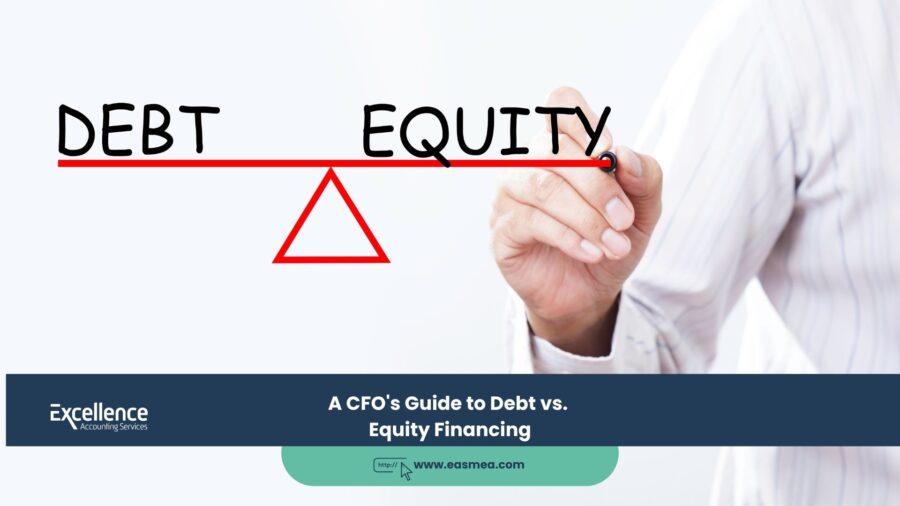
At the heart of every Chief Financial Officer’s (CFO) mandate lies a fundamental strategic challenge: how to fuel the company’s growth and operations in the most efficient and value-enhancing way. This invariably leads to the critical decision between the two primary sources of long-term capital: debt and equity. It’s a choice with profound implications for a company’s risk profile, ownership structure, cost of capital, and ultimately, its overall enterprise value. For CFOs navigating the dynamic landscape of the UAE, this decision has become even more nuanced and strategically vital with the recent introduction of the federal Corporate Tax.
- A CFO's Guide to Debt vs. Equity Financing: Strategic Choices for UAE Growth
- Part 1: Understanding Equity Financing - The Ownership Stake
- Part 2: Understanding Debt Financing - The Lender's Claim
- Part 3: The Impact of UAE Corporate Tax - The New Equation
- Part 4: The CFO's Strategic Balancing Act
- Part 5: The Indispensable Role of Financial Data and Systems
- EAS: Your Strategic Advisor on Capital Structure
- Frequently Asked Questions (FAQs) on Debt vs. Equity
- Is Your Financing Strategy Optimized for Growth and Value?
Historically, many UAE businesses relied heavily on internally generated funds (equity) or founder capital. The absence of corporate taxes meant the traditional “tax shield” benefit of debt financing was non-existent, making equity relatively more attractive despite its higher intrinsic cost. Now, with a 9% Corporate Tax rate applicable to profits above AED 375,000, the game has changed. Interest payments on debt are now tax-deductible, creating a tangible financial incentive to incorporate debt into the capital structure. However, this benefit must be carefully weighed against the inherent risks of leverage. This guide provides a comprehensive framework for UAE CFOs to analyze the debt versus equity dilemma, understand the key trade-offs in the new tax environment, and make informed decisions that optimize their company’s capital structure for sustainable growth and value creation.
Key Takeaways on Debt vs. Equity
- The Core Decision: How much of your company should be funded by borrowing (Debt) versus ownership capital (Equity)?
- Debt Pros & Cons: Cheaper due to tax shield, no dilution, but increases financial risk (default, covenants).
- Equity Pros & Cons: No default risk, flexible, potential strategic value from investors, but expensive (high required returns) and dilutive (loss of ownership/control).
- UAE Tax Impact: The 9% Corporate Tax creates a “tax shield” that lowers the effective cost of debt, making it relatively more attractive than before.
- The Goal: Minimize WACC: The optimal mix minimizes the Weighted Average Cost of Capital, maximizing company value.
- It’s a Strategic Balance: The CFO must weigh the tax benefits of debt against the increasing risks of financial distress as leverage rises.
- Context Matters: The right mix depends on industry, growth stage, profitability, risk tolerance, and market conditions.
Part 1: Understanding Equity Financing – The Ownership Stake
Equity represents the capital invested by the owners and the accumulated profits reinvested back into the business. It forms the foundation of the company’s capital base and bears the ultimate risk and reward.
Sources of Equity:
- Founder’s Capital: Initial investment by the entrepreneurs.
- Retained Earnings: Profits generated by the business and reinvested rather than paid out as dividends. This is the most common source for established SMEs.
- Angel Investors & Seed Funds: Early-stage external capital, often in exchange for a significant ownership stake.
- Venture Capital (VC): Institutional investment for high-growth potential companies, typically involving preferred shares and board seats.
- Private Equity (PE): Investment in more mature companies, often involving buyouts or growth capital.
- Public Markets (IPO): Selling shares to the public (less common for typical SMEs).
Advantages of Equity Financing:
- No Mandatory Payments: Unlike debt, there are no required interest or principal repayments. Dividends are discretionary. This provides significant financial flexibility, especially during downturns.
- No Default Risk: A company cannot go bankrupt simply because it didn’t pay a dividend or generate enough profit for its equity holders.
- Long-Term Alignment: Equity investors (especially strategic ones) are typically aligned with the long-term success of the business.
- Enhanced Credibility: A strong equity base can improve a company’s standing with lenders, suppliers, and customers.
Disadvantages of Equity Financing:
- Dilution of Ownership and Control: Bringing in external equity investors means giving up a percentage of ownership and potentially ceding some control over strategic decisions (e.g., through board representation).
- High Cost: Equity is the most expensive form of capital. Equity investors take on the highest risk and therefore demand the highest potential returns (often 20-30%+ IRR). This “cost of equity” reflects the opportunity cost for investors.
- No Tax Shield: Dividend payments are made out of after-tax profits and are not tax-deductible for the company.
- Complexity: Raising external equity involves complex negotiations, legal documentation (shareholder agreements), and potentially higher administrative costs.
Part 2: Understanding Debt Financing – The Lender’s Claim
Debt represents borrowed funds that must be repaid according to a pre-agreed schedule, usually with interest. Debt holders have a contractual claim on the company’s assets that takes precedence over equity holders.
Sources of Debt:
- Bank Loans (Term Loans, Overdrafts): The most common source for SMEs.
- Lines of Credit: Flexible borrowing facilities for short-term working capital needs.
- Supplier/Trade Credit: Effectively a short-term, often interest-free loan from your suppliers (managing accounts payable).
- Lease Financing: Financing the use of assets like equipment or vehicles.
- Bonds (Corporate Debt Market): Typically only accessible to large corporations.
Advantages of Debt Financing:
- No Dilution of Ownership: Lenders do not gain an ownership stake or voting rights in your company (unless the debt is convertible). Founders retain full control.
- Lower Cost (The Tax Shield): The interest rate on debt is generally lower than the required return on equity. Furthermore, under the UAE Corporate Tax regime, interest payments are tax-deductible (subject to limitations), reducing the effective cost.
Effective Cost of Debt = Interest Rate * (1 – Tax Rate) - Financial Discipline: The requirement to make regular payments can impose a healthy discipline on cash flow management.
- Leverage Amplifies Returns: If the company earns a return on borrowed funds that is higher than the cost of borrowing, the excess return accrues to the equity holders, amplifying their ROI.
Disadvantages of Debt Financing:
- Mandatory Repayments & Default Risk: Failure to make interest or principal payments can trigger default, potentially leading to bankruptcy and loss of the business. This is the primary risk of debt.
- Reduced Financial Flexibility: Fixed repayment schedules reduce the company’s flexibility to invest or weather downturns.
- Loan Covenants: Lenders often impose restrictions (covenants) that can limit strategic decisions, such as taking on more debt, paying dividends, or making acquisitions.
- Collateral Requirements: Secured loans often require pledging company assets as collateral, putting those assets at risk in case of default.
- Increased Volatility: Higher debt levels increase the volatility of earnings available to equity holders.
Part 3: The Impact of UAE Corporate Tax – The New Equation
The introduction of the 9% Corporate Tax fundamentally alters the debt vs. equity calculation for profitable UAE businesses.
The Emergence of the Debt Tax Shield:
Before the tax, a 6% loan cost 6%. Now, for a company paying the 9% tax rate, that same 6% loan has an effective after-tax cost of:
6% * (1 - 0.09) = 5.46%
This 0.54% difference represents the “tax shield”—the tax savings generated by the interest deduction. This makes debt relatively cheaper compared to equity (whose cost is unaffected by corporate tax).
The Constraint: Interest Capping Rules
However, the government anticipated that companies might try to excessively load up on debt purely for tax avoidance. To prevent this, the UAE implemented an interest capping rule, aligned with OECD guidelines.
Generally, a company’s net interest expense deduction is limited to the higher of:
- A de minimis threshold (currently AED 12 million).
- 30% of its EBITDA (Earnings Before Interest, Taxes, Depreciation, and Amortization).
This means there is a limit to how much you can benefit from the debt tax shield. Calculating your EBITDA accurately becomes critical for tax planning.
As CFO, your analysis must now incorporate both the *benefit* of the tax shield and the *limitation* imposed by the capping rules when evaluating different debt levels. This requires sophisticated financial modeling.
Part 4: The CFO’s Strategic Balancing Act
The decision is rarely black and white. It involves a strategic balancing act, guided by analysis and judgment.
Key Considerations for the CFO:
- What is the Cost of Capital? Calculate the current WACC and model how it changes with different mixes of debt and equity. This requires estimating the cost of equity (often using CAPM or build-up methods) and the after-tax cost of debt. A core task for our CFO services.
- What is the Business Risk? How volatile are the company’s revenues and cash flows? Businesses with stable, predictable earnings can handle more debt.
- What is the Optimal Level vs. Current Level? Is the company currently under-leveraged (too much equity) or over-leveraged (too much debt)? Is there an opportunity to recapitalize to optimize the structure?
- What are the Market Conditions? Are interest rates high or low? Is equity capital readily available from investors? Market timing matters.
- How Much Flexibility is Needed? Does the company need the flexibility to make large, unpredictable investments? High debt levels can restrict this.
- What are the Stakeholder Preferences? Are the founders comfortable with dilution? Are lenders imposing restrictive covenants?
This analysis often involves building a detailed financial model to simulate the impact of different financing decisions on key metrics and valuation.
Part 5: The Indispensable Role of Financial Data and Systems
Making informed decisions about debt versus equity is impossible without accurate, timely, and well-structured financial data.
Why Clean Data Matters:
- Calculating Key Ratios: Metrics like Debt-to-Equity, Interest Coverage, and EBITDA rely on accurate P&L and Balance Sheet data.
- Building Reliable Forecasts: Assessing debt capacity requires robust cash flow forecasting, which depends on clean historical data and realistic assumptions. A rolling forecast is essential.
- Investor/Lender Due Diligence: Presenting messy or unreliable financials is the fastest way to lose credibility with potential capital providers.
A modern cloud accounting system like Zoho Books, professionally managed through rigorous accounting and bookkeeping, provides the essential data foundation for these high-level strategic decisions.
EAS: Your Strategic Advisor on Capital Structure
Optimizing your capital structure is a complex, high-stakes endeavor requiring deep financial expertise. Excellence Accounting Services (EAS) partners with UAE businesses to navigate these critical decisions.
- Strategic CFO Services: Our core offering. We provide part-time CFOs who analyze your capital structure, calculate your WACC, model financing scenarios, and advise the board on the optimal path forward.
- Corporate Tax Expertise: We ensure your financing strategy maximizes the benefits of the debt tax shield while remaining fully compliant with UAE Corporate Tax law and interest capping rules.
- Financial Modeling & Forecasting: We build the sophisticated financial models needed to accurately assess the impact of different debt and equity levels.
- Business Valuation: Our valuation services inherently involve determining the optimal capital structure to maximize enterprise value.
- Lender & Investor Readiness: We prepare the financial packages and support the due diligence process required to successfully raise either debt or equity capital.
Frequently Asked Questions (FAQs) on Debt vs. Equity
Generally, yes, especially after considering the tax shield. The required return for equity investors is almost always significantly higher than the interest rate on debt because they bear more risk. However, the *risk* associated with debt (default risk) must also be factored into the strategic decision.
These instruments have characteristics of both debt and equity. Examples include convertible debt (starts as debt, can convert to equity later) or preferred stock (pays a fixed dividend like debt but is technically equity). They can offer flexibility but add complexity.
Many bank loans to SMEs require personal guarantees from the owner. This blurs the line between corporate and personal risk, making debt feel more like “equity risk” to the founder. It’s a critical factor in the risk tolerance assessment.
No. While there’s no direct cash cost, there is an *opportunity cost*. Those retained earnings belong to the shareholders. If the company cannot reinvest them to generate a return that meets or exceeds what the shareholders could earn elsewhere (the cost of equity), then theoretically, the profits should be paid out as dividends.
Early Stage (Pre-Revenue/Profit): Almost entirely equity (founders, angels, VCs). Debt is usually unavailable or too risky.
Growth Stage (Revenue, Approaching Profitability): Mix becomes possible. May use venture debt alongside VC equity.
Mature Stage (Stable Profits): Can support higher debt levels. Focus shifts to optimizing WACC, potentially using debt for share buybacks or dividends.
Venture debt is a type of loan specifically for venture-backed startups that may not yet be profitable but have strong growth potential. It typically comes alongside an equity round and offers less dilution than raising more equity, but it still carries repayment obligations.
For private companies, this is complex. Common methods involve the Capital Asset Pricing Model (CAPM) using data from comparable public companies, adjusted for specific risks (size, liquidity), or a “build-up” method adding various risk premiums to a base risk-free rate. It requires significant judgment and expertise.
Yes. When a supplier gives you 60 days to pay, they are effectively providing you with a short-term, interest-free loan. Managing your accounts payable strategically is a key part of managing your overall debt financing.
Absolutely. Variable-rate debt introduces interest rate risk. Fixed-rate debt provides certainty but might be more expensive upfront. The choice depends on your forecast for interest rates and your risk appetite.
It should be reviewed at least annually as part of the strategic planning process. It should also be revisited whenever there is a significant change in the business (e.g., major acquisition, entry into a new market), a change in market conditions (e.g., large interest rate shift), or when considering a major new financing need.
Conclusion: A Dynamic Decision for a Dynamic Market
The choice between debt and equity is one of the most consequential decisions a CFO will make. It is not a static calculation but an ongoing strategic balancing act, requiring a deep understanding of the company’s operations, risk profile, market conditions, and, critically, the evolving tax landscape in the UAE. The introduction of Corporate Tax has undeniably shifted the optimal balance, making a thoughtful analysis of debt’s role more important than ever. By leveraging accurate data, sophisticated financial modeling, and expert advice, UAE CFOs can navigate this complex decision, optimize their capital structure, minimize their cost of capital, and ultimately drive greater value for their organizations.