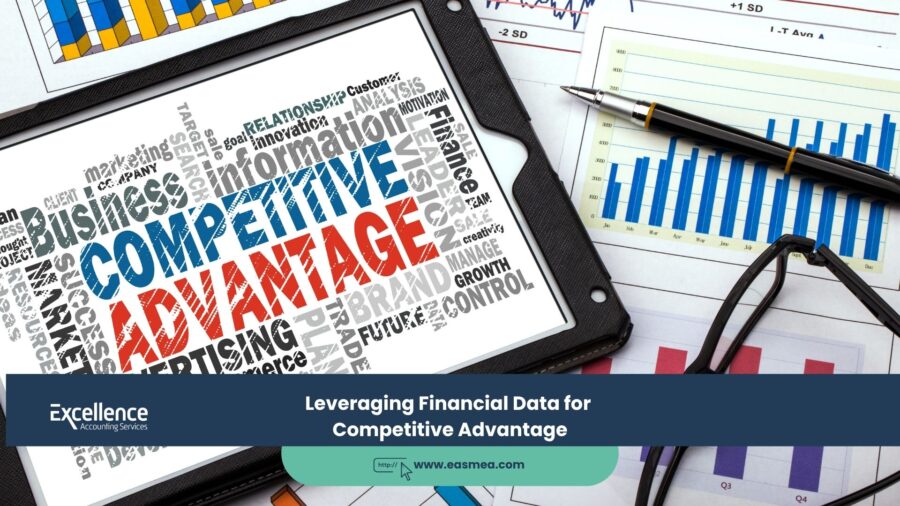
Leveraging Financial Data for Competitive Advantage: Turning Numbers into Your Strategic Edge
In the hyper-competitive UAE market, businesses are constantly searching for an edge. They invest heavily in product innovation, marketing campaigns, and operational efficiencies. Yet, one of the most powerful sources of competitive advantage often lies dormant, hidden within the very numbers that track the company’s performance: financial data. For too many Small and Medium-sized Enterprises (SMEs), financial data is viewed primarily through the lens of compliance—something collected and reported to satisfy auditors and tax authorities. It exists as static reports, historical snapshots that offer little guidance for future action. This reactive approach represents a massive missed opportunity.
- Leveraging Financial Data for Competitive Advantage: Turning Numbers into Your Strategic Edge
- Part 1: The Starting Point - From Compliance Mindset to Strategic Mindset
- Part 2: Unlocking Profitability Insights - Beyond the P&L
- Part 3: Driving Operational Efficiency Through Financial Data
- Part 4: Financial Data as a Crystal Ball - Forecasting and Strategy
- Part 5: The Technology Imperative - Enabling Data-Driven Insights
- Turn Your Data into Your Advantage with EAS
- Frequently Asked Questions (FAQs) on Leveraging Financial Data
- Stop Reporting History. Start Shaping Your Future.
The reality is that your financial data, when properly collected, analyzed, and integrated with operational and sales information, is a goldmine of strategic intelligence. It holds the key to understanding true profitability drivers, identifying hidden inefficiencies, optimizing pricing strategies, making smarter resource allocation decisions, and ultimately, outmaneuvering the competition. Businesses that learn to transform their finance function from a backward-looking scorekeeper into a forward-looking, data-driven strategic partner gain a significant advantage. They move faster, make smarter bets, and allocate capital with far greater precision. This guide explores how UAE SMEs can unlock the strategic power hidden within their financial data, transforming it from a compliance burden into their most potent competitive weapon.
Key Takeaways on Using Financial Data Competitively
- Data is an Asset, Not Just a Record: Shift from viewing financial data as a compliance requirement to seeing it as a strategic asset for decision-making.
- Beyond Surface Metrics: Look beyond basic revenue and profit to analyze granular profitability (by customer, product, channel), efficiency ratios, and cash flow drivers.
- Integration is Power: Combining financial data with sales (CRM) and operational data unlocks exponentially deeper insights than any single data set alone.
- Identify True Profit Drivers: Use data to pinpoint which activities, customers, or products generate the most *profitable* growth, not just the most revenue.
- Optimize Resource Allocation: Data-driven insights allow you to confidently allocate capital, marketing spend, and sales efforts to the areas with the highest ROI.
- Enhance Operational Efficiency: Analyze financial data to identify bottlenecks, reduce waste, and improve processes in areas like inventory and collections.
- Build Predictive Capabilities: Leverage historical data and leading indicators to build more accurate forecasts and anticipate market shifts.
Part 1: The Starting Point – From Compliance Mindset to Strategic Mindset
The first step in leveraging financial data is a fundamental shift in perspective within the leadership team. Finance cannot be seen as just the department that produces month-end reports and handles tax filings.
The Traditional (Compliance) View:
- Focus: Historical accuracy, statutory reporting, tax compliance (VAT, Corporate Tax).
- Data Used: Primarily General Ledger data.
- Output: Standard financial statements (P&L, Balance Sheet, Cash Flow).
- Timing: Primarily backward-looking (monthly, quarterly, annually).
- Role of Finance Team: Scorekeeper, Compliance Officer.
The Modern (Strategic) View:
- Focus: Forward-looking insights, performance optimization, risk management, capital allocation.
- Data Used: Integrated financial, sales (CRM), operational (inventory, production), and even external market data.
- Output: Customized dashboards, KPI tracking, scenario analysis, profitability deep-dives, predictive forecasts.
- Timing: Real-time analysis and forward-looking projections.
- Role of Finance Team: Strategic Advisor, Business Partner, Data Analyst. See our guide on the CFO as a Strategic Advisor.
This strategic view requires accurate foundational data, emphasizing the importance of high-quality accounting and bookkeeping.
Part 2: Unlocking Profitability Insights – Beyond the P&L
A standard Income Statement shows your overall profitability. Strategic financial data analysis digs much deeper to understand *where* that profit actually comes from.
1. Granular Profitability Analysis
Simply knowing your overall gross margin isn’t enough. You need to understand profitability at a more granular level:
- Customer Profitability: Are all customers created equal? By allocating direct costs (COGS, support) and indirect costs (acquisition, overhead share) to individual customers or segments, you can identify your most valuable relationships and potentially “fire” unprofitable ones.
- Product/Service Profitability: Which offerings contribute the most to your bottom line after all associated costs? This guides decisions on product development, pricing, and which items to promote or discontinue.
- Channel Profitability: Compare the net profitability of sales generated through different channels (e.g., direct sales force vs. e-commerce vs. distributors).
This requires integrating financial data with sales data, as explored in our guide on Integrating Sales & Finance Data.
2. Pricing Optimization
Financial data, combined with sales and market data, is essential for moving beyond cost-plus pricing.
- Margin Analysis by Product/Customer: Identify areas where margins are thin and pricing power might exist.
- Discount Effectiveness: Analyze the impact of discounts on volume vs. overall profitability. Are deep discounts actually driving profitable growth or just eroding margins?
- Competitor Benchmarking: Use market data alongside your own cost structure to position your pricing strategically.
- Break-Even Analysis: Use cost data to understand the volume implications of different price points (see our guide on Break-Even Analysis).
3. Targeted Cost Reduction
Detailed financial data allows for surgical cost reduction, not just blunt cuts.
- Expense Trend Analysis: Identify expense categories that are growing faster than revenue.
- Variance Analysis (Budget vs. Actual): Drill down into *why* costs are over or under budget, identifying specific operational drivers.
- Supplier Spend Analysis: Analyze spending patterns by supplier to identify opportunities for negotiation or consolidation. Effective accounts payable management includes this analysis.
- Activity-Based Costing (ABC): For complex businesses, ABC allocates overhead costs based on the specific activities that drive them, providing a much more accurate picture of true product or service cost.
Part 3: Driving Operational Efficiency Through Financial Data
Financial data isn’t just about P&L; it’s a powerful lens for viewing operational performance.
1. Working Capital Optimization
Financial data is the key to managing your Cash Conversion Cycle.
- AR Aging Analysis: Identify slow-paying customers and bottlenecks in your collection process. Track Days Sales Outstanding (DSO).
- AP Aging Analysis: Ensure you are utilizing supplier credit terms effectively without damaging relationships. Track Days Payables Outstanding (DPO).
- Inventory Turnover & DIO Analysis: Identify slow-moving stock, optimize reorder points, and minimize cash tied up in inventory. Track Days Inventory Outstanding (DIO).
Improving working capital efficiency directly improves cash flow and reduces the need for external financing (see Cash Flow Management guide).
2. Sales Performance Management
Integrated data provides a financial lens on sales effectiveness.
- Sales Cycle Length Analysis: Identify stages where deals get stuck.
- Win Rate Analysis by Lead Source/Rep: Understand which channels and reps are most effective.
- CAC Analysis by Channel/Campaign: Determine the ROI of different marketing spends.
- Sales Rep Profitability: Go beyond revenue quotas to measure the margin contribution of each rep.
3. Resource Utilization
For service businesses, financial data combined with time tracking or project management data can reveal:
- Project Profitability: Understand which projects or clients are most profitable after accounting for all staff time and resources.
- Employee Utilization Rates: Ensure billable staff are being utilized effectively.
- Service Line Profitability: Analyze the margin contribution of different service offerings.
Part 4: Financial Data as a Crystal Ball – Forecasting and Strategy
Perhaps the most potent use of financial data is to inform future strategy.
1. Building Predictive Forecasts
Moving beyond simple extrapolation of historical trends.
- Driver-Based Modeling: Build forecasts based on key operational drivers (e.g., website traffic, sales rep quota attainment, production capacity) linked to financial outcomes.
- Pipeline Integration: Incorporate probability-weighted sales pipeline data for more accurate revenue forecasts.
- Leading Indicator Analysis: Identify non-financial metrics (e.g., website demos booked, lead velocity rate) that predict future financial performance.
This requires building an investment-grade financial model.
2. Data-Driven Scenario Planning
Use your financial model and data to quantify the impact of strategic decisions and external shocks.
- Model the financial impact of launching a new product, entering a new market, or making a significant capital investment.
- Stress-test the business against potential risks (e.g., recession, loss of a key customer, supply chain disruption).
This allows for proactive planning and builds financial resilience.
3. Informing Capital Allocation
Historical and projected financial data is essential for making smart decisions about where to invest the company’s capital for the highest risk-adjusted return (ROI, IRR, NPV calculations).
Part 5: The Technology Imperative – Enabling Data-Driven Insights
None of this strategic analysis is possible without the right technological foundation. Manual data gathering and spreadsheet manipulation are too slow, error-prone, and lack the depth required.
A modern, integrated technology stack is essential:
- Cloud Accounting System: The core financial hub (e.g., Zoho Books). Provides accurate, real-time financial data.
- CRM System: Tracks all customer interactions and sales pipeline data.
- Inventory Management System (if applicable): Provides real-time stock levels and cost data.
- Business Intelligence (BI) Tools: Platforms like Zoho Analytics, Power BI, or Tableau allow you to connect these disparate data sources, create custom dashboards, and perform deep-dive analysis.
Implementing and integrating these tools requires expertise, often involving specialists in accounting system implementation.
Turn Your Data into Your Advantage with EAS
Transforming financial data from a reporting burden into a strategic asset requires expertise in both finance and technology. Excellence Accounting Services (EAS) empowers UAE SMEs to harness the power of their data.
- Strategic CFO Services: Our Outsourced CFOs are experts at data analysis and interpretation. We help you identify the KPIs that matter, build insightful dashboards, and use financial data to drive strategic decisions.
- Business Intelligence & Reporting: We design and implement custom financial reports and BI solutions that integrate data from multiple sources, providing you with actionable insights.
- System Integration & Implementation: We help you implement and integrate best-in-class cloud platforms like Zoho Books, CRM, and Inventory to create a single source of truth.
- Profitability & Performance Analysis: We conduct deep-dive analyses to uncover the true drivers of your profitability and identify areas for operational improvement.
- Business Consultancy: Our business consultancy services leverage data analysis to inform strategies around pricing, market entry, and resource allocation.
Frequently Asked Questions (FAQs) on Leveraging Financial Data
The first step is a clean-up. Engage a professional accounting review service to get your historical books organized, reconciled, and accurate. Then, implement a robust cloud accounting system and disciplined processes going forward.
Reporting is about presenting *what* happened (e.g., “Revenue was AED 1M”). Analysis is about understanding *why* it happened and *what* it means for the future (e.g., “Revenue was AED 1M, driven by a 20% increase in Customer Segment A, but profitability declined because CAC for that segment increased by 30%”).
For larger SMEs, yes. For smaller ones, this analytical function can often be effectively performed by a skilled strategic CFO (whether in-house or outsourced) who leverages modern BI tools.
Share the data that helps them perform better and aligns them with company goals. This includes data on deal profitability (not just revenue), customer LTV, CAC by channel, and progress towards margin-based targets. Transparency, when framed constructively, fosters better decision-making.
It can’t predict with certainty, but it can significantly improve the accuracy of your forecasts. By understanding historical patterns, identifying leading indicators, and incorporating real-time operational data, you move from simple guesswork to data-informed probability.
Vanity metrics look good on the surface but don’t necessarily correlate with business health. Examples include total website visits (without looking at conversion rates), number of app downloads (without looking at active users or monetization), or even total revenue growth (if it comes at the expense of profitability and cash flow).
Investors and bankers rely heavily on data. Demonstrating that you have a deep, granular understanding of your business’s financial drivers (unit economics, profitability, cash flow) and can present a credible, data-backed forecast inspires immense confidence and significantly increases your chances of securing capital.
Cloud-based solutions have made powerful tools much more accessible and affordable for SMEs compared to the expensive, on-premise systems of the past. Platforms like Zoho One offer integrated suites at very competitive price points. The ROI from better decision-making usually far outweighs the software cost.
Implement strong internal controls, automate data entry where possible (e.g., bank feeds, integrations), perform regular reconciliations (bank, AR, AP), and consider periodic internal audits or reviews by professionals.
Collecting it but not *using* it strategically. Many businesses have years of valuable data sitting in their accounting systems, but they only look at high-level reports for compliance. They fail to perform the deeper analysis that could unlock significant competitive advantages.
Conclusion: Your Data, Your Differentiator
In an increasingly competitive UAE market, the ability to effectively leverage financial data is rapidly shifting from a best practice to a baseline requirement for success. Businesses that continue to operate with siloed information and a purely historical view of finance will inevitably fall behind those that embrace data integration, analytics, and a forward-looking strategic approach. Your financial numbers tell a story—a story of what’s working, what’s not, where the risks lie, and where the greatest opportunities reside. Learning to read, interpret, and act on that story is the key to building not just a profitable business, but a truly intelligent, resilient, and competitively advantaged one.