
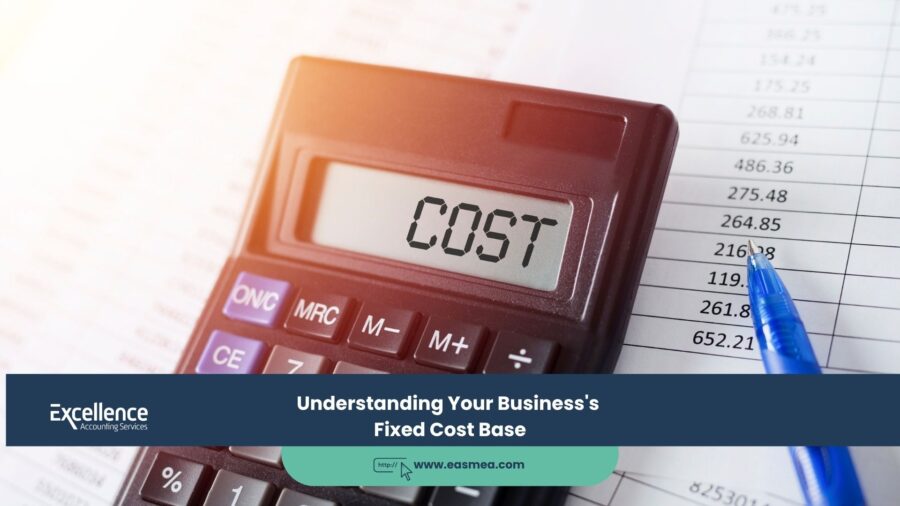
Understanding Your Business’s Fixed Cost Base: A Strategic Guide for UAE Businesses
In the financial architecture of any business, costs form the structural beams and pillars upon which profitability is built. Understanding the nature of these costs is fundamental to sound financial management. Among the most critical distinctions is the difference between fixed and variable costs. While variable costs fluctuate directly with sales volume, fixed costs represent the stable, recurring expenses a business must cover regardless of its level of activity. Think of them as the baseline operational hum—the rent, the core salaries, the essential software subscriptions—that continue even if the sales floor is empty or the factory is idle. For businesses operating in the UAE, accurately identifying, analyzing, and managing this fixed cost base is not just an accounting exercise; it’s a vital component of strategic planning, risk management, and profitability analysis.
- Understanding Your Business's Fixed Cost Base: A Strategic Guide for UAE Businesses
- Part 1: Defining Fixed Costs - The Constant Commitment
- Part 2: Identifying Your Fixed Costs - Digging into the Details
- Part 3: The Strategic Importance - Why Fixed Costs Matter So Much
- Part 4: Strategies for Managing and Optimizing Fixed Costs
- EAS: Your Partner in Understanding and Optimizing Your Cost Structure
- Frequently Asked Questions (FAQs) on Fixed Costs
- Do You Have a Clear Picture of Your Fixed Cost Base?
A company’s fixed cost structure dictates its break-even point, influences its operating leverage, and shapes its resilience in the face of market fluctuations. A high fixed cost base might enable significant economies of scale at high volumes but also poses a greater risk during downturns. Conversely, a low fixed cost base offers flexibility but may limit scalability. Understanding where your business sits on this spectrum is crucial for making informed decisions about pricing, investment, and growth strategy. This guide provides a comprehensive framework for UAE CFOs, finance managers, and business owners to dissect their fixed cost base, understand its profound strategic implications, and implement strategies for effective management and optimization.
Key Takeaways on Fixed Costs
- Definition: Fixed costs remain constant in total amount regardless of sales or production volume within a relevant range (e.g., rent, core salaries, insurance).
- Foundation of Break-Even: Your total fixed costs determine the minimum level of contribution margin needed to avoid losses.
- Drives Operating Leverage: A higher proportion of fixed costs means higher operating leverage – profits increase faster when sales rise above break-even, but losses mount faster when sales fall below.
- “Fixed” is Not Forever: While fixed in the short term, many fixed costs can be managed or changed over the medium to long term (e.g., renegotiating leases, restructuring teams).
- Accurate Identification is Crucial: Misclassifying costs can lead to flawed analysis and poor decision-making. Requires disciplined accounting.
- Strategic Management: Understanding your fixed cost base informs decisions on pricing, outsourcing, automation, and capacity planning.
- Essential for Budgeting: Fixed costs form the predictable baseline for financial forecasts and budgets.
Part 1: Defining Fixed Costs – The Constant Commitment
The defining characteristic of a fixed cost is its independence from the volume of goods or services produced or sold, at least within a certain range of activity (known as the “relevant range”). Whether your factory produces 1,000 widgets or 10,000 widgets in a month, the factory rent remains the same.
Fixed Costs vs. Variable Costs: The Core Distinction
It’s crucial to differentiate fixed costs from variable costs, which fluctuate directly with activity levels.
| Characteristic | Fixed Costs | Variable Costs |
|---|---|---|
| Behavior (Total Cost) | Remains constant as activity changes | Changes proportionally as activity changes |
| Behavior (Cost Per Unit) | Decreases as activity increases (spread over more units) | Remains constant as activity changes |
| Examples (UAE Context) | Office Rent, Core Salaries, Trade License Fees, Insurance, Depreciation, Software Subscriptions | Raw Materials, Sales Commissions, Shipping Costs, Direct Labor (piece rate), Payment Processing Fees |
Understanding this distinction is the foundation for techniques like Break-Even Analysis and Contribution Margin analysis.
The Concept of the “Relevant Range”
It’s important to note that costs are only fixed within a certain range of activity. If your business grows so much that you need to rent a second warehouse or hire an entire new administrative team, your total fixed costs will jump to a new, higher level. The break-even analysis assumes you are operating within a stable relevant range where fixed costs remain constant.
Stepped Fixed Costs
Some costs behave like fixed costs within a narrow range but increase in steps as activity grows significantly (e.g., needing to hire a new supervisor once production exceeds a certain threshold). These are sometimes called “stepped fixed costs.”
Part 2: Identifying Your Fixed Costs – Digging into the Details
Accurately identifying your fixed costs requires a careful review of your company’s Chart of Accounts and historical expense data. This isn’t always straightforward, as some costs may be “mixed.”
The Process:
- Review Your Income Statement (P&L): Go through each expense line item.
- Analyze Cost Behavior: For each expense, ask: “If our sales doubled next month, would this specific cost increase?”
- If the answer is clearly “No” (e.g., Rent), it’s a fixed cost.
- If the answer is clearly “Yes, proportionally” (e.g., Raw Materials), it’s a variable cost.
- Address Mixed Costs: Some costs have both fixed and variable components (e.g., a utility bill with a fixed connection charge plus a variable usage charge, or a salesperson’s salary with a fixed base plus variable commission). These need to be split:
- High-Low Method: A simple technique comparing total costs at the highest and lowest activity levels to estimate the fixed and variable portions.
- Regression Analysis: A more statistically robust method (often done in Excel) that analyzes historical data points to mathematically separate fixed and variable components.
- Sum Total Fixed Costs: Add up all identified fixed costs (and the fixed portions of mixed costs) for a given period (usually monthly or annually).
This process highlights the critical importance of accurate, well-categorized data from your accounting and bookkeeping system. Using a platform like Zoho Books with a properly structured Chart of Accounts makes this analysis significantly easier and more reliable.
Part 3: The Strategic Importance – Why Fixed Costs Matter So Much
Understanding your fixed cost base is far more than an accounting classification exercise. It has profound implications for strategy and decision-making.
1. Foundation for Break-Even Analysis
Your Total Fixed Costs are the numerator in the break-even calculation. They represent the hurdle that your total contribution margin (Sales Revenue – Total Variable Costs) must clear before you start making a profit. Knowing your fixed costs allows you to determine:
- The minimum sales volume needed to survive.
- The impact of price changes on profitability.
- The sales volume needed to achieve a target profit level.
2. Understanding Operating Leverage
Operating leverage measures the sensitivity of your operating income (EBIT) to changes in sales revenue. It is directly influenced by your fixed cost structure.
High Operating Leverage (High Fixed Costs, Low Variable Costs per Unit):
- Once break-even is passed, profits increase very rapidly with each additional sale (high contribution margin).
- However, losses also mount quickly if sales fall below break-even.
- Examples: Software companies, airlines, hotels.
Low Operating Leverage (Low Fixed Costs, High Variable Costs per Unit):
- Profits increase more slowly above break-even.
- Losses are less severe if sales fall below break-even (lower fixed cost hurdle).
- Examples: Retail businesses, consulting firms.
Understanding your operating leverage helps you assess your business’s risk profile and its potential for profit amplification (or loss magnification) based on sales fluctuations.
3. Informing Pricing Strategy
Your prices must be set high enough so that the contribution margin per unit, multiplied by the expected sales volume, is sufficient to cover all fixed costs and achieve your target profit. Fixed costs per unit decrease as volume increases, which is a key principle behind economies of scale and volume-based pricing strategies.
4. Guiding Cost Management Efforts
While variable costs are managed by controlling usage and negotiating per-unit prices, managing fixed costs requires a different approach. It involves longer-term decisions about capacity, structure, and commitments.
5. Baseline for Budgeting and Forecasting
Fixed costs are generally the most predictable component of your budget. Establishing an accurate baseline of fixed costs is the starting point for building any reliable financial forecast or budget. This is crucial for effective financial reporting and planning.
6. Supporting Key Operational Decisions
- Outsourcing Decisions: Should you perform a function in-house (often involving fixed costs like salaries and equipment) or outsource it (often converting it to a variable or semi-variable cost)?
- Automation Investments: Investing in automation (e.g., new machinery, software) often increases fixed costs (depreciation, licenses) but reduces variable costs (direct labor). An analysis requires understanding this trade-off. (See our guide on Automation ROI).
- Shutdown Decisions: In a severe downturn, if you cannot cover your variable costs, you should shut down immediately. If you can cover variable costs but not all fixed costs, the decision is more complex. Understanding which fixed costs are truly unavoidable is critical.
Part 4: Strategies for Managing and Optimizing Fixed Costs
While “fixed” implies inflexibility, many fixed costs can be actively managed over time.
- Regular Review: Periodically analyze every fixed cost line item. Is it still necessary? Is it providing value? Are there cheaper alternatives?
- Lease Negotiations: Don’t automatically renew commercial leases (See our guide). Research market rates and negotiate aggressively during renewal periods or explore relocating to more cost-effective premises.
- Technology Optimization: Review software subscriptions. Are you using all the features? Can you consolidate platforms? Explore cloud-based options that might offer more variable, usage-based pricing.
- Outsourcing Non-Core Functions: Consider outsourcing functions like IT support, HR (HR consultancy can help assess this), or even finance (outsourced CFO) to convert fixed salaries into potentially more flexible service fees.
- Headcount Management: While salaries are fixed costs, staffing levels are manageable. Regularly assess organizational structure and productivity to ensure optimal headcount. Implement performance management systems.
- Energy Efficiency: For businesses with significant utility costs (often semi-fixed), investments in energy-efficient equipment or practices can yield long-term savings.
Optimization doesn’t always mean cutting; it means ensuring your fixed cost base aligns with your strategic needs and provides the best possible value.
EAS: Your Partner in Understanding and Optimizing Your Cost Structure
Mastering your fixed cost base requires accurate data, insightful analysis, and strategic thinking. Excellence Accounting Services (EAS) provides the expertise to help UAE businesses manage costs effectively.
- Strategic CFO Services: Our CFOs analyze your entire cost structure, calculate operating leverage, perform break-even analysis, and advise on strategies for cost optimization and control.
- Accurate Cost Accounting: Our bookkeeping services ensure your costs are meticulously tracked and correctly classified, providing the reliable data needed for analysis.
- Budgeting and Forecasting: We build robust budgets and forecasts grounded in a clear understanding of your fixed and variable cost drivers.
- Business Process Review: Our consultants can review processes to identify potential fixed cost savings through efficiency improvements or outsourcing opportunities.
- Technology Advisory: We help you leverage systems like Zoho Books for better cost tracking and reporting, supported by our implementation expertise.
Frequently Asked Questions (FAQs) on Fixed Costs
Not necessarily. The fixed base salaries of administrative staff are fixed. However, the wages of direct production workers paid per piece are variable. Sales commissions based on volume are variable. Even for salaried employees, overtime pay can be a variable component.
Depreciation (using standard methods like straight-line) is typically treated as a fixed cost because the total amount expensed each year doesn’t change based on how many units the machine produces. The *cost per unit* decreases as production increases, but the *total* depreciation expense remains constant for the period.
Committed fixed costs are long-term obligations that cannot be easily reduced in the short term (e.g., long-term leases, essential equipment depreciation). Discretionary fixed costs arise from annual management decisions and can be adjusted more easily (e.g., advertising budgets, R&D spending, training programs).
Fixed costs do *not* affect your contribution margin. Contribution margin is solely Sales Revenue minus Variable Costs. Fixed costs are covered *by* the total contribution margin generated.
It’s extremely rare and usually only applies to very simple, commission-only business models operating with minimal infrastructure. Almost every business has some baseline fixed costs (e.g., trade license, basic software).
Not necessarily. Lower fixed costs mean lower risk but potentially lower scalability. Industries requiring heavy investment in infrastructure (e.g., manufacturing, telecom) inherently have high fixed costs, which enable massive economies of scale once high volumes are achieved. The optimal structure depends on the industry and business strategy.
Knowing your fixed cost base tells you the minimum revenue you need to survive (your break-even point). It helps you make tough decisions about cost-cutting, focusing on discretionary fixed costs first. Businesses with lower fixed costs are generally more resilient during downturns.
The shutdown point is the level of operations at which a company is indifferent between continuing to operate and shutting down temporarily. This occurs when revenue is just enough to cover total variable costs. Below this point, every unit sold actually *increases* the loss. Even if you can’t cover fixed costs, it might make sense to keep operating as long as you are covering variable costs and contributing *something* towards fixed costs.
Legitimate fixed costs incurred wholly and exclusively for business purposes (rent, salaries, depreciation, etc.) are generally deductible expenses when calculating your taxable income, reducing your 9% Corporate Tax liability.
It allows for precise tracking and categorization of all expenses. You can run reports showing fixed costs trends over time, compare them against budget, and easily drill down into details. Setting up recurring bills for fixed expenses like rent or software subscriptions also ensures timely payment and accurate recording.
Conclusion: Mastering the Baseline for Financial Stability
Your fixed cost base is the financial bedrock upon which your business operates. It dictates your break-even point, shapes your risk profile through operating leverage, and forms the predictable core of your budgets and forecasts. While these costs may seem inflexible in the short term, a strategic understanding allows for effective management and optimization over the long run. By accurately identifying, meticulously tracking, and strategically analyzing your fixed costs, UAE businesses can gain crucial insights into their financial structure, make more informed decisions about pricing and investment, and build a more resilient and profitable foundation for sustainable growth.