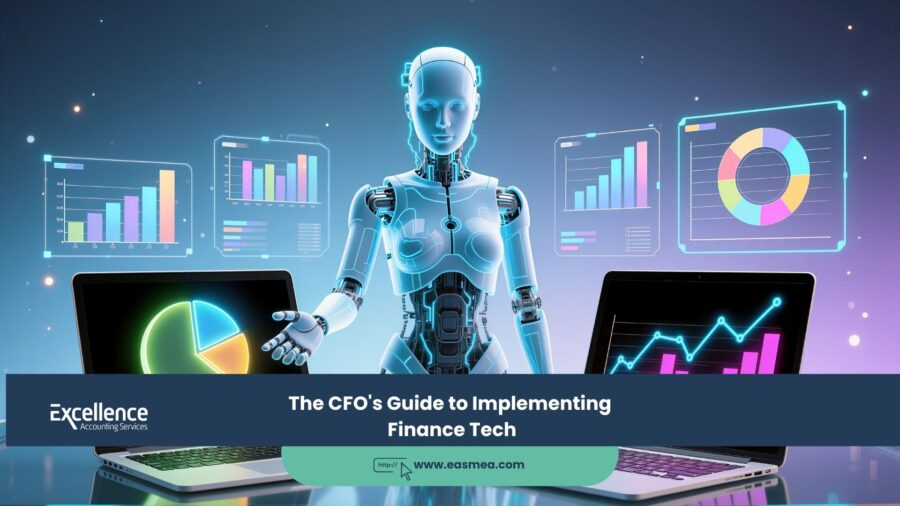
Beyond the Ledger: The Strategic CFO’s Guide to Implementing Finance Technology
The modern Chief Financial Officer is at a crossroads. The traditional role of historical scorekeeper and cost controller is being forcibly evolved by a relentless wave of data and digitalization. Today, the C-suite and the board don’t just want to know *what* happened last quarter; they want to know *why* it happened, *what* will happen next, and *how* the business can pivot. This demand for real-time insight and forward-looking strategy is fundamentally impossible to meet when the finance team is buried in “spreadsheet spaghetti,” manual reconciliations, and legacy on-premise systems.
- Beyond the Ledger: The Strategic CFO's Guide to Implementing Finance Technology
- Section 1: The Case for Change - Why Your Legacy System is a Strategic Liability
- Section 2: Building the CFO's Business Case: The True ROI of Finance Tech
- Section 3: Architecting the Modern Finance Stack - What to Buy?
- Section 4: The Implementation Roadmap - A CFO's Governance Plan
- Section 5: The Human Element - Overcoming Resistance, Ensuring Adoption
- What Excellence Accounting Services (EAS) Can Offer
- Frequently Asked Questions (FAQs) for the CFO
- Ready to Transform Your Finance Function?
For CFOs in the UAE, this transformation is amplified by a new, non-negotiable compliance landscape. The introduction of VAT and, more recently, Corporate Tax, has turned financial data integrity from a best practice into a legal imperative. A reliance on manual, siloed processes is no longer just inefficient; it is a direct and significant business risk. The question is no longer *if* you should implement modern finance technology, but *how* you can lead the transformation successfully.
This guide is not for your IT department. It is a strategic brief for the CFO, the finance leader who must sponsor, champion, and ultimately deliver the business case for technology-driven change. We will cover the full lifecycle of a finance tech implementation from a CFO’s perspective: building the strategic business case, calculating the ROI, selecting the right stack, managing the human and financial risks of implementation, and finally, unlocking the true value of a finance function that has been transformed from a cost center into a strategic partner.
Key Takeaways for the CFO
- This is a Business, Not IT, Project: The CFO must own the project, with IT as a key partner. The goal is business transformation, not just a software upgrade.
- The ROI is Both Hard and Soft: The business case must include “hard” savings (e.g., reduced FTE hours, faster close) and “strategic” gains (e.g., real-time forecasting, improved compliance).
- Don’t Automate Bad Processes: Implementation is the perfect time for process re-engineering. Simply “lifting and shifting” your old, broken workflows into a new system is a recipe for failure.
- Change Management is Everything: The biggest risk is not technology failure but low user adoption. The “human element” is the most critical part of the project.
- Compliance is a Key Driver: In the UAE, any new system must be purpose-built to handle VAT and Corporate Tax compliance, including audit trails and record-keeping, as a core feature.
Section 1: The Case for Change – Why Your Legacy System is a Strategic Liability
Before you can get buy-in for a new system, you must build a consensus on the pain of the old one. A CFO must articulate that legacy systems (or a reliance on Excel) are not a “cost saved” but a “risk incurred” and an “opportunity missed.”
The High Cost of “Good Enough”
The “if it ain’t broke, don’t fix it” mindset is a trap. Your current system is likely “broke” in ways that are creating hidden liabilities:
- Data Silos: Your sales data is in a CRM, your finance data is in an on-premise server, and your budgets are in 50 different Excel files. There is no “Single Source of Truth,” as we discussed in our blog on centralized systems.
- Manual Data Entry & “Spreadsheet Spaghetti”: Your highly-skilled finance team spends 80% of its time on low-value data entry and manual reconciliations, and only 20% on analysis. This is a massive waste of human capital and a breeding ground for copy-paste errors.
- The 20-Day Month-End Close: By the time your team closes the books 2-3 weeks into the next month, the data is too old to be actionable. The leadership team is flying blind for the most critical part of the new month.
- Compliance & Audit Risk: In a manual system, audit trails are weak or non-existent. Proving your VAT or Corporate Tax position to an auditor becomes a heroic, time-consuming effort that drains resources and carries a high risk of penalties.
- Talent Repulsion: Top-tier finance talent does not want to work in an archaic environment. A modern tech stack is now a critical tool for recruiting and retaining the best people.
Section 2: Building the CFO’s Business Case: The True ROI of Finance Tech
A CFO cannot approve a six-figure investment based on “efficiency.” You need a data-driven business case. The ROI of finance tech is a powerful combination of quantifiable savings and strategic, long-term value.
The “Return” (The Gains)
Hard ROI (Quantifiable & Defensible):
- Process Speed: Calculate the time saved. “Reduce month-end close from 15 days to 3 days.” “Reduce invoice processing time from 5 minutes to 30 seconds.”
- Labor Re-allocation: “Automating AP/AR will free up 2.0 FTEs from data entry, allowing us to build an FP&A function without new hires.” This is a core value of outsourcing accounts payable and accounts receivable.
- Cash Flow Optimization: “Automated invoicing and collections will reduce our DSO (Days Sales Outstanding) by 10 days, freeing up X amount in working capital.”
- Cost Avoidance: “Reducing audit prep time from 4 weeks to 1 week will save Y in audit fees.” “Automated compliance checks will save Z in potential FTA penalties.”
Strategic ROI (The C-Suite Value):
- Real-Time Visibility: The ability for a CEO to open a dashboard and see real-time cash position, sales, and P&L. This is the foundation of an agile business.
- Forecasting & “What-If” Analysis: Moving from a static annual budget to a dynamic, rolling forecast. The ability to model the P&L impact of a new product line or a new office in minutes, not weeks.
- Scalability: A new cloud-based system can handle 10x the transaction volume without 10x the headcount, enabling rapid growth without a corresponding explosion in overhead.
- Governance & Control: A modern system provides an immutable audit trail and user-based permissions, which a strategic internal audit will confirm. This is critical for building investor confidence or preparing for a due diligence process.
The “Investment” (The Costs)
A credible CFO must present both sides. The costs include:
- Software Costs: One-time licenses or recurring (SaaS) subscription fees.
- Implementation & Customization: The cost of the expert partner (like EAS) to configure, test, and deploy the system.
- Data Migration: The often-underestimated cost of cleaning and migrating your old data.
- Training & Change Management: The cost of training your team on the new processes.
- Temporary Disruption: A provision for a temporary dip in productivity during the “go-live” transition.
Section 3: Architecting the Modern Finance Stack – What to Buy?
A “tech stack” is simply the collection of tools you choose. The key is integration. They must all speak to each other, with the core system as the Single Source of Truth.
1. The Core: Cloud ERP / Accounting Platform
This is the heart of your stack, your new General Ledger. For SMEs and mid-market companies, platforms like Zoho Books offer a powerful, scalable, and cost-effective core that is fully compliant with UAE tax laws. Larger, more complex enterprises might look at larger ERPs like NetSuite or SAP. The goal is a single, cloud-based platform that handles core financials, banking, and reporting.
2. The Automators: AP/AR & Expense Management
These are tools that “bolt on” to your core. Think of apps that use OCR (Optical Character Recognition) to scan supplier invoices and automatically create a bill in your accounting system. This eliminates the vast majority of manual data entry in your accounts payable process.
3. The Analyzers: FP&A and Business Intelligence (BI)
This is where the real value is unlocked. Once your data is clean and centralized in the core, BI tools (like Power BI, Tableau, or Zoho Analytics) can sit on top, pulling in data from the ERP, CRM, and HR systems to create the powerful, real-time dashboards that the C-suite craves. This is the engine of a modern CFO service.
Section 4: The Implementation Roadmap – A CFO’s Governance Plan
A tech project without strong governance from the finance leader is doomed. The CFO must chair the steering committee and oversee this high-level plan:
- Phase 1: Discovery & Process Re-engineering (The “Blueprint”).
- This is the most critical phase. Do NOT just copy your old processes.
- Engage a consultant to map your *current* state vs. your desired *future* state.
- Ask: “Why do we do it this way?” If the answer is “because we’ve always done it this way,” it’s the first process you must change.
- Phase 2: Selection & Business Case Finalization.
- Select both the software *and* the implementation partner. The partner is often more important than the software.
- Finalize the ROI model and get formal board approval for the budget.
- Phase 3: Design, Build, and… Data Cleansing.
- The partner configures the system to your “future state” blueprint.
- Your internal team begins the painful but essential process of “data cleansing.” You cannot migrate 20 years of messy, duplicated data into a clean new system. “Garbage in, garbage out” is the #1 reason implementations fail.
- Phase 4: Test, Train, and Test Again.
- This is User Acceptance Testing (UAT). A core group of your finance team must try to “break” the system by running real-world scenarios.
- Train your people. Not just “how to click the button,” but “why this new process is better.”
- Phase 5: Go-Live & Hypercare.
- A phased “go-live” (e.g., one module at a time) is often safer than a “big bang” approach.
- The first 30-60 days (“hypercare”) are critical. Your implementation partner must be on-site or on-call to fix immediate issues and reinforce training.
Section 5: The Human Element – Overcoming Resistance, Ensuring Adoption
As a CFO, you know that people can be the biggest obstacle to change, especially in a rules-based function like finance. Your team may be comfortable with their spreadsheets and view new tech as a threat.
Your change management plan must be robust:
- Communicate the “Why”: Be transparent. “This isn’t about replacing you. It’s about replacing the *boring parts* of your job so you can focus on the high-value analysis we hired you for.”
- Appoint “Super-Users”: Identify the tech-savvy, enthusiastic members of your team and make them “super-users.” Train them first, and they will become internal champions who can train their peers.
- Involve Them Early: Don’t just dump a new system on your team. Involve them in the “Discovery” and “Testing” phases. They know the current processes and pitfalls better than anyone.
- Invest in Training: Do not skimp on the training budget. It’s the highest-ROI part of the implementation.
What Excellence Accounting Services (EAS) Can Offer
Leading a finance transformation is a massive undertaking. Partnering with an expert who has managed this process before is the single best way to de-risk the project. At EAS, we are finance professionals first, technologists second.
- Strategic CFO Services: We sit with you to build the business case and ROI model, presenting it to your board with the authority of a finance leader.
- Business Consultancy & Process Re-engineering: We run the “Discovery” phase to map your current processes and design an optimized “future state” *before* any software is chosen.
- Accounting System Implementation: As certified partners for platforms like Zoho Books, we are experts in the technical execution. We handle the configuration, data migration, and training.
- Internal Audit & Controls: We ensure your new system has the robust internal controls, permissions, and audit trails required for the new UAE Corporate Tax landscape.
- Outsourced Accounting and Bookkeeping: Once your new system is live, our team can even run it for you, providing a best-in-class finance function at a fraction of the cost of an in-house team.
As certified Zoho Books partners, we believe it offers an exceptional balance of power and value for UAE businesses. You can explore its potential with a free trial.
Frequently Asked Questions (FAQs) for the CFO
Treating it as an “IT project” and abdicating leadership. The CFO must own the project, the business case, and the change management. The second biggest mistake is underestimating the “data cleansing” and data migration effort. “Garbage in, garbage out” will kill your ROI.
An all-in-one ERP (like NetSuite) offers a single, unified platform but can be rigid and expensive. A “best-of-breed” stack (e.g., Zoho Books + specialized AP/HR apps) offers more flexibility and can be more cost-effective, but relies heavily on strong APIs and integrations. The choice depends on your company’s size, complexity, and budget.
For a small to mid-sized business, a core accounting system implementation should take between 3 to 6 months. Anything faster is likely cutting corners, and anything longer is losing momentum. This timeline is 100% dependent on your team’s availability and the cleanliness of your data.
By showing them “what’s in it for them.” For Sales: “This integration will stop Finance from hassling you for client data. When you mark a deal ‘Closed-Won’ in the CRM, it will auto-generate the invoice, and you’ll see a real-time commission report.”
This is a classic trap. You might save 20% on the upfront cost but suffer a 50% failure rate. An implementation partner isn’t just a “installer.” They are the experienced project manager, the process expert, the change agent, and the scapegoat. Their fee is an insurance policy against a failed project.
In three key ways: 1) **Audit Trail:** It creates an immutable, time-stamped log of every transaction. 2) **Record-Keeping:** It centralizes all your records for the mandatory 7-year period. 3. **Reporting:** It can be configured to automatically tag and segregate non-deductible expenses (like 50% of client entertainment), making your tax calculation accurate and defensible.
This is critical. “Configuration” is using the software’s built-in settings to make it work for you (Good). “Customization” is writing new code to change the software’s core functions (Bad, expensive, breaks future updates). Your goal should be 90% configuration, 10% customization at most. Change your process, not the software.
This is a valid concern. Modern cloud providers (like Zoho, Microsoft, AWS) have security protocols far more advanced than your in-house server room. Your security risk shifts from *infrastructure* to *access*. Your partner must help you set up strong access controls, multi-factor authentication, and user permissions so that people can only see the data they need to.
If you’re “too busy” to fix the system, it’s because the broken system is *making* you busy. The busiest time is the most critical time to start. The “right time” was a year ago. The second-best time is now. Every day you wait, you are compounding your “technical debt” and compliance risk.
A “Process and Systems Review.” Before you look at any software, you must engage an expert partner (like EAS) for a 1-2 week diagnostic. They will interview your team, map your current workflows, identify the real bottlenecks, and deliver a “Future State” roadmap. This document becomes the blueprint for your entire project.
Conclusion: The CFO as the Architect of the Future
Implementing new finance technology is one of the most high-stakes, high-reward projects a CFO can lead. It is a direct challenge to the status quo. It will be difficult, and it will expose flaws in your old way of working. But the alternative—clinging to manual processes in an increasingly digital and regulated world—is no longer a viable strategy. By owning this transformation, you are not just buying software; you are investing in a future where your finance team is a data-driven, strategic partner that guides the business with clarity and foresight. You are, in effect, building the engine for the company’s next phase of growth.