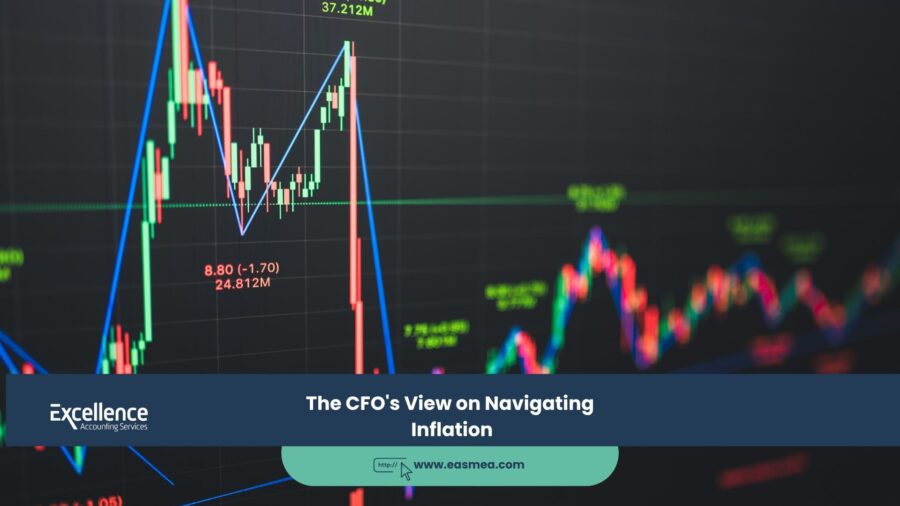
The CFO’s View: A Strategic Playbook for Navigating and Winning in an Inflationary Era
For the past decade, “inflation” was a term reserved for economics textbooks and discussions of far-off, unstable markets. For businesses in the UAE, the operating environment was defined by stable costs and predictable growth. That era is over. Today, inflation is no longer a distant threat; it is an active, persistent, and corrosive force at the heart of every business. It is a silent killer of margins, a thief of cash flow, and the single greatest challenge to long-term profitability.
- The CFO's View: A Strategic Playbook for Navigating and Winning in an Inflationary Era
- The New Reality: Why Inflation Is a CFO-Level Crisis
- Part 1: The Defensive Playbook - Protecting Your P&L from Margin Erosion
- Part 2: The Offensive Playbook - Optimizing the Balance Sheet & Cash Flow
- Part 3: The Human & Tax Equation - The Two Inevitabilities
- How Excellence Accounting Services (EAS) Can Offer
- Frequently Asked Questions (FAQs) for Navigating Inflation
- Is Your Financial Strategy Strong Enough to Fight Inflation?
From the CEO’s chair, the call is for growth and resilience. From the COO’s desk, it’s about managing a fragile supply chain. But from the Chief Financial Officer’s (CFO) perspective, inflation is a complex, multi-front war. It’s a war that must be fought in the trenches of the P&L, on the battlefield of the Balance Sheet, and at the strategic planning table. The CFO’s view is not just about recording the impact of inflation; it’s about building a financial framework to *outmaneuver* it.
This is not a time for passive financial management. It’s a time for a proactive, data-driven, and often courageous financial strategy. This comprehensive guide provides the CFO’s playbook for navigating the new inflationary reality. We will dissect the defensive and offensive strategies required to protect your margins, optimize your cash, manage your capital, and build a business that doesn’t just survive inflation, but emerges stronger.
Key Takeaways
- Inflation is a Margin Killer: The first priority is to defend your Gross and Net Profit Margins from rising COGS and Opex. This requires real-time data and granular analysis.
- Pricing is Your #1 Weapon: You must move from annual, “gut-feel” price increases to a dynamic, data-driven, value-based pricing strategy.
- Cash Flow is an Active Strategy: Inflation erodes the value of cash. The CFO’s job is to accelerate the Cash Conversion Cycle, shrinking Days Sales Outstanding (DSO) and managing inventory.
- “Phantom Profits” are a Tax Trap: Inflation can create accounting profits (e.g., from old inventory) that aren’t *real* economic profits. You must plan for the tax implications of this.
- Data Replaces Instinct: In a volatile environment, historical trends are misleading. The CFO must champion a shift to real-time dashboards, rolling forecasts, and scenario-planning.
The New Reality: Why Inflation Is a CFO-Level Crisis
In a low-inflation world, a company can be successful with a “good-enough” financial function. A budget is set annually, reports are run monthly, and the business focuses on sales. Inflation shatters this model. Historical data becomes useless. An annual budget is obsolete in a single quarter. “Gut-feel” pricing, once a strength, becomes a critical liability.
The CFO’s primary mandate shifts from *reporting* on the past to *modeling* the future. The core challenge is that inflation attacks the business on all fronts simultaneously:
- The P&L Attack: Supplier costs (COGS) rise, eroding gross margins. Employee wage demands (Opex) rise, eroding net margins.
- The Balance Sheet Attack: The purchasing power of your cash reserves falls. The cost of your debt rises. The value of your receivables declines every day they aren’t collected.
- The Strategic Attack: Your long-term CapEx plans are thrown into disarray as project costs and interest rates climb, making the ROI of new investments uncertain.
A strategic CFO, or a high-level Outsourced CFO, recognizes this and re-organizes the finance function from a passive scorekeeper into the company’s strategic, data-driven nerve center.
Part 1: The Defensive Playbook – Protecting Your P&L from Margin Erosion
The first priority in an inflationary environment is to stop the bleeding. Your P&L is the patient, and the disease is “margin compression.” This defensive strategy is about quick, decisive, and data-driven actions.
1. Master Your Data: From Lagging Reports to Real-Time Intelligence
You cannot fight what you cannot see. The CFO’s first move is to demand better data, faster. An annual or even quarterly review is no longer sufficient.
- Granular Profitability: You must know your *true* profitability, not just for the company, but for every single product, service line, and client. This requires robust accounting and bookkeeping systems.
- Real-Time Dashboards: Replace static monthly financial reports with live dashboards tracking leading indicators: weekly gross margins, daily sales vs. cost, and material price variances.
- Rolling Forecasts: The annual budget is dead. The CFO must implement a 12-month *rolling forecast* that is updated monthly or quarterly. This allows the business to react to new cost information immediately.
2. The Strategic Pricing Imperative
In an inflationary world, pricing is your most powerful tool for margin defense. The CFO must lead the charge to transform pricing from a static “set it and forget it” activity into a dynamic, strategic function.
- Pass Costs On (Intelligently): You *must* pass on rising costs. But you can’t do it with a single, blunt, across-the-board price hike that alienates customers.
- Value-Based vs. Cost-Plus: Shift the conversation from “Our costs went up 10%, so we’re charging 10% more” (Cost-Plus) to “Our service delivers AED 100k in value, and our new price reflects that” (Value-Based).
- Price Elasticity: Use data to understand which products can absorb a price increase and which cannot. A deep business consultancy approach can help analyze your market position.
- De-bundle and Re-bundle: Can you unbundle your services to create a lower-cost entry point, while charging more for “premium” add-ons? Can you add a “fuel surcharge” or “materials surcharge” instead of raising your base price?
3. A Surgical Approach to Cost Control
While you are raising prices, you must simultaneously wage a surgical “war on waste.” This is not about blind, demoralizing cost-cutting. It’s about data-driven optimization. A periodic internal audit can be a powerful tool to uncover these inefficiencies.
- Procurement as a Profit Center: Your procurement and accounts payable team is now a strategic unit. The CFO must empower them to:
- Re-negotiate with all major suppliers.
- Consolidate vendors to increase purchasing power.
- Explore alternative materials or suppliers.
- Lock in long-term contracts for critical supplies, even at a slight premium, to create cost *predictability*.
- Scrutinize Every Line of Opex: The CFO must lead a “what-is-the-ROI-of-this-dirham” review of all non-essential operating expenses.
- Software: Are we paying for 100 software licenses but only using 60?
- Travel & Entertainment: Is this trip essential, or can it be a virtual meeting?
- Outsourced Services: Are we getting true value from all our consultants and agencies?
Part 2: The Offensive Playbook – Optimizing the Balance Sheet & Cash Flow
If the P&L is your defense, the Balance Sheet is your offense. A smart CFO knows that inflation changes the value of everything you own and everything you owe. The goal is to make your capital work *for* you, not against you.
1. The War on Working Capital
Inflation is a tax on time. The longer it takes you to convert your work into cash, the more value that cash loses. The Cash Conversion Cycle (CCC) becomes the CFO’s primary battlefield.
- Accounts Receivable (AR): A sale is not a sale until it’s collected. Every day a dirham sits in your customer’s bank account, inflation is eating it. The CFO must:
- Aggressively shorten payment terms. Change from “Net 60” to “Net 30.”
- Implement (or outsource) a professional, relentless accounts receivable and collections process.
- Offer “early pay” discounts (e.g., 2% discount for paying in 10 days) that are *higher* than your cost of capital.
- Inventory: This is the CFO’s paradox. Holding inventory can be a *hedge* against inflation (you buy at today’s low price). But holding *too much* inventory traps cash that you desperately need. The solution is:
- Perform a rigorous analysis (often with an accounting review) to identify and liquidate slow-moving or obsolete stock.
- Focus on “ABC” analysis: Secure high-volume, critical “A” items, but run lean on low-value “C” items.
2. Re-evaluating Capital & Investment (CapEx)
Inflation and the tool to fight it (rising interest rates) change the math on every long-term investment. The “hurdle rate” (minimum acceptable return) for new projects must go up.
- Rigor on ROI: That new factory or warehouse expansion must be re-evaluated. The CFO must demand a new feasibility study with updated costs for materials, labor, and (most importantly) the new, higher cost of debt.
- Lease vs. Buy: In an environment with high asset prices and rising interest rates, does it make more sense to *lease* new equipment rather than buy it, preserving your cash for working capital?
- Strategic M&A: Can you *buy* a competitor or supplier (who is struggling with inflation) for a good price, versus building your own solution? This requires expert due diligence.
Part 3: The Human & Tax Equation – The Two Inevitabilities
A business runs on people, and it must pay its taxes. The CFO’s strategy must integrate these two non-negotiable realities.
1. Managing Wage Inflation (The People Factor)
Your employees are facing inflation too, and they will demand higher pay. This puts the CFO in a tight spot between managing margin-crushing wage inflation and managing a talent-crushing high turnover rate.
- Data, Not Emotion: The CFO must partner with the HR team to get real market data on compensation.
- Variable Pay: Shift the compensation mix. Instead of a 10% base pay increase, offer a 4% increase plus a generous, *performance-based* bonus. This aligns incentives and protects fixed costs.
- Invest in Efficiency: Can you use technology or a new accounting system implementation to automate low-value tasks, allowing you to pay your high-value people more?
- Manage Payroll Flawlessly: In a tight labor market, the *last* thing you can afford is errors. A perfect, on-time payroll service is a fundamental part of talent retention.
2. The “Phantom Profit” Tax Trap (The UAE CT Factor)
Inflation can be a major trap with the new UAE Corporate Tax. It can create “phantom profits” that aren’t real, but are still taxable.
Example:
- You buy a widget for AED 100 in January.
- Inflation hits. In July, you sell that widget for AED 150. Your accounting profit is AED 50.
- You will pay 9% tax on that AED 50 profit.
- But to *replace* that widget, the new cost in July is AED 140.
- Your *economic* profit (what you’re left with) is only AED 10 (AED 150 sale – AED 140 replacement cost). But you paid tax on AED 50!
The CFO must work with tax advisors to manage this. This might involve changing your inventory accounting method (e.g., from FIFO to a weighted-average cost, if permissible) and requires meticulous VAT and CT planning to manage cash flow for these larger-than-expected tax bills.
How Excellence Accounting Services (EAS) Can Offer
You don’t have to navigate this inflationary storm alone. Excellence Accounting Services provides the high-level strategic partnership of a CFO and the detailed execution of a world-class finance team. We help you build and execute this playbook.
- Outsourced CFO Services: Our Outsourced CFOs act as your strategic partner, building your rolling forecasts, leading your pricing strategy, and managing your cash flow.
- Strategic & Tax Advisory: We integrate your business strategy with a robust corporate tax and VAT plan to ensure you are not just compliant, but efficient.
- Data Integrity & Audit: We provide the bedrock of clean data through our bookkeeping, reconciliation, and internal audit services.
- Business Valuation: We can help you understand how inflation is impacting your company’s business valuation in real-time.
- Full-Suite Support: From payroll and HR to supporting your company formation or restructuring, we provide a holistic back-office solution.
Frequently Asked Questions (FAQs) for Navigating Inflation
Rising costs can be isolated and temporary (e.g., a single supplier’s price hike). Inflation is a broad, persistent, and economy-wide *decrease in the purchasing power of money* that causes *all* costs (materials, shipping, labor, rent) to rise simultaneously and continuously. It’s a strategic problem, not just a procurement one.
To protect the Gross Profit Margin. The CFO must immediately ensure that the company’s pricing strategy is keeping pace with its rising Cost of Goods Sold (COGS). This requires fast, accurate data. If your gross margin is collapsing, no amount of Opex cutting can save you.
The “annual price increase” is dead. You need a dynamic policy. This could mean quarterly price reviews, or even “price-on-request” for long-lead-time projects. Many B2B contracts are now including “escalator clauses” that automatically adjust the price based on a published commodity index.
This is the central paradox. Cash loses purchasing power every day. Inventory (of the *right* kind) can appreciate in value. However, inventory ties up cash, which you need for liquidity. A smart CFO holds 3-6 months of cash for a buffer, then uses the rest to strategically buy *critical, non-perishable* inventory that is known to have a volatile price, while keeping all other inventory lean.
It generally decreases it, for two reasons: 1) It creates uncertainty, which increases the “risk premium” (discount rate) that a buyer will use. 2) If you fail to protect your margins, your actual EBITDA (profit) will be lower. A lower profit *multiplied by* a lower multiple (due to risk) can have a devastating impact on your business valuation.
It’s an accounting profit that isn’t an *economic* profit. If you bought inventory for AED 50 (in January) and sell it for AED 80 (in June), your accounting system shows a AED 30 profit. But if the *replacement cost* of that same inventory is now AED 75, you’ve only made AED 5 in true economic profit. This is a cash flow trap, as you pay taxes on the AED 30 “phantom profit.”
By being transparent and focusing on value. Instead of sending a cold email, have your sales team call your top customers and explain, “Like you, we’re facing a 20% rise in raw material costs. To maintain the quality you expect, our prices are increasing. We are offering you a chance to lock in your next two orders at the old price as a thank you.” You’re reinforcing your value, not just your cost.
The CFO is the data-driven partner to HR. They must model the financial impact of different compensation strategies. For example, they can model the cost of a 10% raise vs. the cost of a 15% turnover rate (which includes recruiting, training, and lost productivity). Often, the raise is the cheaper option. The CFO provides the data to make this strategic, non-emotional decision.
Shrinkflation is a form of hidden price increase where the *price* of a product stays the same, but the *size* or *quantity* decreases (e.g., a 100-gram chocolate bar becomes 90 grams for the same price). It’s a common strategy in B2C. For a B2B business, this is less common, but it could mean reducing service levels for a base price, and charging for a “premium” tier. It can be perceived as deceptive if not handled carefully.
An outsourced CFO provides the strategic expertise without the full-time executive cost. They have seen this playbook across multiple industries. They will immediately: 1) Build your rolling cash flow forecast. 2) Create your product/client profitability models. 3) Lead your new pricing strategy. 4) Analyze your working capital to find hidden cash. 5) Run scenarios to help you make tough decisions on CapEx and staffing. They are the expert co-pilot you need to navigate the storm.
Conclusion: Inflation as a Catalyst for Excellence
Inflation is a harsh and unforgiving business environment. It punishes slow, inefficient, and undisciplined companies. But for those who embrace the challenge, it can be a powerful catalyst for positive, permanent change.
A strategic CFO views this era as an opportunity. It is an opportunity to shed unprofitable clients, to fix broken processes, to build a dynamic pricing model, and to forge a new level of financial discipline. The companies that use this period to get lean, smart, and data-driven will not just survive; they will build an enduring competitive advantage, ready to capture disproportionate market share when the next cycle of growth begins.