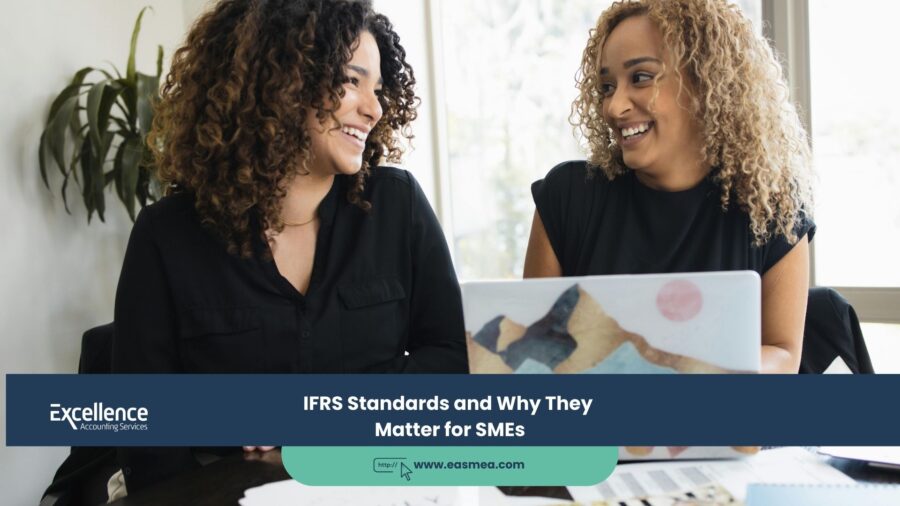
The Common Language of Success: Why IFRS Standards Are Now Mandatory for UAE SMEs
Imagine trying to build a skyscraper where every architect, engineer, and contractor uses a different system of measurement. One uses meters, another uses feet, and a third uses “steps.” The result would be chaos, structural failure, and a building that no one wants to enter. In the world of global business, financial statements are the blueprints. If every company accounted for revenue, assets, and profit differently, the global economy would be un-investable.
- The Common Language of Success: Why IFRS Standards Are Now Mandatory for UAE SMEs
- What is IFRS and Why Does the World Use It?
- Full IFRS vs. IFRS for SMEs: Picking the Right Tool
- The Strategic Benefits of IFRS (Beyond Just Tax)
- Key IFRS Concepts Every SME Owner Should Know
- The Transition: Moving from "Shoebox" to IFRS
- Common Pitfalls to Avoid
- How Excellence Accounting Services (EAS) Helps You Transition
- Frequently Asked Questions (FAQs) on IFRS for SMEs
- Is Your Business Speaking the Right Financial Language?
This is why International Financial Reporting Standards (IFRS) exist. They are the “metric system” of global finance—a single, high-quality set of accounting standards that ensures financial statements are consistent, transparent, and comparable across borders. For decades, multinational corporations have operated under these rules.
But for Small and Medium Enterprises (SMEs) in the UAE, accounting has often been less formal—sometimes little more than cash-basis bookkeeping to track the owner’s money. That era is over. With the introduction of the UAE Corporate Tax law, the Federal Tax Authority (FTA) has explicitly linked taxable income to financial statements prepared using accepted accounting standards. Suddenly, IFRS is not just “best practice” for the big players; it is a legal and operational necessity for the SME.
This comprehensive guide will demystify IFRS for the SME owner. We will explain the difference between “Full IFRS” and “IFRS for SMEs,” explore the critical benefits beyond compliance (like access to capital), and provide a roadmap for transitioning your business to this global standard.
Key Takeaways
- It’s the Law (Sort of): The UAE Corporate Tax Law requires taxable income to be calculated based on financial statements prepared using accepted accounting standards (like IFRS).
- There is a “Lite” Version: “IFRS for SMEs” is a simplified, standalone standard designed specifically for private entities, reducing the disclosure burden by 90% compared to Full IFRS.
- Banks Speak IFRS: If you want a loan in the UAE, your bank will demand IFRS-compliant, audited financial statements. “Shoebox accounting” gets rejected.
- Accrual is King: IFRS mandates accrual-based accounting (recognizing revenue when earned, not when paid), which gives a truer picture of financial health than cash-basis accounting.
- It Increases Valuation: When selling your business, buyers pay a premium for clean, IFRS-compliant history because they can trust the numbers.
What is IFRS and Why Does the World Use It?
IFRS stands for International Financial Reporting Standards. They are a set of accounting rules issued by the London-based International Accounting Standards Board (IASB). Their goal is to bring consistency, transparency, and comparability to financial statements worldwide.
Currently, over 140 jurisdictions, including the European Union, Australia, Canada, and the GCC countries, mandate or permit IFRS. It allows an investor in Dubai to compare the balance sheet of a company in Abu Dhabi with one in London or Singapore, knowing they are speaking the same financial language.
The UAE Context: The Shift to Maturity
The UAE has always been a global hub. However, the regulatory landscape for SMEs was historically loose. Many SMEs operated on simple Excel sheets. Two major shifts have changed this:
- Banking Regulations: In the wake of stronger Anti-Money Laundering (AML) rules and Basel III requirements, UAE banks tightened lending. They now require auditable, standardized financials to assess credit risk.
- Corporate Tax (The Catalyst): This is the game-changer. Article 20 of the Corporate Tax Law states that the taxable income of a taxable person shall be determined on the basis of financial statements prepared in accordance with accounting standards accepted in the State. While the FTA allows for some flexibility for very small businesses (using cash basis), for most established SMEs, IFRS (or IFRS for SMEs) is the safest, most robust path to compliance.
Full IFRS vs. IFRS for SMEs: Picking the Right Tool
Many business owners hear “IFRS” and panic, imagining thousands of pages of complex rules designed for banks and oil giants. This is a misunderstanding. There are actually two distinct frameworks.
1. Full IFRS
This is the complete set of standards. It is complex, rigorous, and requires extensive disclosures.
Who is it for?
- Publicly listed companies (mandatory).
- Financial institutions (Banks, Insurance).
- Large multinationals with public accountability.
Using Full IFRS for a small bakery or consultancy would be overkill—like using a Formula 1 car to go grocery shopping.
2. IFRS for SMEs
Recognizing the burden of Full IFRS, the IASB created a simplified, self-contained standard for small and medium-sized entities (private companies).
Key Differences:
- Size: The standard is about 250 pages (vs. 3,000+ for Full IFRS).
- Simplicity: Many complex options (like revaluation of assets or capitalizing development costs) are removed or simplified.
- Disclosures: The required notes to the financial statements are significantly reduced.
- Updates: It is updated only once every few years, providing stability, whereas Full IFRS changes frequently.
The Verdict: For 99% of private businesses in the UAE, IFRS for SMEs is the correct, cost-effective, and compliant choice.
The Strategic Benefits of IFRS (Beyond Just Tax)
Adopting IFRS is not just a compliance tick-box exercise. It is a strategic upgrade for your business infrastructure.
1. Unlocking Access to Capital (Banking & Investment)
UAE banks are risk-averse. When you apply for a loan or trade finance, the credit officer’s first step is to analyze your financial health. If your statements are prepared using “management accounting” (i.e., your own rules) or cash basis, the bank cannot trust the numbers.
IFRS financial statements, verified by an external audit, act as a “seal of quality.” They tell the bank: “This business is professional, transparent, and its profits are real.” This directly impacts your ability to get approved and the interest rate you are offered.
2. Accurate Performance Measurement (Accrual Accounting)
Many SMEs run on “Cash Accounting”—recording income only when cash hits the bank. This is misleading.
Example: You sign a AED 500,000 contract in December but get paid in January. * Cash Basis: December looks like a failure (0 revenue). January looks amazing. * IFRS (Accrual): You recognize the revenue in December when the work was done.
IFRS forces you to match revenue and expenses to the period they actually occurred. This gives you a financial report that reflects true performance, allowing for better strategic decision-making.
3. Maximizing Business Valuation
If you plan to sell your business or bring in a partner (succession planning), valuation is everything. Investors will discount the value of a company with messy books because they perceive high risk (“What are they hiding?”).
Clean, IFRS-compliant historical data reduces this perceived risk. It facilitates the due diligence process and supports a higher business valuation multiple.
4. Comparability and Benchmarking
IFRS allows you to benchmark your performance against global competitors. Is your Gross Margin of 25% good? If your competitor in London (who uses IFRS) reports 40%, and you are using the same accounting standards, you know you have an efficiency problem to solve.
Key IFRS Concepts Every SME Owner Should Know
You don’t need to be an accountant, but you should understand the core concepts that will change how your numbers look.
1. Revenue Recognition (The 5-Step Model)
Under IFRS (specifically IFRS 15 principles adapted for SMEs), you can’t just book revenue when you send an invoice. You must recognize revenue when you satisfy a “performance obligation.”
Example: A software company sells a 1-year subscription for AED 12,000 upfront. Under cash basis, that’s AED 12,000 revenue today. Under IFRS, that is a liability (Deferred Revenue). You recognize AED 1,000 revenue each month as you deliver the service. This smooths your income and reflects reality. (See SaaS Finance).
2. Property, Plant, and Equipment (Depreciation)
IFRS requires you to capitalize assets (machines, vehicles, computers) and depreciate them over their useful life. You cannot expense a AED 100,000 truck in month one just to lower your tax bill. You must spread that cost over 5 years. This ensures your P&L shows the true cost of operations for that period.
3. Provisions and Accruals
IFRS requires prudence. If you have a probable future cost (e.g., End of Service Gratuity for employees, or a pending lawsuit), you must recognize that expense *now* as a provision, even if you haven’t paid it yet. This prevents future shocks and ensures current profits aren’t overstated.
4. Inventory Valuation
IFRS generally requires inventory to be valued at the *lower* of Cost or Net Realizable Value (NRV). If you bought stock for AED 100, but it’s now obsolete and can only be sold for AED 50, you must take the loss *now*. You cannot keep it on the books at AED 100 to inflate your assets.
The Transition: Moving from “Shoebox” to IFRS
Moving to IFRS is a process, not an event. It requires a “First-Time Adoption” strategy.
Step 1: The Diagnostic (Gap Analysis)
Engage a professional for an accounting review. Compare your current accounting policies (or lack thereof) with IFRS requirements. Identify the gaps: Do you track assets? Do you accrue revenue? Do you calculate gratuity?
Step 2: Policy Selection
IFRS for SMEs offers choices (e.g., cost model vs. revaluation model for assets). You need a CFO or consultant to help you select the policies that best reflect your business reality and are tax-efficient.
Step 3: Adjusting Opening Balances
To produce your first IFRS report, your opening Balance Sheet must be restated. You may need to write off bad debts you’ve been hiding, value your inventory correctly, and calculate your full gratuity liability. This might result in a one-time hit to your retained earnings, but it “cleans the slate.”
Step 4: System Implementation
You cannot do IFRS on a spreadsheet. You need a system that handles accruals, depreciation, and multi-currency automatically.
The Solution: Zoho Books. A modern cloud ERP can be configured to handle IFRS requirements (like revenue recognition schedules and fixed asset tracking) automatically. We specialize in this accounting system implementation.
Common Pitfalls to Avoid
- Ignoring it until Tax Time: If you wait until the end of the year to try and convert your cash records to IFRS for your tax return, it will be a disaster. It must be done monthly.
- Mixing Personal and Business: IFRS adheres strictly to the “Separate Entity Concept.” Your personal car, home expenses, and family vacations cannot be in the company books. This is also a major red flag for FTA audits.
- Underestimating Gratuity: Many UAE SMEs pay gratuity out of cash flow when an employee leaves. Under IFRS, you must accrue this liability monthly. For a company with 50 staff, this is a massive liability that must sit on the balance sheet.
How Excellence Accounting Services (EAS) Helps You Transition
Transitioning to IFRS is a technical challenge. EAS provides the expertise to make it seamless.
- IFRS Conversion & Implementation: Our team of Chartered Accountants will manage your first-time adoption, restating your opening balances and defining your accounting policies.
- Outsourced Accounting: We provide ongoing bookkeeping services that maintain your books on an IFRS basis every single day, ensuring you are always ready for the bank or the taxman.
- External Audit: As registered auditors, we provide the external audit services that banks and free zones require, certifying that your statements are IFRS compliant.
- Corporate Tax Alignment: Our tax consultants ensure that your IFRS accounting policies are optimized for tax efficiency, identifying all legal deductions and reliefs.
- CFO Advisory: Our Outsourced CFOs help you interpret your new IFRS reports to make better strategic decisions.
Frequently Asked Questions (FAQs) on IFRS for SMEs
For Corporate Tax purposes, the law requires financial statements based on accepted accounting standards. While very small businesses (under AED 3M revenue) *may* be allowed to use cash basis under “Small Business Relief,” any company planning to grow, borrow money, or exceed that threshold should adopt IFRS for SMEs to ensure future compliance and credibility.
They are essentially the same. IAS (International Accounting Standards) were the older standards issued before 2001. IFRS are the newer standards issued after 2001. The current framework includes both valid IAS and IFRS standards. When we say “IFRS,” we refer to the entire current set of rules.
Not necessarily, but it changes *when* you pay tax. Because IFRS uses accrual accounting, you might recognize revenue (and thus profit) earlier than under cash basis. However, IFRS also allows for provisions (like bad debts or gratuity) which are expenses that reduce your profit. A tax expert can help you navigate this.
Generally, no. Once you adopt IFRS, consistency is a key principle. Switching back and forth would destroy comparability and likely be rejected by the FTA and banks.
Under IFRS, this is a “Defined Benefit Plan.” You must estimate the liability you owe to employees based on their current service and salary, and record it on the balance sheet as a liability. This ensures your company doesn’t have a hidden “debt” to its employees that isn’t on the books.
Yes, for two reasons. First, the federal Corporate Tax law overrides Free Zone regulations regarding the calculation of taxable income. Second, if you ever want a bank loan or want to sell the business, those stakeholders *will* require it, regardless of Free Zone rules.
Zoho Books is a *tool* that supports IFRS. It allows for accrual accounting, depreciation, and foreign currency adjustments. However, it requires a human accountant to set the correct policies, post the adjusting entries, and make the judgment calls required by IFRS. Software + Expert = Compliance.
Fair Value means valuing an asset at what you could sell it for today, rather than what you paid for it. Full IFRS uses this heavily. IFRS for SMEs restricts the use of Fair Value to keep things simpler, mostly applying it to financial instruments and investment property, making it easier for owners to manage.
Construction is heavily impacted. Under IFRS 15, you likely need to use “Percentage of Completion” accounting. You recognize revenue based on how much of the project is done, not how much you’ve billed. This matches revenue to the costs incurred and provides a much more accurate picture of project profitability.
The initial conversion cost can vary based on the complexity of your historical data. However, the ongoing cost is simply the cost of professional bookkeeping. The ROI comes from lower interest rates on loans, tax compliance (avoiding fines), and higher business valuation. It is an investment that pays for itself.
Conclusion: Speaking the Language of Growth
Adopting IFRS standards is a coming-of-age moment for any SME. It signals that the business has graduated from a “mom-and-pop” operation to a professional, transparent, and scalable enterprise. In the UAE’s new regulated economy, IFRS is the bridge between your business and the global financial system.
By adopting IFRS for SMEs, you are not just satisfying a tax requirement; you are building a strong financial foundation that will support your growth, secure your funding, and protect your legacy. Don’t wait for an audit to force your hand. Embrace the standard today and start speaking the language of success.