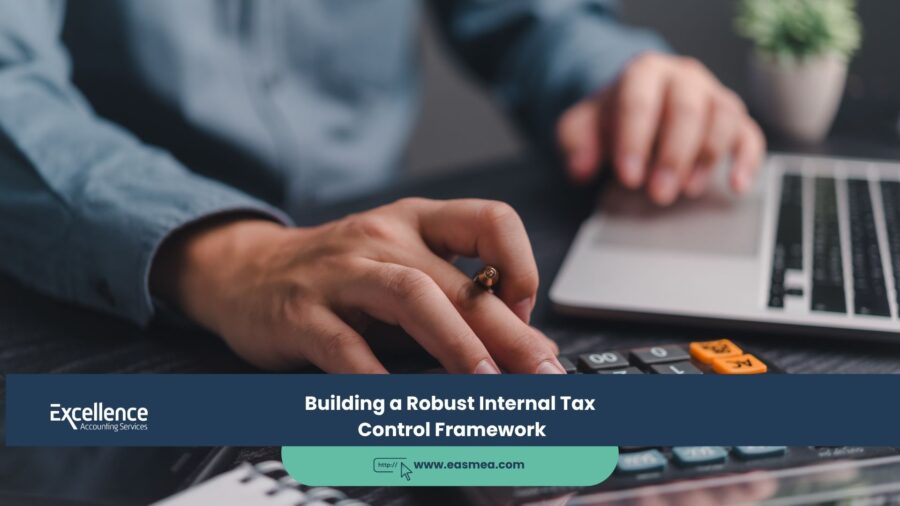
Building a Robust Internal Tax Control Framework: Your Blueprint for Compliance and Confidence
In the UAE’s dynamic new tax landscape, the concept of “compliance” has fundamentally shifted. It is no longer a year-end activity focused solely on filing a return. Today, compliance is a continuous, embedded process that demands rigorous internal governance. The Federal Tax Authority (FTA) expects businesses to not only pay the correct amount of tax but also to demonstrate that they have the systems, processes, and controls in place to ensure accuracy and consistency. Hope is not a strategy; process is.
- Building a Robust Internal Tax Control Framework: Your Blueprint for Compliance and Confidence
- Part 1: The Foundation - Adapting the COSO Framework for Tax
- Part 2: A Step-by-Step Guide to Building Your TCF
- How Excellence Accounting Services (EAS) Can Build Your TCF
- Frequently Asked Questions (FAQs) on Tax Control Frameworks
- Ready to Build Your Blueprint for Tax Compliance?
This is where an Internal Tax Control Framework (TCF) becomes essential. A TCF is a structured, documented system of controls designed to provide reasonable assurance that a company’s tax risks are identified, managed, and monitored effectively. It is your organization’s internal rulebook for all things tax. Far from being a bureaucratic burden, a well-designed TCF is a strategic asset. It reduces the risk of costly errors and penalties, enhances operational efficiency, provides management with confidence in their financial data, and signals to the FTA that your organization is a diligent and responsible taxpayer. This guide provides a comprehensive blueprint for building a robust TCF, adapting a world-renowned framework to the specific challenges of UAE tax law.
Key Takeaways on Internal Tax Control Frameworks
- A Strategic Necessity: A TCF is a proactive system for managing tax risks, not just a reactive compliance measure.
- Based on Proven Principles: The most effective TCFs are built on the five components of the globally recognized COSO Internal Control Framework.
- Top-Down Approach: A strong “tone at the top” from senior management is critical for fostering a culture of tax compliance throughout the organization.
- Risk-Based Focus: A TCF is not about controlling everything; it’s about identifying your key tax risks and implementing proportionate controls to mitigate them.
- Technology is a Key Enabler: Modern accounting systems are crucial for automating controls, ensuring data accuracy, and providing a clear audit trail.
- A Living Document: A TCF is not a one-time project. It must be regularly monitored, reviewed, and updated to remain effective as your business and the law evolves.
Part 1: The Foundation – Adapting the COSO Framework for Tax
Instead of reinventing the wheel, the best practice for building a TCF is to adapt the Committee of Sponsoring Organizations of the Treadway Commission (COSO) framework. This is the gold standard for internal controls globally. It consists of five integrated components that provide a roadmap for your TCF.
The Five Components of a Tax Control Framework
- Control Environment: The “tone at the top” – the governance, values, and culture surrounding tax.
- Risk Assessment: The process of identifying, analyzing, and responding to tax risks.
- Control Activities: The specific policies, procedures, and actions taken to mitigate tax risks.
- Information & Communication: How tax-related information is captured, processed, and communicated.
- Monitoring Activities: The ongoing evaluation to ensure the TCF is operating effectively.
Part 2: A Step-by-Step Guide to Building Your TCF
Let’s break down how to implement each of the five components in a practical way for a UAE business.
Component 1: The Control Environment (Governance)
This is the foundation. If the leadership doesn’t prioritize tax compliance, no amount of detailed procedures will be effective.
- Establish a Tax Strategy: The board or senior management should formally approve a high-level tax strategy. This document outlines the company’s approach to tax, its risk appetite, and its commitment to compliance.
- Define Roles and Responsibilities: Create a clear RACI (Responsible, Accountable, Consulted, Informed) matrix for tax processes. Who is responsible for preparing the VAT return? Who is accountable for the final Corporate Tax calculation? This clarity prevents tasks from falling through the cracks. This high-level oversight is a key function of our CFO services.
- Promote Competence: Ensure that the finance team has the necessary training and resources to manage their tax responsibilities. This includes ongoing professional development to keep up with changes in tax law.
Component 2: Risk Assessment
You cannot control a risk you have not identified. This phase involves a structured process to find your tax vulnerabilities.
The goal of a tax risk assessment is to answer three questions: What can go wrong? How likely is it to go wrong? And if it does, what is the impact on our business?
- Create a Tax Risk Register: Brainstorm potential risks across all areas of the business. Examples include:
- VAT Risk: Incorrectly classifying a service as zero-rated instead of standard-rated.
- Corporate Tax Risk: Claiming a deduction for a non-deductible expense.
- Transfer Pricing Risk: Intercompany service charges not being at arm’s length.
- Compliance Risk: Missing a tax return filing deadline.
- Analyze and Prioritize: For each risk, assess its likelihood and potential impact (financial, reputational). This allows you to focus your control efforts on the highest-priority risks. A formal internal audit can be an excellent way to conduct this initial assessment.
Component 3: Control Activities
These are the specific actions you take to address the risks identified in the previous step. Controls can be preventive (to stop errors from happening) or detective (to find errors after they have happened).
| Risk Area | Example Preventive Control | Example Detective Control |
|---|---|---|
| Incorrect VAT on Sales | Using a pre-configured accounting system with locked-down tax codes for different revenue streams. | A monthly review of the sales ledger by a manager to spot-check the VAT treatment of unusual or high-value invoices. |
| Invalid Input VAT Claims | A mandatory checklist to ensure every supplier invoice is a valid Tax Invoice before it is entered into the system for payment. | Monthly account reconciliation of the VAT input account, with a sample of invoices reviewed for compliance. |
| Missed Filing Deadlines | A compliance calendar with automated reminders sent to the responsible personnel. | A monthly compliance dashboard reviewed by the CFO to confirm all submissions have been made. |
Component 4: Information & Communication
The right information must get to the right people at the right time. This component is powered by your systems and reporting processes.
- The Central Role of Your Accounting System: This is the most critical piece of technology in your TCF. A system like Zoho Books is designed to be a control system. It provides a single source of truth, creates an unchangeable audit trail, and automates many control activities. A professional accounting system implementation is vital.
- Clear Reporting Lines: Establish clear channels for escalating tax issues. An accountant should know who to report a significant VAT error to. Management needs regular, concise reports on the company’s tax position and risks, a core element of effective financial reporting.
Component 5: Monitoring Activities
A TCF is not a “set it and forget it” exercise. You need to continuously check that it is working as intended.
- Ongoing Monitoring: This includes day-to-day activities like management reviews and automated system checks.
- Separate Evaluations: This involves periodic, deeper reviews, such as an annual self-assessment of the TCF or a formal internal audit focused specifically on tax processes. The findings from these evaluations should be used to improve and update the framework.
How Excellence Accounting Services (EAS) Can Build Your TCF
Designing and implementing a comprehensive Tax Control Framework requires a blend of tax expertise, process knowledge, and business acumen. At EAS, we partner with you to build a TCF that is robust, practical, and tailored to your specific risks.
- TCF Design and Implementation: Our business consultants work with you to design a TCF from the ground up, covering everything from governance to detailed control activities.
- Tax Risk Assessment: We conduct thorough risk assessments to identify your key exposures under Corporate Tax and VAT law.
- Internal Audit and Assurance: Our internal audit team can perform periodic evaluations of your TCF to provide independent assurance to management and the board that it is operating effectively.
- Process Improvement: We help you remediate control weaknesses by improving your underlying processes, from accounts payable to financial reporting.
Frequently Asked Questions (FAQs) on Tax Control Frameworks
No. While a large corporation’s TCF will be more complex, the principles apply to all businesses. An SME still needs to ensure its invoices are correct, its returns are filed on time, and its deductions are valid. The TCF should be scaled to the size and complexity of your business.
A TCF is the system of controls itself—the day-to-day processes, policies, and systems you use to manage tax risk. An internal audit is a periodic, independent evaluation *of* that system to check if it is designed properly and working effectively.
Start with a risk assessment. Get your finance team and key business leaders in a room and brainstorm what could go wrong with your tax compliance. This will highlight your biggest weaknesses and give you a clear starting point for designing your most critical controls.
No, but it is a critical component. A TCF also includes the human elements: the governance, the training, the manual reviews, and the overall strategy. The technology enables and automates parts of the framework, but it doesn’t replace it.
Ultimately, the CEO and the Board of Directors are responsible for the overall system of internal controls, including tax. Operationally, the CFO or Head of Finance is typically accountable for its design, implementation, and maintenance.
Immensely. Having a documented TCF demonstrates to the FTA that you take compliance seriously. It allows you to quickly and easily explain your processes and show how you arrived at your tax figures. This can lead to a smoother, faster, and less contentious audit.
It should be proportionate. You should have a high-level policy document, a tax risk register, and documented procedures for your key tax processes (e.g., a desktop procedure for preparing the VAT return). It doesn’t need to be a thousand-page manual, but it must be clear and accessible.
Yes. You should adopt an integrated approach. While some risks are specific to VAT or Corporate Tax, many of the underlying controls (e.g., related to data accuracy, record-keeping, segregation of duties) are relevant to both taxes.
Yes. You can outsource the activity, but you cannot outsource the responsibility. Your TCF should include controls over your outsourced provider, such as reviewing their work, having a clear service level agreement, and periodically assessing their performance.
The TCF should be reviewed at least annually. It should also be updated whenever there is a significant change in your business (e.g., entering a new market, a major acquisition) or a significant change in the tax law.
Conclusion: From Reactive Defence to Proactive Assurance
In the UAE’s regulated tax environment, businesses can no longer afford to be reactive. A robust Internal Tax Control Framework is the definitive mechanism for shifting from a defensive posture of simply filing returns to a proactive stance of managing risk and providing assurance. It is the blueprint that embeds diligence into your culture, builds resilience into your processes, and gives your leadership, stakeholders, and the tax authorities the confidence that your tax affairs are under control. Building a TCF is an investment not just in compliance, but in good governance and sustainable, long-term success.