
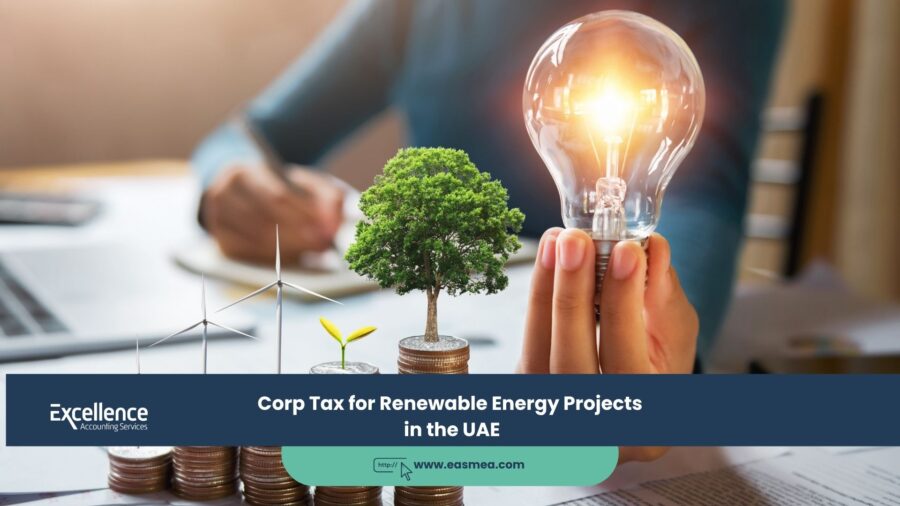
Powering the Future: A Strategic Guide to Corp Tax for Renewable Energy Projects in the UAE
The UAE is in the midst of a profound energy transformation. Guided by its ambitious UAE Net Zero by 2050 strategic initiative, the nation is making massive investments in solar, wind, and green hydrogen, positioning itself as a global leader in clean energy. This green revolution is characterized by long-term, capital-intensive projects with unique financial structures. Coinciding with this monumental shift is the introduction of the UAE’s Corporate Tax regime, a pivotal development in the country’s economic landscape.
- Powering the Future: A Strategic Guide to Corp Tax for Renewable Energy Projects in the UAE
- Part 1: The General Framework - Applicability of Corporate Tax
- Part 2: The Free Zone Question - A Path to 0% Tax?
- Part 3: Decoding Taxable Income - Revenue Sources Explored
- Part 4: The Heart of the Matter - Maximizing Deductible Expenses
- Part 5: Structuring for Success
- How Excellence Accounting Services (EAS) Powers Your Renewable Energy Venture
- Frequently Asked Questions (FAQs) for Renewable Energy Projects
- Is Your Renewable Energy Project Structured for Tax Efficiency?
The intersection of these two strategic forces—the drive for sustainability and the implementation of a new tax system—creates a unique set of challenges and opportunities for investors, developers, and operators in the renewable energy sector. The financial viability of a multi-billion dirham solar park or a cutting-edge green hydrogen facility is no longer just a matter of engineering and financing; it is now deeply intertwined with tax strategy. Proactive, sophisticated tax planning is not an afterthought but a critical component of a project’s lifecycle, from the initial feasibility study to final decommissioning. This guide provides a comprehensive overview of the key Corporate Tax considerations for renewable energy projects in the UAE.
Key Takeaways for Renewable Energy Projects
- Capital Allowances are Critical: The ability to deduct the cost of high-value assets like solar panels and wind turbines over time (depreciation) is the single most important tax consideration for this sector.
- Revenue is More Than Just Energy Sales: Taxable income can come from Power Purchase Agreements (PPAs), government grants, and the sale of carbon credits, each with its own specific treatment.
- Structuring is Key: Using Special Purpose Vehicles (SPVs) and forming Tax Groups can provide significant advantages in managing project-specific finances and consolidating losses against profits.
- Free Zone Benefits are Conditional: While operating in a Free Zone can offer a 0% tax rate, projects must meet strict “Qualifying Income” criteria, which can be complex for energy producers selling to the mainland grid.
- Financing Costs Have Limits: The deductibility of interest on project loans is a major benefit but is subject to the 30% EBITDA interest capping rule.
- Proactive Planning is Non-Negotiable: Tax implications must be modeled and integrated into the project’s financial plan from day one to ensure long-term viability and attractive investor returns.
Part 1: The General Framework – Applicability of Corporate Tax
At its core, a company operating a renewable energy project in the UAE is treated like any other business for tax purposes. It is subject to the standard UAE Corporate Tax law, which means:
- A 0% tax rate on annual taxable income up to AED 375,000.
- A 9% tax rate on annual taxable income exceeding AED 375,000.
However, the unique nature of energy projects—high upfront investment, long operational life, complex revenue streams, and specialized legal structures—requires a much deeper analysis of how these standard rules apply in practice.
Part 2: The Free Zone Question – A Path to 0% Tax?
A common strategic question is whether to base a project within one of the UAE’s numerous Free Zones to take advantage of the 0% Corporate Tax rate for Qualifying Free Zone Persons (QFZPs). While attractive, this path is complex for energy projects.
To benefit from the 0% rate, a QFZP’s income must be “Qualifying Income.” A key component of Qualifying Income is revenue from transactions with other Free Zone persons. For a power plant, the primary customer is often a government-owned utility on the mainland (e.g., DEWA, EWEC). Income from sales to a mainland entity is generally non-qualifying income and would be subject to the 9% tax rate.
While certain activities conducted in a Free Zone for a mainland client might qualify, the sale of the primary output (electricity) to the mainland grid typically does not. This makes achieving a full 0% benefit challenging for many utility-scale projects.
Therefore, while Free Zone company formation offers other benefits, the 0% tax incentive must be assessed with extreme care based on the specific offtake and contractual arrangements of the project.
Part 3: Decoding Taxable Income – Revenue Sources Explored
The taxable income of a renewable energy project is its revenue minus its deductible expenses. Understanding what constitutes revenue is the first step.
1. Power Purchase Agreements (PPAs)
The primary revenue source is the long-term PPA with the offtaker (the utility). Revenue must be recognized in accordance with accepted accounting standards (like IFRS 15). This typically means recognizing revenue as electricity is delivered, not when cash is received. The structure of the PPA (e.g., fixed price, indexed, ‘take-or-pay’ clauses) will directly influence the timing and amount of revenue recognition for both accounting and tax purposes.
2. Government Grants and Subsidies
Governments may offer grants to encourage investment in renewables. Under the Corporate Tax Law, the treatment of a grant depends on its nature. A grant related to an asset (e.g., a grant to help build the solar farm) is typically not treated as immediate income but is instead netted against the cost of the asset or deferred and recognized as income over the asset’s useful life.
3. Carbon Credits and Renewable Energy Certificates (RECs)
Income generated from the sale of carbon credits or RECs is considered part of a business’s taxable income and is subject to the standard Corporate Tax rates.
Part 4: The Heart of the Matter – Maximizing Deductible Expenses
For a capital-intensive business, deductions are paramount. This is where a proactive tax strategy delivers the most value.
1. Capital Allowances (Depreciation) – The Cornerstone of Tax Planning
Renewable energy projects have enormous upfront Capital Expenditures (CapEx) on assets like solar panels, wind turbines, batteries, and supporting infrastructure. These costs cannot be deducted in the year they are incurred. Instead, their cost is recognized over their useful life through depreciation for accounting purposes, and “Capital Allowances” for tax purposes.
The Corporate Tax Law allows for the cost of assets to be deducted on a straight-line basis over a set period. While detailed guidance on asset-specific lifespans is forthcoming, this principle allows the project to shield a significant portion of its future profits from tax. Meticulous bookkeeping and asset management are crucial to track the cost base of thousands of individual assets and calculate these allowances correctly.
2. Interest and Financing Costs
These projects are heavily debt-financed. The interest paid on loans is a deductible expense. However, this is subject to two key limitations:
- General Interest Limitation: The net interest expense deduction is capped at 30% of the business’s EBITDA (Earnings Before Interest, Tax, Depreciation, and Amortization).
- Related Party Limitation: If the loan is from a related party, the interest rate must be at an “arm’s length” rate.
Modeling the impact of the 30% EBITDA cap is a critical part of the initial financial feasibility study.
3. Tax Loss Relief
It is common for large infrastructure projects to incur losses in their initial years due to high depreciation and interest costs. The Corporate Tax Law allows these losses to be carried forward indefinitely and used to offset up to 75% of the taxable income in future profitable years. This is a vital provision that recognizes the long-term nature of these investments.
Part 5: Structuring for Success
How the project is legally and financially structured has direct tax consequences.
1. Tax Groups
A parent company that owns multiple renewable project SPVs (each holding a different solar or wind farm) can elect to form a Tax Group. This allows the group to file a single consolidated tax return. The key advantages are:
- Loss Offsetting: Losses from a new project that is still in its early phase can be used to offset profits from a more mature, profitable project within the same group.
- Administrative Simplicity: It simplifies compliance by eliminating the need to file multiple returns.
2. Transfer Pricing
Where an international company is involved (e.g., a foreign parent company supplying technology or providing technical services to the UAE project company), transfer pricing rules apply. All transactions between these related parties must be priced at arm’s length, as if they were between unrelated entities. This requires robust documentation to justify the pricing and avoid a tax adjustment by the FTA.
How Excellence Accounting Services (EAS) Powers Your Renewable Energy Venture
The renewable energy sector’s unique financial landscape demands specialized tax and advisory services. EAS provides end-to-end support for investors and developers in this critical industry.
- Project Feasibility and Financial Modeling: Our feasibility study experts integrate sophisticated tax modeling into your project’s financial projections to ensure its viability from day one.
- Tax-Efficient Structuring: We advise on the optimal legal and tax structure for your project, including company formation, SPV setup, and Tax Group applications.
- Business Valuation: We provide expert business valuation services for project financing, M&A, and investor reporting.
- Outsourced CFO and Accounting: Our CFO services provide high-level strategic oversight for your SPVs, while our bookkeeping team manages the complex project accounting required.
- Ongoing Tax Compliance: We manage all aspects of your Corporate Tax and VAT return filing, ensuring you remain compliant with all FTA regulations.
Frequently Asked Questions (FAQs) for Renewable Energy Projects
Currently, the UAE Corporate Tax Law does not provide a specific, sector-wide exemption or a reduced tax rate for renewable energy projects. They are subject to the standard 0%/9% rate structure. Any “incentive” comes from the effective application of general provisions like capital allowances and tax loss relief.
Revenue is recognized based on accounting standards, typically as the electricity is produced and delivered to the grid each month/quarter, not based on the total contract value. This aligns the tax liability with the actual generation of economic value.
No. Solar panels are capital assets. Their cost is capitalized and then deducted over their prescribed useful life through tax depreciation (capital allowances). This spreads the tax benefit over many years, mirroring the asset’s income-generating life.
The losses generated in those years can be carried forward indefinitely. Once the project becomes profitable, you can use these accumulated losses to offset up to 75% of your taxable income in each subsequent year until the losses are fully utilized.
This is a related party transaction subject to transfer pricing rules. The price the UAE project company pays the German parent for the turbines must be at “arm’s length.” You will need to prepare and maintain documentation to prove that the price is fair and comparable to what would be paid to an independent supplier.
Generally, a grant related to the purchase of assets is not treated as immediate income. The typical treatment is to either reduce the cost base of the asset for depreciation purposes or to defer the grant and recognize it as income over the asset’s useful life.
Yes. Income derived from the sale of assets, tangible or intangible (like carbon credits), by a UAE-based entity is generally considered taxable income subject to UAE Corporate Tax.
Yes, provided the ownership criteria (at least 95%) are met. The holding company and the two SPVs can elect to form a Tax Group and file a single, consolidated tax return. This would allow losses from one project to offset profits from the other.
Yes. The construction of the project and the ongoing O&M services are generally subject to 5% VAT. The sale of electricity to the grid is also subject to 5% VAT. A key activity will be ensuring you can recover all the input VAT incurred on your construction and operational costs.
A feasibility study is where you model the project’s entire financial life. This is the ideal stage to model different tax scenarios, forecast the impact of capital allowances and interest deduction limits, and determine the most tax-efficient project structure *before* any significant investment is made.
Conclusion: Integrating Tax into the Green Blueprint
The UAE’s commitment to a sustainable future is clear, and the renewable energy sector is at the vanguard of this transition. For these ambitious and vital projects to succeed, however, they must be built on a foundation of sound financial and tax planning. Corporate Tax is not a peripheral issue; it is a central variable that impacts everything from investor returns to long-term operational cash flow. By integrating a proactive, expert-led tax strategy into the project blueprint from the very beginning, developers and investors can navigate the complexities of the new regime, maximize their financial efficiency, and contribute more effectively to the nation’s clean energy goals.