
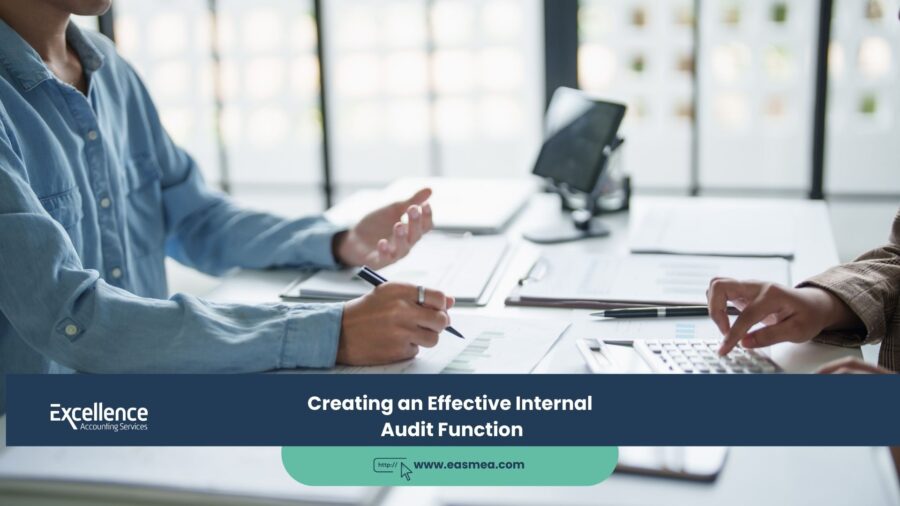
The Guardian of Governance: A Strategic Guide to Creating an Effective Internal Audit Function
In the past, “Internal Audit” was often viewed with suspicion. Auditors were seen as the corporate police force—inspectors who arrived after the battle to count the dead and assign blame. Their job was compliance, their tool was the checklist, and their arrival was dreaded by management.
- The Guardian of Governance: A Strategic Guide to Creating an Effective Internal Audit Function
- What is Internal Audit? (And What It Isn't)
- The Strategic Imperative: Why You Need It Now
- The 5 Pillars of an Effective Internal Audit Function
- The Audit Cycle: A Step-by-Step Execution Guide
- Internal Controls: The Heart of the Audit
- The Technology Solution: Auditing in the Digital Age
- In-House vs. Outsourced: The Strategic Choice
- How Excellence Accounting Services (EAS) Builds Your Defense
- Frequently Asked Questions (FAQs) on Internal Audit
- Who is Watching Your Risk?
Today, that model is extinct. In a modern, high-growth business environment—especially one as dynamic and regulated as the UAE—Internal Audit has evolved into a critical strategic partner. It is no longer just about “checking the boxes”; it is about “improving the business.” An effective Internal Audit function acts as the organization’s immune system: proactively identifying risks, testing the strength of controls, and offering insights that drive efficiency and value.
For UAE business leaders facing new challenges like Corporate Tax, Anti-Money Laundering (AML) regulations, and global supply chain volatility, building an effective internal audit function is not a luxury—it is a necessity for survival and governance. This comprehensive guide will walk you through the blueprint of a world-class Internal Audit function, from defining its charter to executing a risk-based plan that protects and enhances your organization.
Key Takeaways
- Independence is Everything: Internal Audit must report to the Audit Committee, not the CEO/CFO. If they cannot speak truth to power without fear, they are useless.
- Risk-Based, Not Cycle-Based: Don’t audit “Accounts Payable” just because it’s been a year. Audit it because it’s a high-risk area for fraud. Focus resources where the risk is highest.
- Consultant, Not Policeman: The modern auditor helps management solve problems. They don’t just say “this is wrong”; they say “here is the root cause and how to fix it efficiently.”
- Technology is the Enabler: Moving from random sampling to 100% data analysis using modern tools transforms the depth and quality of audit insights.
- The Three Lines of Defense: Internal Audit is the “Third Line.” It provides assurance on the First Line (Management) and the Second Line (Risk/Compliance functions).
What is Internal Audit? (And What It Isn’t)
To build it, you must define it.
Definition: Internal Audit is an independent, objective assurance and consulting activity designed to add value and improve an organization’s operations. It helps an organization accomplish its objectives by bringing a systematic, disciplined approach to evaluate and improve the effectiveness of risk management, control, and governance processes.
What It Is Not:
- It is NOT External Audit: External auditors serve the shareholders and verify the financial statements. Internal auditors serve the board/management and look at *all* risks (operational, strategic, IT, reputational), not just financial ones.
- It is NOT Management: Auditors do not *fix* the problems or run the controls. They identify the issues. Management owns the risk and the solution. If auditors fix the controls, they lose their independence to audit them later.
- It is NOT a Witch Hunt: The goal is not to catch people doing wrong; it is to test if the *system* prevents wrong-doing.
The Strategic Imperative: Why You Need It Now
Why invest in this function? Because the cost of *not* having it is too high.
- The “Corporate Tax” Defense: The FTA requires robust documentation and substance. An internal audit verifies that your tax governance framework is working *before* the FTA knocks on your door. (Link to Audit Prep).
- Fraud Prevention: In high-growth SMEs, controls often lag behind revenue. This gap is where fraud thrives. Internal audit closes the gap.
- Operational Efficiency: Auditors see across silos. They can spot that Sales and Operations are using two different systems that don’t talk, causing waste. Their recommendations often save more money than the cost of the audit function.
- Board Assurance: Directors have a fiduciary duty. They need an independent voice to tell them what is really happening on the ground, unfiltered by management bias.
The 5 Pillars of an Effective Internal Audit Function
You cannot just hire an auditor and say “go audit.” You must build the infrastructure.
Pillar 1: Independence & Objectivity (The Reporting Line)
This is the most critical structural element.
The Gold Standard: The Chief Audit Executive (CAE) reports **functionally** to the Audit Committee of the Board (for scope, results, and performance) and **administratively** to the CEO (for day-to-day logistics like payroll).
The Failure Mode: If the auditor reports to the CFO, they cannot effectively audit the Finance department. They will be pressured to soften reports that make their boss look bad.
Pillar 2: The Audit Charter (The Mandate)
This is the constitution of the department. It is a formal document, approved by the Board, that defines: * The purpose and mission of Internal Audit. * The authority to access *all* records, personnel, and physical properties (no “off-limits” areas). * The responsibility to maintain confidentiality and ethics.
Pillar 3: Risk-Based Methodology (The Compass)
You have limited resources. You cannot audit everything. You must audit what matters.
The Audit Universe: A list of every auditable entity in the company (e.g., HR, IT, Sales, a specific Factory, a specific process like “Procure-to-Pay”).
Risk Assessment: Scoring each entity on “Impact” and “Likelihood” of failure. High-risk areas (e.g., Cyber Security, Treasury) get audited annually. Low-risk areas (e.g., Cafeteria Operations) get audited every 3 years.
Pillar 4: Talent & Expertise (The Team)
The days of the “generalist accountant” auditor are fading. Modern risks require specialists. * IT Auditors: To test cyber defenses and ERP controls. * Fraud Examiners (CFE): To investigate red flags. * Data Analysts: To crunch millions of transactions.
For many companies, hiring all these specialists full-time is impossible. This drives the trend towards **Co-Sourcing** or **Outsourcing** to firms like EAS.
Pillar 5: Quality Assurance (Auditing the Auditors)
Who watches the watchers? An effective function must have a Quality Assurance and Improvement Program (QAIP). This involves periodic internal reviews and an external assessment every 5 years (required by IIA standards) to ensure the audit team is following global best practices.
The Audit Cycle: A Step-by-Step Execution Guide
How does an audit actually happen? It follows a disciplined lifecycle.
Phase 1: Annual Planning
At the start of the year, the CAE performs a company-wide risk assessment. They interview executives, review financial data, and look at industry trends.
Output: The Annual Audit Plan. “This year, we will audit: 1. Procurement, 2. Cyber Security, 3. Payroll, 4. Inventory Management.” This plan is approved by the Audit Committee.
Phase 2: Engagement Planning
For each specific audit (e.g., Procurement), the auditor plans the scope. * Objective: Ensure best prices are obtained and no vendor fraud exists. * Scope: All contracts > AED 50k signed in 2024. * Kick-off Meeting: The auditor meets with the Procurement Manager to explain the process and request data (the “PBC List”).
Phase 3: Fieldwork (Testing)
The “boots on the ground” phase. * Walkthroughs: Tracing a transaction from start to finish to understand the process flow. * Test of Controls: Checking if the rules are followed (e.g., “Did the CFO sign this PO?”). * Substantive Testing: Verifying the numbers (e.g., “Does this invoice match the contract price?”). * Data Analytics: Analyzing 100% of vendor payments to look for duplicates or split invoices.
Phase 4: Reporting
The auditor drafts the report. * The Finding: “We found 5 vendors created without a valid trade license.” * The Risk: “This exposes the company to fraud and supply chain risk.” * The Recommendation: “Implement a mandatory vendor vetting checklist.” * Management Response: The manager *must* agree to an action plan and a deadline. “We will fix this by Q3.”
Phase 5: Follow-Up
An audit report is useless if it sits on a shelf. The auditor tracks the “Action Plan.” If the manager promised to fix the vendor issue by Q3, the auditor goes back in Q4 to verify it was actually done. Unresolved issues are reported to the Board.
Internal Controls: The Heart of the Audit
Auditors don’t just look for errors; they look for control weaknesses. Controls come in three flavors:
- Preventive Controls: Designed to stop an error/fraud *before* it happens. (e.g., Passwords, Biometric locks, Segregation of Duties in software). These are the strongest controls.
- Detective Controls: Designed to find an error *after* it happens. (e.g., Monthly Bank Reconciliation, Inventory Counts, Variance Analysis).
- Corrective Controls: Designed to fix the error once found. (e.g., Data backups, Insurance).
A good internal audit recommends shifting from Detective to Preventive controls. “Don’t just catch the bad payment next month; configure the system to block it today.”
The Technology Solution: Auditing in the Digital Age
You cannot audit a digital business with a clipboard. Modern Internal Audit relies on tech.
In-House vs. Outsourced: The Strategic Choice
Should you hire a full-time Internal Audit Manager, or outsource the function to a firm like EAS?
In-House Internal Audit
Pros: Deep knowledge of company culture; always on-site.
Cons: Expensive (salary, benefits); hard to attract top talent for small teams; risk of “going native” (losing independence/objectivity); difficult to have all specialized skills (IT, Fraud, Tax) in one or two people.
Outsourced / Co-Sourced Internal Audit (EAS)
Pros: * Cost-Effective: You pay for the service, not the idle time. * Skill Access: You get a team, not a person. You get an IT auditor for the IT audit, a tax expert for the tax audit, and a fraud examiner for investigations. * Independence: As an external party, we have no political baggage or fear of office politics. We report truth to power. * Flexibility: Scale up for a major project, scale down when not needed.
For most SMEs and mid-sized groups in the UAE, outsourcing or co-sourcing is the superior strategic and financial choice.
How Excellence Accounting Services (EAS) Builds Your Defense
We don’t just perform audits; we build governance functions. EAS acts as your strategic partner in risk and control.
- Outsourced Internal Audit: We can act as your entire Internal Audit department, reporting directly to your Audit Committee. We handle the risk assessment, planning, execution, and reporting.
- Co-Sourced Audit: Already have a team? We partner with them to provide specialized skills (e.g., IT Audit, Tax Review) or extra hands during peak times.
- Internal Control Design: We don’t just test controls; we help you build them. We write the policies and procedures that secure your assets.
- Risk Assessment Workshops: We facilitate sessions with your leadership to identify and prioritize the strategic risks facing your business.
- Fraud Investigation: If you suspect wrongdoing, our forensic experts conduct discreet, rigorous investigations to find the truth.
- Pre-Audit Health Checks: We prepare you for your external audit or FTA tax audit by conducting a “dry run” to fix issues before they become findings.
Frequently Asked Questions (FAQs) on Internal Audit
For listed companies (PJSCs) and banks/insurers, yes, it is mandatory under SCA and Central Bank regulations. For private LLCs, it is not legally mandatory but is highly recommended for governance. However, Corporate Tax laws effectively require the *controls* that internal audit provides to ensure accurate reporting.
Internal Control is a *process* (checks and balances) implemented by management (e.g., password protection). Internal Audit is a *function* that checks if those controls are working effectively. Management *owns* the controls; Audit *tests* them.
Generally, No. This creates a conflict of interest. They cannot audit their own work (or the work of their colleagues). Best practice governance (and many regulations) requires these to be separate firms to ensure total independence.
It depends on the risk. High-risk areas (Cash, Procurement, Cyber) might be audited every year. Medium risk (HR, Fixed Assets) every 2 years. Low risk every 3-4 years. A risk-based plan determines the frequency.
Value isn’t just “fraud caught.” It’s measured by: * Cost savings identified (e.g., duplicate payments recovered). * Process efficiencies recommended (time saved). * Reduction in external audit fees (because the external auditor relies on internal audit’s work). * “No surprises” for the Board.
This happens. The auditor and management discuss it. If they can’t agree, the finding is included in the report with “Management’s Response” explaining their disagreement. The Audit Committee then decides who is right. This “constructive friction” is healthy.
Yes, modern audit does. Strategic risks (e.g., “Are we entering a new market without a plan?”, “Is our pricing model outdated?”) are part of the audit universe. Auditors check if the *process* for setting strategy is sound, not necessarily the strategy itself.
A rule of thumb is often 1 auditor per 50-100 employees, or 0.1% of revenue, but it varies wildly based on complexity and regulation. A tech company needs fewer (but more specialized) auditors than a bank.
Instead of auditing payroll once a year, the auditor uses software to monitor payroll transactions in *real-time* (e.g., flagging duplicate bank accounts instantly). This is the future of audit, enabled by data analytics.
Start with a **Risk Assessment**. Don’t hire staff yet. Hire a consultant (like EAS) to map your risks. Identify the top 5 risks that could kill the business. Then, perform specific audits on just those 5 areas. Build the function slowly from there.
Conclusion: From Policeman to Trusted Advisor
Creating an effective Internal Audit function is one of the most mature steps a business can take. It signals a shift from “running by instinct” to “running by governance.” It tells your stakeholders that you are serious about protecting the company’s value.
By moving away from the old “policeman” model and building a risk-based, technology-enabled, and strategic function, you gain a powerful ally. You gain a partner who watches your back, shines a light in the dark corners, and helps you navigate the complex risk landscape of the modern world with confidence.