
Data-Driven Decisions with Virtual CFO Insights: Turning Numbers into Narrative
In the digital age, businesses are drowning in data yet starving for wisdom. Every transaction, customer interaction, and operational process generates a stream of data points. For many SMEs in the UAE, this data sits passively in their accounting software, used primarily for one purpose: looking backward. It’s used to generate historical financial statements and file tax returns. While this is essential, it unlocks only a fraction of the data’s true potential. The most successful businesses are those that learn to use their financial data not as a rearview mirror, but as a sophisticated GPS for navigating the future.
- Data-Driven Decisions with Virtual CFO Insights: Turning Numbers into Narrative
- Part 1: The Foundation - From Raw Data to a Single Source of Truth
- Part 2: The Core Discipline - KPI Development and Tracking
- Part 3: The Deep Dive - Advanced Profitability Analysis
- Part 4: The Forward View - Forecasting and Scenario Planning
- Part 5: The Communication Tool - The CFO Dashboard
- Unlock the Story in Your Numbers with EAS Virtual CFO Services
- Frequently Asked Questions (FAQs) on Data-Driven CFO Insights
- Your Data is Telling a Story. Are You Listening?
This is the transformational power a Virtual CFO (vCFO) brings to an organization. A vCFO is an expert in translating raw financial data into a compelling strategic narrative. They move beyond the “what” (what were our sales last quarter?) to the “why” (why did sales dip, and which customer segments were most affected?) and, most importantly, the “what’s next?” (what data-backed actions can we take to reverse this trend?). They are data storytellers who transform confusing spreadsheets into clear, actionable insights that empower CEOs to make smarter, faster, and more confident decisions. This guide will explore the methodologies a vCFO uses to harness the power of data, turning your finance function from a static reporting center into a dynamic engine for intelligent growth.
Key Takeaways on Data-Driven CFO Insights
- Data is the Foundation: A vCFO’s strategic advice is built on a foundation of clean, accurate, and real-time financial data.
- Beyond Financials to KPIs: They focus on the Key Performance Indicators (KPIs)—both financial and non-financial—that are the true drivers of business performance.
- Profitability Analysis is Key: A vCFO dissects profitability by customer, product, and channel to identify what’s truly making money and what isn’t.
- Forecasting, Not Guessing: They use historical data and business drivers to build sophisticated financial forecasts and “what-if” scenarios.
- The CFO Dashboard: A key tool is the monthly management dashboard, which visualizes complex data into an easy-to-understand format for leadership.
- Technology is the Enabler: This level of analysis is only possible with a modern, cloud-based accounting system that provides a single source of truth.
Part 1: The Foundation – From Raw Data to a Single Source of Truth
Before any meaningful analysis can begin, a vCFO’s first priority is to ensure the integrity and quality of the underlying data. “Garbage in, garbage out” is the oldest rule in data analytics, and it applies with full force to financial data.
The vCFO’s Foundational Data Checklist:
- Is the accounting system robust and fit for purpose? Is the business using a professional, cloud-based platform or struggling with spreadsheets?
- Are the books up-to-date and reconciled? Bank accounts, credit cards, and other key accounts must be reconciled regularly to ensure accuracy. This is a core focus of our account reconciliation services.
- Is data being captured with enough detail? For example, is revenue just recorded as a single number, or is it tagged by sales channel, customer type, and product line?
A vCFO will often lead a cleanup and process improvement project, sometimes involving a new accounting system implementation, to create the “single source of truth” necessary for high-quality analysis.
Part 2: The Core Discipline – KPI Development and Tracking
A Profit & Loss statement tells you if you made money, but it doesn’t tell you *how* or *why*. A vCFO’s real value comes from identifying and tracking the handful of Key Performance Indicators (KPIs) that are the true levers of the business.
Examples of Strategic KPIs a vCFO will track:
| KPI Category | Example KPI | What it Tells the CEO |
|---|---|---|
| Profitability | Gross Profit Margin % | “How efficient is our core business at generating profit from sales, before overheads?” |
| Sales & Marketing Efficiency | Customer Acquisition Cost (CAC) | “How much are we spending on marketing and sales to acquire each new customer?” |
| Customer Value | Customer Lifetime Value (LTV) | “What is the total profit we can expect to make from a customer over their entire relationship with us?” |
| SaaS / Recurring Revenue | Monthly Recurring Revenue (MRR) & Churn % | “How predictable is our revenue, and at what rate are we losing customers?” |
| Liquidity / Cash Flow | Cash Runway | “How many months can we continue operating at our current burn rate before we run out of money?” |
The vCFO’s job is to work with the leadership team to select the 5-7 KPIs that are most relevant to their specific business model and then build a system to track and report on them consistently.
Part 3: The Deep Dive – Advanced Profitability Analysis
One of the most powerful analyses a vCFO performs is to go beyond the company-wide profit margin and dissect profitability at a granular level. This often uncovers surprising and counter-intuitive insights.
Profitability by Customer
By allocating not just the direct cost of goods, but also a portion of sales and support costs to each customer, a vCFO can identify:
- Your “VIP” Customers: The 20% of customers who are generating 80% of your profit.
- Your “Problem” Customers: Customers who may have high revenue but are actually unprofitable due to their high service demands or constant discounting.
The Strategic Decision: This data allows the CEO to focus sales and marketing efforts on acquiring more “VIP-style” customers and to potentially re-price or even “fire” unprofitable customers.
Profitability by Product/Service
Similarly, a vCFO will analyze the true, fully-loaded margin of each product or service line. This can reveal:
- Hidden Gems: Niche products that have exceptionally high margins.
- Loss Leaders: Popular products that are actually losing money once all associated costs are factored in.
The Strategic Decision: This insight drives decisions about product development, marketing focus, and pricing strategy. It’s a key part of our strategic business consultancy.
Part 4: The Forward View – Forecasting and Scenario Planning
A vCFO’s most valuable role is helping the CEO look around the corner. They do this by building dynamic financial models that are not just static predictions, but flexible tools for decision-making.
The 3-Way Forecast
The gold standard is a “3-way forecast” that projects the Profit & Loss, Balance Sheet, and Cash Flow Statement together. This provides a holistic view of the company’s future financial health.
“What-If” Scenario Analysis
The real power of a good financial model is the ability to run “what-if” scenarios. The vCFO can answer critical strategic questions with data:
- “What happens to our cash runway if we hire two new developers next month?”
- “What is the impact on our profitability if we increase prices by 10%, but expect a 5% drop in volume?”
- “What level of revenue do we need to hit to break even if our main supplier increases their prices by 8%?”
This transforms gut-feel decisions into data-driven strategic choices.
Part 5: The Communication Tool – The CFO Dashboard
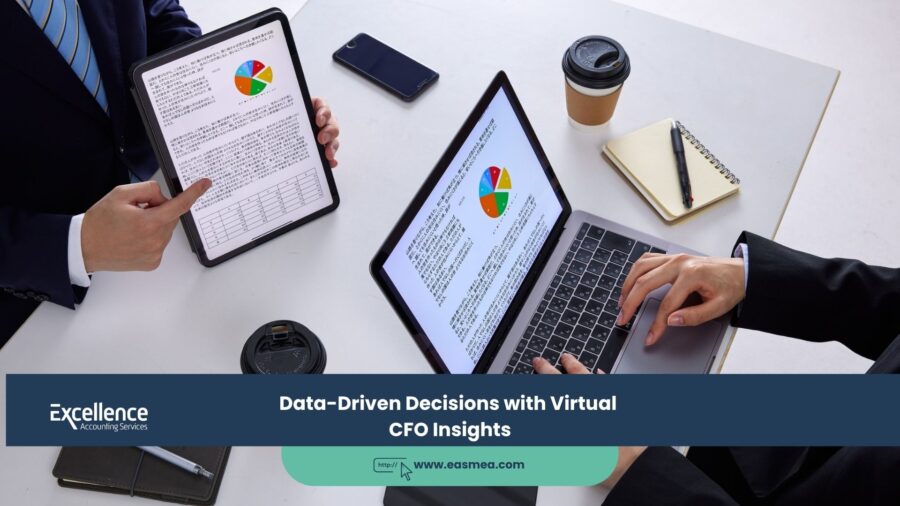
A vCFO distills all this complex analysis into a single, powerful communication tool: the monthly management dashboard.
This is typically a one or two-page report that visualizes the most critical information for the leadership team. It includes:
- A summary of the P&L (Budget vs. Actual).
- A graphical representation of the cash flow forecast.
- A dashboard of the key KPIs with trend lines.
- Strategic commentary from the vCFO, explaining the story behind the numbers and recommending actions.
This dashboard becomes the centerpiece of the monthly management meeting, focusing the entire leadership team on the same data and the same strategic priorities. Our financial reporting services are designed to produce this level of insightful analysis.
The technology that underpins this is crucial. A platform like Zoho Books, with its powerful reporting and dashboarding capabilities, allows a vCFO to efficiently pull and visualize this data, spending more time on analysis and less on manual data compilation.
Unlock the Story in Your Numbers with EAS Virtual CFO Services
Excellence Accounting Services (EAS) offers a premier Part-Time Virtual CFO service that is fundamentally data-driven. We partner with you to transform your financial data into your most powerful strategic asset.
- Custom KPI Development: We work with you to identify the unique drivers of your business and build a system to track and report on them.
- Advanced Profitability Analysis: We go beyond the surface to analyze your profitability by customer, product, and channel, uncovering hidden opportunities.
- Sophisticated Financial Modeling: We build dynamic, 3-way financial forecasts and scenario models to support your most critical strategic decisions.
- Insightful Management Reporting: We deliver clear, concise CFO dashboards that tell the story behind the numbers and provide actionable recommendations.
- Integrated Tax and Financial Strategy: We ensure your data-driven decisions are fully aligned with a compliant and efficient Corporate Tax and VAT strategy.
Frequently Asked Questions (FAQs) on Data-Driven CFO Insights
An accountant provides the “what” (your historical results). A vCFO provides the “so what?” and “now what?”. They analyze the trends within those statements, compare them to your budget and KPIs, and provide forward-looking advice on what actions to take. The value is in the interpretation and strategic guidance, not just the report itself.
A great vCFO will want to integrate financial data with operational data. This could include website traffic from Google Analytics, sales pipeline data from your CRM, or customer usage data from your product platform. Combining these datasets provides a much richer and more predictive view of the business.
Data analysis is central to improving cash flow. A vCFO will analyze your Accounts Receivable aging report to identify slow-paying customers for targeted follow-up. They will analyze your inventory turnover data to identify slow-moving stock that is tying up cash. This data-driven approach is far more effective than just “feeling” like you’re short on cash.
A data-driven culture is one where business decisions are made based on evidence and analysis, not just gut instinct. A vCFO champions this culture by consistently bringing data to the management table, by insisting that strategic proposals are backed by a financial model, and by providing the tools (like the CFO dashboard) that make data accessible to the whole leadership team.
It is absolutely critical. A potential buyer will conduct extensive due diligence. A vCFO prepares you for this by building a “data room” with clean, well-organized financials and reports. Their deep analysis of KPIs like LTV and CAC will be central to justifying the company’s business valuation to the buyer.
Almost every business has more data than it thinks. Even a simple set of accounting records contains a wealth of information about sales trends, customer behavior, and cost structures. A good vCFO can start by extracting powerful insights from the data you already have, while simultaneously putting a plan in place to capture more detailed data going forward.
Cohort analysis is a powerful technique where a vCFO groups your customers by the month or year they first signed up. By tracking the behavior of each cohort over time, you can answer critical questions like “Are our newer customers more valuable than our older ones?” or “Is our customer churn rate improving?”. It’s a key tool for subscription and e-commerce businesses.
The financial forecasts created by a vCFO are essential for proactive tax planning. By projecting your taxable income for the year, you can plan for tax payments in advance and avoid surprises. The data can also be used to model the tax impact of major decisions, like a large asset purchase, allowing you to structure it in the most tax-efficient way.
Data cannot predict the future with 100% certainty, but it can significantly improve the accuracy of your forecasts and reduce uncertainty. By building a financial model based on the key historical drivers of your business, a vCFO can create a range of likely future outcomes, allowing you to plan for the most probable scenario while being prepared for others.
The first step is to commit to data quality. Ensure you have a professional accounting system and that your bookkeeping is accurate and up-to-date. The second step is to seek expertise. Engaging a part-time vCFO is the most effective way to bring the skills and mindset needed to start unlocking the strategic story hidden in your numbers.
Conclusion: From Information to Transformation
In the competitive landscape of Dubai, the difference between a good business and a great business often lies in the quality of its decisions. Great businesses replace guesswork with data, intuition with insight, and reaction with strategy. The Virtual CFO is the catalyst for this transformation. They provide the framework, the tools, and the expertise to harness your company’s own data, turning it from a static record of the past into a dynamic guide for the future. By investing in data-driven insights, you are not just improving your financial planning; you are building a more intelligent, agile, and resilient organization poised for long-term success.