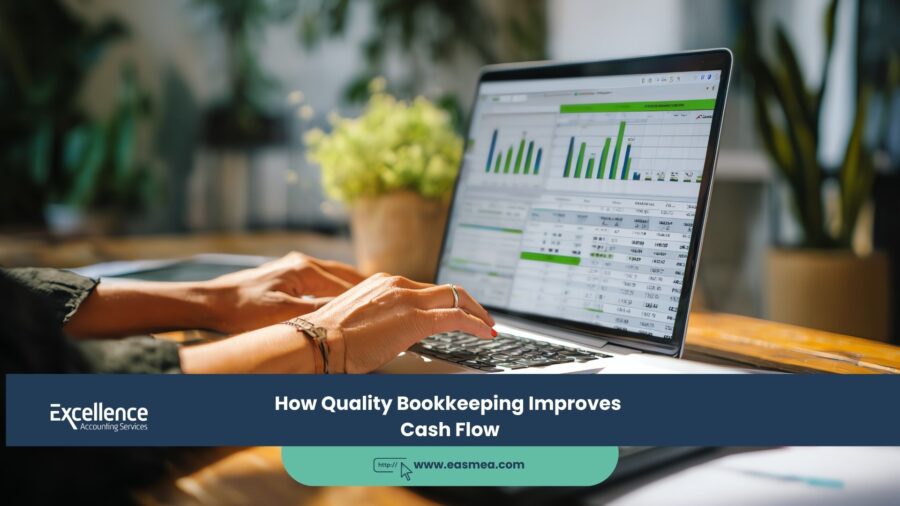
The Hidden Engine of Liquidity: How Quality Bookkeeping Directly Improves Your Cash Flow
In the high-stakes world of business, “Cash is King.” It is the oxygen that keeps the lights on, pays the staff, and fuels growth. Yet, when business owners look for ways to improve their cash flow, they often look outward: they chase more sales, seek bank loans, or look for investors. They rarely look inward at the humble, often overlooked engine room of their business: bookkeeping.
- The Hidden Engine of Liquidity: How Quality Bookkeeping Directly Improves Your Cash Flow
- The Disconnect: Why "Profitable" Companies Go Broke
- Mechanism 1: Accelerating Inflows (Accounts Receivable)
- Mechanism 2: Optimizing Outflows (Accounts Payable)
- Mechanism 3: Inventory Visibility
- Mechanism 4: Tax Efficiency and Penalty Avoidance
- Mechanism 5: Enabling Strategic Forecasting
- The Technology Multiplier: From Manual to Automated
- How Excellence Accounting Services (EAS) Turns Books into Cash
- Frequently Asked Questions (FAQs) on Bookkeeping and Cash Flow
- Stop the Cash Leaks. Start the Growth.
There is a dangerous misconception that bookkeeping is merely a compliance task—a historical record-keeping exercise to satisfy the tax authorities. This view leaves millions of dirhams on the table. In reality, quality bookkeeping is the foundation of liquidity management. It is the difference between knowing you have money and actually having it in the bank.
Poor bookkeeping leads to lost invoices, missed payment deadlines, tax penalties, and “leakage” that drains your bank account unnoticed. Quality bookkeeping, on the other hand, accelerates collections, optimizes payments, prevents waste, and provides the visibility needed to navigate financial storms. This comprehensive guide will explore the direct, mechanical link between the quality of your books and the quantity of your cash, providing actionable strategies to transform your accounting function from a cost center into a cash generator.
[Image of a cash flow cycle diagram showing inflows and outflows]
Key Takeaways
- Speed Equals Cash: Accurate, timely bookkeeping allows for faster invoicing. The faster you invoice, the faster you get paid. Delays in recording data lead directly to delays in cash inflow.
- Visibility is Power: You cannot manage what you cannot see. Quality bookkeeping provides a real-time view of who owes you money (AR) and who you owe (AP), allowing for strategic timing of payments.
- Errors are Expensive: A lost receipt is a lost tax deduction. A duplicate payment to a supplier is cash out the door. Quality bookkeeping stops these leaks.
- Compliance Preserves Cash: In the UAE, penalties for VAT and Corporate Tax errors are severe. Accurate books prevent these avoidable cash outflows.
- It Enables Forecasting: You can’t predict your future cash position if your current data is wrong. Quality books are the prerequisite for the 13-week cash flow forecast that saves businesses.
The Disconnect: Why “Profitable” Companies Go Broke
It happens every day: a company shows a healthy Net Profit on its P&L but has zero cash in the bank to pay salaries. This is the “profit vs. cash” paradox. The root cause is often a breakdown in the Cash Conversion Cycle (CCC)—the time it takes to turn an investment in inventory back into cash.
Bookkeeping is the mechanism that tracks and manages this cycle. If the bookkeeping is sloppy, the cycle slows down. Invoices get sent late. Follow-ups are missed. Inventory counts are wrong. The “friction” in your bookkeeping processes directly creates friction in your cash flow. Removing this friction is the fastest way to unlock liquidity.
Mechanism 1: Accelerating Inflows (Accounts Receivable)
Your Accounts Receivable (AR) ledger is not just a list of numbers; it is a list of your cash that is currently sitting in someone else’s bank account. Quality bookkeeping is the key to retrieving it.
1. The Speed of Invoicing
The Bad Way: The bookkeeper waits until the end of the month to gather delivery notes and issue invoices.
The Cash Impact: If you deliver on the 1st but invoice on the 30th, you have voluntarily given your customer a 30-day interest-free loan before the payment clock even starts.
The Quality Way: Transactions are recorded daily. Invoices are generated and sent immediately upon delivery. This instantly accelerates the payment clock.
2. Accuracy Prevents Disputes
The Bad Way: An invoice is sent with the wrong PO number, a typo in the address, or an incorrect price due to messy data.
The Cash Impact: The customer rejects the invoice. It sits in their “query” pile for weeks until you follow up. You then have to correct and re-issue it. The clock restarts. This error can easily delay cash by 45-60 days.
The Quality Way: Accurate bookkeeping ensures data integrity. The invoice is right the first time, removing barriers to payment.
3. Systematic Follow-Up (Dunning)
The Bad Way: You only chase payments when you run out of cash. You have no clear report of who owes what.
The Cash Impact: Customers prioritize vendors who chase them. If you are silent, you are paid last.
The Quality Way: A clean AR Aging Report allows you to systematically chase overdue invoices. Automated reminders (via systems like Zoho Books) ensure you are always top-of-mind.
Mechanism 2: Optimizing Outflows (Accounts Payable)
Managing Accounts Payable (AP) is not just about paying bills; it’s about *timing* cash outflows to keep money in your business as long as possible without damaging relationships.
1. Avoiding Duplicate Payments
The Risk: In a messy system with paper invoices and no reconciliation, it is shockingly common to pay the same invoice twice.
The Fix: Quality bookkeeping involves “3-way matching” (Purchase Order vs. Receiving Note vs. Invoice) and marking invoices as paid in the system immediately. This simple control saves direct cash.
2. Capturing Early Payment Discounts
The Opportunity: Suppliers often offer a “2/10 net 30” deal (2% discount if paid in 10 days).
The Fix: If your books are weeks behind, you miss this window. Real-time bookkeeping alerts you to these opportunities. A 2% discount is risk-free profit that improves cash flow.
3. Strategic Payment Timing
The Strategy: Never pay an invoice early unless there is a discount. If a bill is due on the 30th, pay it on the 30th.
The Fix: An accurate AP Aging Report allows you to schedule payments precisely. It prevents the “panic payment” scenario where you pay everything at once and drain your account.
Mechanism 3: Inventory Visibility
Inventory is cash on a shelf. If you have too much, your cash is trapped. If you have too little, you miss sales.
Quality bookkeeping links your sales data to your inventory data. It allows you to calculate:
- Inventory Turnover: How fast are you selling?
- Dead Stock: What items haven’t moved in 6 months?
Identifying “dead stock” allows you to liquidate it (run a sale), converting useless assets back into cash. Without accurate records, this cash remains frozen in your warehouse.
Mechanism 4: Tax Efficiency and Penalty Avoidance
In the UAE, tax is a significant cash flow factor. Poor records lead to cash leakage through two channels: Overpayment and Penalties.
1. Maximizing VAT Recovery
To reclaim the VAT you pay on expenses (Input VAT), you must have a valid tax invoice.
The Leak: If receipts are lost or faded, or if bookkeeping is sloppy, these expenses are missed. You cannot claim the refund.
The Fix: A rigorous system of capturing and digitizing receipts ensures every single eligible dirham of VAT is reclaimed from the FTA. (Link to VAT Return Filing).
2. Avoiding Penalties
The FTA imposes strict penalties for late filings, incorrect returns, and poor record-keeping.
The Cash Impact: A AED 10,000 penalty is a direct hit to your cash flow. It offers zero ROI.
The Fix: Quality bookkeeping ensures compliance with mandatory record-keeping laws, protecting your cash from avoidable fines.
Mechanism 5: Enabling Strategic Forecasting
You cannot navigate a ship without a map. In business, that map is the **Cash Flow Forecast**.
A forecast predicts your bank balance for the next 13 weeks. It tells you, “In Week 6, we will be negative AED 50,000.” Knowing this *now* gives you 6 weeks to fix it (collect debts, delay payments, get a loan). Finding out in Week 6 is a disaster.
The Catch: You cannot build a reliable forecast on unreliable data. “Garbage In, Garbage Out.” Quality bookkeeping provides the accurate historical data (how fast do customers *actually* pay?) needed to build a forecast you can trust. (Link to Financial Forecasting).
The Technology Multiplier: From Manual to Automated
Achieving this level of quality with manual spreadsheets is nearly impossible as you scale. Modern cloud accounting is the enabler of high-quality bookkeeping.
How Excellence Accounting Services (EAS) Turns Books into Cash
At EAS, we don’t just record history; we help you shape your future cash flow. Our services are designed to optimize every stage of the cash cycle.
- Outsourced Bookkeeping: We ensure your books are up-to-date daily, not monthly. We handle the accounting and bookkeeping grunt work so you have real-time visibility.
- AR & AP Management: We actively manage your ledgers. We send the invoices, chase the payments (via our Accounts Receivable service), and optimize your payment schedules (via Accounts Payable).
- Cash Flow Forecasting: Our Outsourced CFOs build the 13-week forecasts that keep you safe and solvent.
- System Implementation: We implement Zoho Books to automate your processes and reduce errors.
- Diagnostic Review: Our accounting review service acts as a health check, identifying where your current bookkeeping is causing cash leaks.
Frequently Asked Questions (FAQs) on Bookkeeping and Cash Flow
Banks lend on trust and data. If you apply for a loan with messy, outdated spreadsheets, the bank sees “High Risk” and will either reject you or charge a high interest rate. If you present audited, clean financial statements generated from a professional system, you prove you are a low-risk borrower. Quality bookkeeping effectively lowers your cost of capital.
No. Your bank balance is a snapshot of *today*. It doesn’t tell you about the AED 50,000 rent check clearing tomorrow, or the AED 100,000 supplier payment due next week. Bookkeeping tracks “commitments” (Accounts Payable) and “expected inflows” (Accounts Receivable), giving you the *future* picture, which is the only one that matters for planning.
Bank reconciliation is the process of matching your accounting records to your bank statement. It ensures you haven’t missed any transactions. Without it, you might think you have AED 10,000 to spend, but you actually have AED 2,000 because you forgot to record an automatic withdrawal. This leads to bounced checks and damaged reputation.
Ideally, **daily** or **weekly**. Waiting until the end of the month creates a “blind spot” where you are operating without data for 30 days. Real-time bookkeeping allows for real-time decisions.
The CCC relies on three numbers: Inventory, Receivables, and Payables. Quality bookkeeping ensures these three numbers are accurate. It allows you to calculate your CCC and see if it’s getting better or worse. If your bookkeeping is wrong, your CCC calculation is wrong, and you can’t fix what you can’t measure.
Yes, a massive one. You can make a “Profit” of AED 100,000 on a sale today, but if the customer pays you in 90 days, your “Cash Flow” today is zero. You still have to pay your staff *now*. Bookkeeping tracks both the “Profit” (for tax/strategy) and the “Cash” (for survival).
Technology allows for “frictionless” payment. When you send a digital invoice from a system like Zoho Books, you can include a “Pay Now” button (integrating with payment gateways). This makes it easy for the customer to pay immediately via credit card, drastically reducing the time between invoice and payment compared to waiting for a cheque.
In the UAE, Post-Dated Cheques (PDCs) are common. A bad bookkeeper might record a PDC as “cash” the day it is received. A good bookkeeper records it in a special “PDC Receivable” account and only moves it to “Cash” on the maturity date. This prevents the dangerous illusion that you have more liquid cash than you actually do.
If you have accurate records, you know exactly how much you spend with a specific supplier annually. You can use this data (“We spent AED 1M with you last year”) to negotiate volume discounts or better payment terms (e.g., moving from 30 days to 60 days), which directly improves your cash flow.
You *can*, but *should* you? Every hour you spend reconciling bank statements is an hour you are *not* selling or growing your business. Furthermore, an amateur mistake (like misclassifying an expense) can cost you thousands in tax fines. Outsourcing is often cheaper than the “opportunity cost” of doing it yourself.
Conclusion: From “Shoebox” to Strategic Asset
For too long, businesses have treated bookkeeping as a “shoebox” task—stuffing receipts away to be dealt with later. This mindset is a cash flow killer. In the modern economy, your bookkeeping function is the central nervous system of your business.
By investing in quality bookkeeping—whether through technology, training, or outsourcing—you are not just “keeping score.” You are building a machine that accelerates cash inflows, optimizes outflows, ensures compliance, and provides the visibility needed to navigate the future. It is the single most effective, low-risk investment you can make to improve your company’s financial health.