
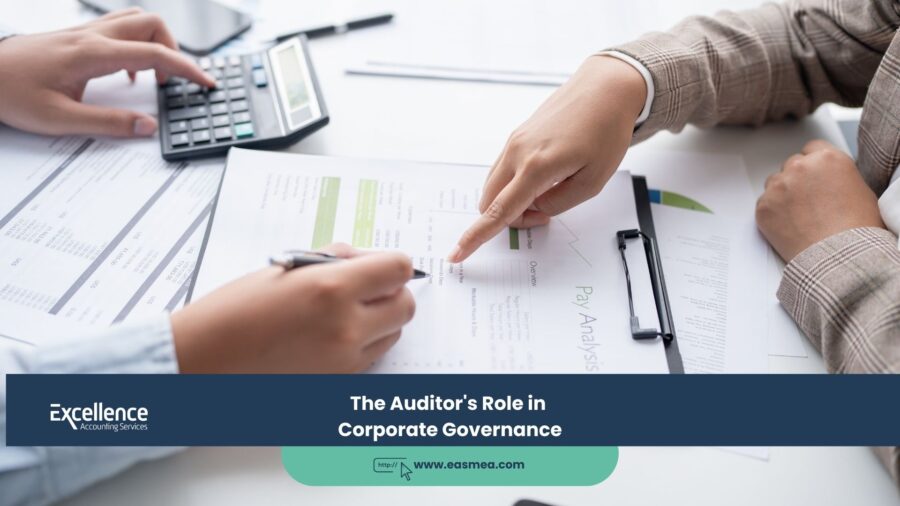
The Guardians of Trust: The Auditor’s Critical Role in Corporate Governance
In the complex machinery of modern business, “Corporate Governance” is the framework of rules, relationships, and processes by which a company is directed and controlled. It is the system that balances the interests of a company’s many stakeholders: shareholders, management, customers, suppliers, financiers, government, and the community. But a system of rules is only as good as the mechanism that enforces it. Without verification, rules are merely suggestions.
- The Guardians of Trust: The Auditor's Critical Role in Corporate Governance
- The Corporate Governance Ecosystem: Where Does the Auditor Fit?
- The Two Guardians: Internal Audit vs. External Audit
- The Audit Committee: The Critical Bridge
- The Auditor's Role in Risk Management (The New Frontier)
- The UAE Context: Governance in a Family Business & SME Environment
- Beyond Compliance: The Auditor as a Strategic Advisor
- How Excellence Accounting Services (EAS) Strengthens Your Governance
- Frequently Asked Questions (FAQs) on Audit & Governance
- Build a Governance Structure That Drives Value.
This is where the auditor enters the stage. Whether internal or external, the auditor is the linchpin of corporate governance. They are the independent eyes and ears of the shareholders and the board. They are the guardians of financial integrity, the detectors of risk, and the validators of truth. In a global market plagued by uncertainty and skepticism, the auditor’s signature is the seal of trust that allows capital to flow, contracts to be signed, and economies to function.
For business leaders in the UAE, where the corporate landscape is maturing rapidly with new regulations like Corporate Tax and stricter compliance standards, understanding the auditor’s role is no longer just for public companies. It is essential for any family business, SME, or subsidiary that aspires to longevity and growth. This comprehensive guide explores the dual roles of internal and external audit, their relationship with the board, and how they serve as the backbone of effective governance.
Key Takeaways
- The Governance Triad: Effective governance relies on three lines of defense: Management (Operational Control), Internal Audit (Risk Management), and External Audit (Independent Assurance).
- Internal vs. External: Internal auditors work *for* the company to improve operations and controls. External auditors work *for* the shareholders to verify financial statements. Both are vital.
- The Audit Committee is the Bridge: A strong Audit Committee acts as the crucial link between the auditors and the Board of Directors, ensuring independence and oversight.
- Risk is the New Focus: Modern auditing has moved beyond just “checking the math.” It is now heavily focused on identifying strategic, operational, and cyber risks.
- Trust is the Product: The ultimate output of the audit function is not a report; it is *trust*. Trust lowers the cost of capital and increases business valuation.
- UAE Context: With the new Corporate Tax law, the auditor’s role in verifying tax compliance and “substance” has become a critical governance function.
The Corporate Governance Ecosystem: Where Does the Auditor Fit?
To understand the auditor’s role, we must first visualize the ecosystem of a well-governed company. It is a system of checks and balances designed to prevent the “Agency Problem”—the risk that management (the agents) will act in their own self-interest rather than the interest of the owners (the principals).
- Shareholders (The Owners): They provide the capital but do not run the daily operations. They need assurance that their investment is safe.
- Board of Directors (The Stewards): Elected by shareholders to oversee management. They set the strategy and risk appetite.
- Management (The Operators): The CEO and C-suite who run the business. They are responsible for producing financial reports and maintaining internal controls.
- The Auditors (The Verifiers): The independent body that verifies the information provided by management to the board and shareholders.
Without the auditor, the chain of trust breaks. Shareholders would have to blindly trust management’s reports, which history (Enron, WorldCom, Wirecard) has proven to be a dangerous strategy.
The Two Guardians: Internal Audit vs. External Audit
While both use the word “audit,” these are two distinct functions with different objectives, reporting lines, and scopes. A strong governance framework requires both.
1. The External Auditor: The Independent Referee
Who they are: Independent firms (like EAS) hired by the shareholders (often via the Annual General Meeting).
Primary Goal: To express an opinion on whether the company’s financial statements are “true and fair” and free from material misstatement.
Reporting Line: They report to the Shareholders (via the Audit Committee/Board).
Key Governance Role:
- Financial Integrity: They validate the P&L and Balance Sheet, ensuring they comply with IFRS. This is the basis of investor trust.
- Compliance Check: They ensure the company is following laws, such as the UAE Commercial Companies Law and Corporate Tax regulations.
- Fraud Detection: While not their primary job, their rigorous testing acts as a powerful deterrent and detection mechanism for financial fraud.
The external audit is the “seal of approval” that allows a company to borrow from banks or attract investors. (Link to External Audit Services).
2. The Internal Auditor: The Strategic Consultant
Who they are: Employees of the company or outsourced partners (like EAS) who work within the organization.
Primary Goal: To evaluate and improve the effectiveness of risk management, control, and governance processes.
Reporting Line: They report functionally to the Audit Committee (to ensure independence) and administratively to the CEO.
Key Governance Role:
- Process Improvement: They don’t just look at numbers; they look at operations. “Is our procurement process efficient? Are we wasting money?”
- Risk Management: They help management identify risks (Cybersecurity, Supply Chain, Reputational) and test if the controls to mitigate them are working.
- Control Monitoring: They are the “eyes and ears” of the Audit Committee, constantly testing internal controls (e.g., segregation of duties).
The internal auditor helps the company *get better*, while the external auditor checks if the score is *correct*. (Link to Internal Audit Services).
The Audit Committee: The Critical Bridge
In best-practice governance, auditors do not report directly to the CEO or CFO (whom they are auditing). They report to the **Audit Committee**.
The Audit Committee is a sub-committee of the Board of Directors, typically comprised of independent, non-executive directors with financial expertise. Their role is pivotal:
- Selection: They recommend the appointment of the external auditor and negotiate their fees.
- Oversight: They review the audit plan and the final audit report. They ask the tough questions that management might want to avoid.
- Protection: They protect the independence of the Internal Audit function, ensuring they have the budget and authority to investigate any area of the business.
- Resolution: If there is a disagreement between the auditor and management (e.g., on revenue recognition), the Audit Committee is the final arbiter.
The Auditor’s Role in Risk Management (The New Frontier)
Governance is fundamentally about managing risk. In the past, auditors focused heavily on financial reporting risk. Today, their scope has expanded to the broader enterprise risk landscape.
1. Financial Risk
The classic domain. Auditors assess the risk of material misstatement. * Are assets overstated? (Link to Valuation). * Are liabilities hidden? (e.g., off-balance-sheet financing). * Is the company a “going concern” (can it survive the next 12 months)?
2. Operational Risk
Internal auditors focus heavily here. * Supply Chain: What happens if our main supplier goes bankrupt? Do we have a backup? * IT & Cyber: Are our financial systems secure? Is our data backed up? A modern audit involves IT specialists. * Fraud: Are there gaps in our Accounts Payable process that allow for fake invoices?
3. Compliance & Regulatory Risk
In the UAE, this is the fastest-growing area of risk. * VAT & Tax: The auditor reviews the tax computations to ensure the company is not exposing itself to massive fines from the FTA. (Link to VAT Services). * AML (Anti-Money Laundering): For designated sectors (like real estate or gold), auditors check compliance with strict AML laws.
The UAE Context: Governance in a Family Business & SME Environment
The UAE economy is dominated by family conglomerates and SMEs. Historically, “governance” was seen as something only for public companies. This is changing.
The Family Business Challenge
In a family business, the roles of Shareholder, Board, and Management are often blurred (the father is the Owner, Chairman, and CEO). This creates a governance risk.
The Auditor’s Role: * Separation: The auditor helps separate “family money” from “business money.” * Succession: By formalizing financials and controls, the auditor builds a structure that can survive the founder, enabling smoother succession planning. * Conflict Resolution: An independent audit provides an objective “source of truth” that can resolve disputes between family members about the company’s performance.
The SME Challenge
SMEs often view audits as an unnecessary cost. However, with the introduction of Corporate Tax, even SMEs are subject to rigorous record-keeping requirements.
The Auditor’s Role: * Capacity Building: The auditor often acts as a guide, helping the SME upgrade from Excel to proper systems like Zoho Books. * Creditworthiness: An audited financial statement is the only way an SME can secure a bank loan at a reasonable rate. (Link to Bookkeeping and Loans).
Beyond Compliance: The Auditor as a Strategic Advisor
The best auditors do more than just “tick the box.” They provide “Management Letters” or “Internal Control Memos” that offer immense strategic value.
- Benchmarking: “We noticed your gross margins are 5% lower than the industry average. Here is where you are leaking profit.”
- Efficiency: “Your Cash Conversion Cycle is 90 days, but it could be 60 if you automate your invoicing.”
- Tax Strategy: “You are not taking advantage of the Small Business Relief or Free Zone exemptions you are entitled to.”
This moves the audit from a “cost center” to a “value driver.”
How Excellence Accounting Services (EAS) Strengthens Your Governance
Governance is a journey, not a destination. EAS provides the full spectrum of audit and assurance services to support your board and management.
- External Audit: We provide independent, rigorous, and value-added audits that satisfy banks, regulators, and shareholders.
- Internal Audit & Risk Advisory: We act as your outsourced internal audit function, designing controls, testing risks, and reporting directly to your Audit Committee.
- Pre-Audit Health Check: We clean up your books and prepare your schedules *before* the statutory audit, ensuring a smooth and penalty-free process.
- Governance Advisory (CFO Services): Our outsourced CFOs help you establish an Audit Committee, design your board reporting pack, and build a world-class governance structure.
- Due Diligence: We perform the deep-dive audits required for M&A, protecting you from bad investments.
Frequently Asked Questions (FAQs) on Audit & Governance
Independence is the auditor’s superpower. If an auditor is friends with the CEO, or owns shares in the company, their opinion is worthless because they have a conflict of interest. Investors rely on the auditor being an unbiased third party who will speak the truth, even if it’s bad news. This is why audit firms cannot also do the bookkeeping for their audit clients.
An **Audit** provides “reasonable assurance” (high level). It involves testing evidence, confirming balances with banks, and inspecting physical assets. A **Review** provides “limited assurance” (moderate level). It involves mostly inquiry and analytical procedures. An audit is much more rigorous and is usually required for banking and licensing.
No. An audit is designed to provide *reasonable* assurance that financial statements are free from *material* misstatement, whether caused by fraud or error. It is not a guarantee. However, a robust audit acts as a powerful deterrent, and auditors are trained to look for specific “fraud risk factors.”
The auditor verifies the “Accounting Net Profit,” which is the starting point for the tax calculation. They check if expenses are valid and if revenue is recognized correctly under IFRS. A clean audit report reduces the risk of the FTA challenging your tax return during a tax audit.
Best practice corporate governance (and law for public companies) suggests rotating the audit *partner* every 5 years, and considering rotating the audit *firm* every 7-10 years. This prevents the auditor from becoming too “cozy” with management and ensures a fresh pair of eyes on the books.
Management Override is when a senior executive forces an accounting entry to bypass controls (e.g., “Book this revenue now even though we haven’t shipped it”). This is a common way financial statement fraud happens. Auditors specifically test manual journal entries at period-end to catch this.
They don’t *need* one legally, but they *should* have one for survival. A “Board of Advisors” or a simple Audit Committee introduces accountability. It forces the family to treat the business as a separate entity, which is crucial for resolving disputes and ensuring the business survives to the next generation.
Yes, and for most SMEs, you *should*. Building a full in-house internal audit team is expensive. Outsourcing to a firm like EAS gives you access to a team of specialists (IT auditors, tax auditors, fraud experts) for a fraction of the cost, and ensures total independence from management.
It’s a deficiency in your processes so severe that there is a reasonable possibility a material error in your financial statements will not be prevented or detected. If an auditor finds this, they must report it to the Audit Committee. It’s a red flashing light that your governance is failing.
It reduces risk for the lender. If a bank has to guess if your numbers are real, they charge you 15% interest to cover their risk. If a reputable auditor certifies your numbers are real, the bank’s risk drops, and they might lend to you at 7%. The savings on interest often pay for the audit fee many times over.
Conclusion: The Currency of Trust
In the end, Corporate Governance is not about ticking boxes or filling out forms. It is about building a sustainable institution that deserves the trust of its stakeholders. The auditor is the custodian of that trust.
By embracing the audit function—not as a cost, but as a strategic asset—UAE business leaders can build companies that are resilient, transparent, and investable. In a world where reputation can be destroyed in seconds, the assurance provided by a rigorous, independent audit is the most valuable insurance policy a board can buy.