

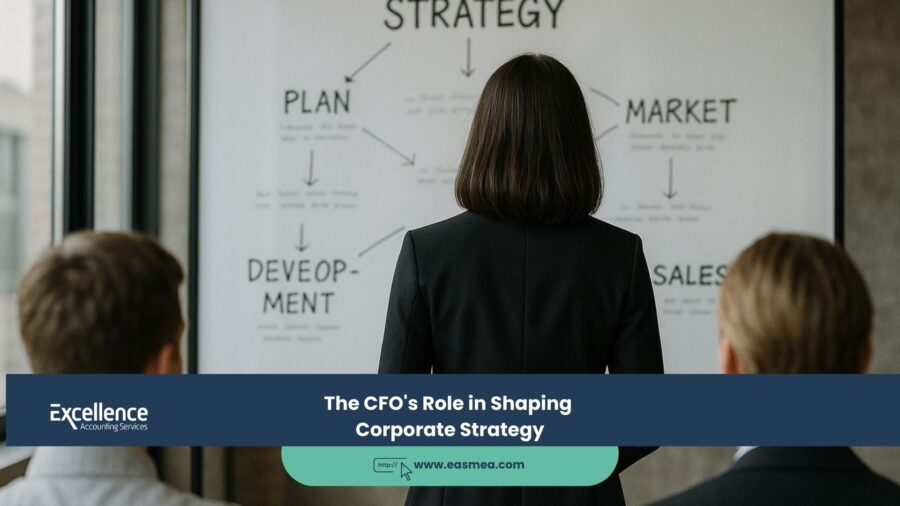
From Scorekeeper to Architect: The CFO’s Role in Shaping Corporate Strategy
There was a time when the Chief Financial Officer (CFO) was the “Chief Accountant.” Their world was defined by the rearview mirror: closing the books, reporting history, ensuring compliance, and saying “no” to spending requests. They were the guardians of the assets, the scorekeepers of the business. While these responsibilities remain foundational, the role has undergone a seismic shift.
- From Scorekeeper to Architect: The CFO's Role in Shaping Corporate Strategy
- The Evolution: Three Personas of the Modern CFO
- Pillar 1: Capital Allocation – The Ultimate Strategic Lever
- Pillar 2: Predictive Analysis – Seeing Around Corners
- Pillar 3: Risk Management as a Competitive Advantage
- Pillar 4: Performance Management – The "Source of Truth"
- The UAE Context: Why Strategy Needs a Local Compass
- How Excellence Accounting Services (EAS) Delivers Strategic Finance
- Frequently Asked Questions (FAQs) on the Strategic CFO
- Do You Have a Scorekeeper or an Architect?
In today’s volatile, complex, and data-rich business environment, the CFO has emerged as the most critical strategic partner to the CEO. They are no longer just reporting the news; they are making the news. The modern CFO is the “Architect” of corporate value—the executive who sits at the intersection of strategy, operations, and finance, uniquely positioned to see the whole picture and direct capital to where it will generate the highest return.
For businesses in the UAE, navigating a landscape of new taxes, global competition, and rapid digitalization, this evolution is not a luxury; it is a necessity. A company led by a CEO with a vision and a CFO with a spreadsheet is good; a company led by a CEO and a CFO who co-author the strategy is unstoppable. This guide explores the strategic mandate of the modern CFO, detailing how they shape vision into value.
[Image of a chess board with financial figures as pieces, symbolizing strategic finance]
Key Takeaways
- The Shift from Guardian to Catalyst: The modern CFO spends less time on transaction processing and more time on strategic analysis, acting as a catalyst for change across the organization.
- Capital Allocation is Strategy: The most important strategic decision a company makes is where to put its money. The CFO is the ultimate arbiter of this process.
- Data is the Strategic Asset: The CFO owns the “single source of truth.” Their ability to use predictive analytics to model the future is what gives the company its competitive edge.
- Risk is a Strategic Variable: The CFO doesn’t just avoid risk; they manage it strategically, balancing the cost of mitigation against the potential for reward.
- Alignment is Key: The CFO links the company’s high-level strategy to its daily operations through budgeting, KPIs, and performance management.
The Evolution: Three Personas of the Modern CFO
To understand the strategic role, we must look at the three “personas” a modern CFO must balance. The “Traditional CFO” only played the first role. The “Strategic CFO” plays all three.
1. The Guardian (The Foundation)
This is the table stakes. The CFO must ensure the books are accurate, the assets are safe, and the company is compliant. Without this trust, strategy is impossible.
Key Tasks: Financial reporting, internal controls, tax compliance, and cash management.
2. The Architect (The Builder)
This is the strategic designer. The CFO works with the CEO to design the business model, the capital structure, and the growth path. They ask: “How do we structure this company to maximize long-term value?”
Key Tasks: M&A strategy, capital allocation, business modeling, and strategic planning.
3. The Catalyst (The Driver)
This is the change agent. The CFO uses financial data to challenge the status quo, drive efficiency in operations, and push the sales team to improve margins. They ask: “How can we do this better, faster, and more profitably?”
Key Tasks: Performance management, team alignment, and digital transformation.
Pillar 1: Capital Allocation – The Ultimate Strategic Lever
Strategy, at its core, is the decision of how to allocate limited resources to achieve unlimited ambitions. The CFO is the master of this allocation.
Every dirham of cash generated by the business has five potential homes. The CFO’s job is to decide which home generates the highest Risk-Adjusted Return on Invested Capital (ROIC):
- Organic Growth (R&D, Marketing): Investing in new products or markets. The CFO uses feasibility studies to determine if a new product launch is a viable bet.
- Inorganic Growth (M&A): Buying competitors or capabilities. The CFO leads the due diligence and valuation to ensure the company doesn’t overpay and destroy value.
- Balance Sheet Optimization: Paying down debt to reduce risk and interest costs, or refinancing to free up cash.
- Returns to Shareholders: Paying dividends or buying back shares. The CFO calculates if the cash is better in the shareholders’ hands or reinvested in the company.
- Building a War Chest: Holding cash reserves to weather a downturn or seize a sudden opportunity.
Strategic Impact: A CEO might say “We want to grow.” A Strategic CFO says, “We should grow by acquiring Competitor X because our organic CAC is too high, and we can finance it with cheap debt, increasing our ROIC by 4%.” That is strategy.
Pillar 2: Predictive Analysis – Seeing Around Corners
The traditional finance function is reactive. It tells you what happened last month. The strategic finance function is predictive. It tells you what is likely to happen next year.
The CFO uses financial forecasting and scenario modeling to “stress test” the strategy before it’s executed.
- Scenario Planning: “What happens to our cash flow if sales drop 20%?” “What if our biggest supplier raises prices by 15%?” The CFO builds these models so the CEO can sleep at night.
- Driver-Based Forecasting: Instead of guessing “revenue will grow 10%,” the CFO models the operational drivers (leads x conversion x price) to show *how* to achieve that growth.
- Customer Profitability Analysis: The CFO uses data to show that while “Client A” brings in huge revenue, they consume so many resources that they are actually unprofitable. The strategy then shifts to re-pricing or dropping that client.
Strategic Impact: This moves the company from “gut feel” decisions to data-driven certainty. It allows the company to pivot *before* a crisis hits.
Pillar 3: Risk Management as a Competitive Advantage
In a global market, risk is unavoidable. The Strategic CFO doesn’t just try to eliminate risk (which eliminates return); they try to *optimize* it.
This involves managing financial risks like currency fluctuations and interest rates, but it goes deeper.
- Strategic Risk: “Is our business model becoming obsolete?” The CFO analyzes trends to spot existential threats.
- Compliance Risk: In the UAE, this is huge. The CFO ensures the UAE Corporate Tax strategy is compliant but efficient, preventing penalties that could derail the strategy.
- Operational Risk: “Do we have too much cash tied up in inventory?” The CFO drives internal audits to fix process leaks.
Strategic Impact: By hedging currency or securing credit lines *before* they are needed, the CFO creates stability. This stability gives the CEO the confidence to make bold, long-term strategic moves while competitors are paralyzed by volatility.
Pillar 4: Performance Management – The “Source of Truth”
A strategy is only as good as its execution. The CFO is the scorekeeper of execution.
The CFO translates the high-level strategy into specific, measurable KPIs for every department. They create the “dashboard” that tells the company if it is winning or losing. (See Building a Financial Dashboard).
- Aligning Incentives: The CFO ensures that the sales team’s commission plan drives *profit*, not just revenue. They ensure the operations manager’s bonus is tied to *efficiency*, not just output.
- Variance Analysis: The CFO leads the monthly review, not to assign blame, but to find the “why.” “We missed the target. Was it the market, or was it our execution?” (See Variance Analysis).
Strategic Impact: This creates a culture of accountability. The strategy doesn’t just live in a PowerPoint deck; it lives in the daily metrics that drive the team’s behavior.
The UAE Context: Why Strategy Needs a Local Compass
For a CFO in the UAE, the strategic landscape has specific nuances.
- The Tax Revolution: With the introduction of Corporate Tax, tax planning is now a core strategic pillar. Decisions on holding structures, transfer pricing, and free zone vs. mainland operations have massive value implications.
- Global Hub Status: UAE companies often trade globally. Managing multi-currency risk and cross-border cash flow is a daily strategic necessity.
- Digitization Agenda: The UAE government is pushing for digital transformation (e.g., e-invoicing). The CFO must lead the accounting system implementation to ensure the company is future-ready.
How Excellence Accounting Services (EAS) Delivers Strategic Finance
Many SMEs cannot afford a full-time, strategic CFO (who commands a high salary). This creates a “strategy gap.” EAS fills this gap with our Outsourced CFO services.
- Outsourced CFO Services: We provide the high-level strategic partnership—capital allocation, modeling, risk management—on a fractional basis. You get the expertise without the full-time cost.
- Strategic Financial Analysis: We dig deep into your data to find the hidden drivers of value and profitability.
- Valuation & Feasibility: We provide the math behind your biggest decisions, whether it’s a new project launch or an acquisition.
- The Foundation: We ensure the “Guardian” role is perfect. Our bookkeeping teams ensure your data is pristine so your strategy is built on rock, not sand.
- Business Consultancy: We work with you to define the long-term vision and build the financial roadmap to get there.
Frequently Asked Questions (FAQs) on the Strategic CFO
A **Controller** looks backward. They ensure the books are accurate, taxes are filed, and controls are in place. They are the “Guardian.” A **CFO** looks forward. They use the Controller’s data to plan the future, raise capital, and drive strategy. Many SMEs have a Controller but lack a CFO, leaving them without strategic financial leadership.
Usually when it reaches a certain complexity, not just revenue. You need one when: * You are planning to raise capital or debt. * You are considering an acquisition or major expansion. * Your growth has stalled, and you don’t know why. * You have cash flow issues despite being profitable. * You are preparing for an exit/sale.
By bringing data to the discussion. A CFO calculates the Customer Lifetime Value (LTV) and Customer Acquisition Cost (CAC). They tell Marketing: “You can spend up to AED 500 to acquire a customer and still be profitable.” They tell Sales: “Stop discounting Product A; it destroys our margin. Focus on Product B.” This aligns the commercial teams with financial reality.
Yes, because financial strategy is driven by data patterns that are universal. An experienced outsourced CFO has seen these patterns across dozens of industries. They bring an objective, outside perspective that an internal employee often lacks. They can ask the “tough questions” about your strategy that others might avoid.
By enforcing accountability. When the CFO sets clear budgets and holds managers accountable for variances, it creates a culture of discipline. When the CFO demands ROI analysis for every spend, it creates a culture of efficiency. Financial discipline inevitably seeps into operational culture.
It’s deciding what to do with the money in the bank. Should we: A) Hire 5 more salespeople? B) Buy a new machine? C) Pay off our loan? D) Take the profit out as a dividend? The CFO calculates which of these options will make the company worth the most in 5 years. That is capital allocation.
It adds a new layer of complexity to every decision. “Where should we locate this new division—Free Zone or Mainland?” “How do we price services between our entities (Transfer Pricing)?” “Should we lease or buy this asset?” Every strategic move now has a tax consequence that the CFO must model and optimize.
Absolutely. The CFO is the key player in an exit. They prepare the business for sale by cleaning up the financials (Guardian), increasing the valuation by improving margins (Catalyst), and leading the due diligence process with the buyer (Architect). A strong CFO can add millions to the final sale price.
Look beyond accounting certifications (CPA/ACCA are a given). Look for: * **Communication:** Can they tell a story with data? * **Curiosity:** Do they ask “why” about the operations? * **Courage:** Will they challenge the CEO when the numbers don’t add up? * **Tech-Savviness:** Do they understand automation and data analytics?
They build a cash flow forecast. Before they can talk about 5-year strategy, they must ensure the company can survive the next 13 weeks. Once survival is assured (Guardian), they move to diagnosing profitability (Catalyst), and then to planning growth (Architect).
Conclusion: The Partnership That Defines Success
In the modern business landscape, the distance between the CEO and the CFO has closed. They are now the dynamic duo of corporate leadership. The CEO provides the vision; the CFO provides the roadmap. The CEO steps on the gas; the CFO ensures there is fuel in the tank and the engine doesn’t overheat.
By embracing the role of the Strategic CFO—moving from scorekeeper to architect—businesses can transform their finance function from a cost center into a value engine. In the competitive, evolving market of the UAE, this strategic partnership is the ultimate competitive advantage.