

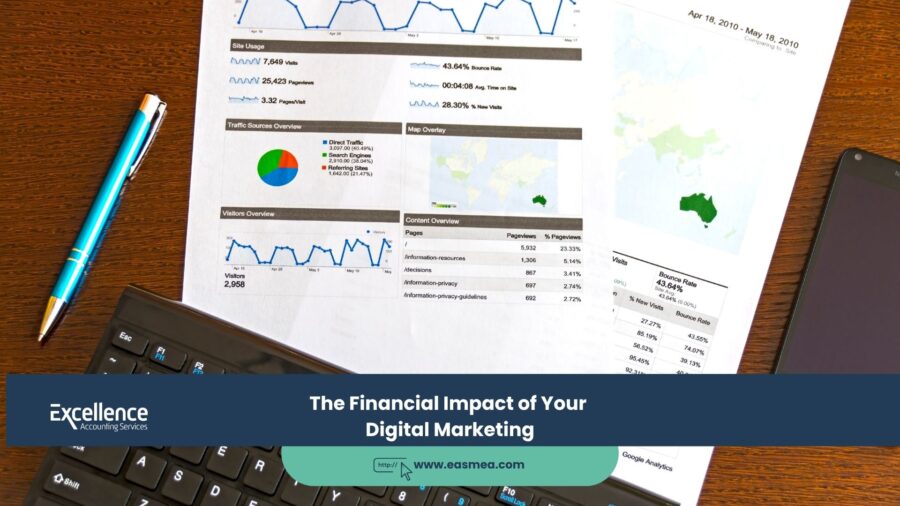
The Financial Impact of Your Digital Marketing: A UAE Guide to True ROI
Digital marketing is no longer an optional extra for businesses in the UAE; it’s a fundamental driver of growth and customer engagement. Companies are investing significant sums in Google Ads, Meta campaigns, SEO, content marketing, and more. Marketing teams diligently track a plethora of metrics—clicks, impressions, website traffic, conversion rates, social media engagement. Dashboards are filled with data. But for the CFO, the CEO, and the board, a critical question often remains unanswered: What is the *actual financial impact* of all this activity?
- The Financial Impact of Your Digital Marketing: A UAE Guide to True ROI
- Part 1: Moving Beyond Vanity Metrics - The Finance Perspective
- Part 2: Calculating the True Customer Acquisition Cost (CAC)
- Part 3: Calculating Customer Lifetime Value (LTV) - The Profit Perspective
- Part 4: The ROI Metrics - Connecting Cost and Value
- Part 5: The Attribution Challenge - Connecting Marketing to Revenue
- Part 6: Bridging the Data Gap - Integrating Systems
- EAS: Connecting Marketing Spend to Financial Results
- Frequently Asked Questions (FAQs) on Digital Marketing ROI
- Are You Measuring the True Financial Impact of Your Marketing?
Too often, marketing performance is discussed in isolation, using “vanity metrics” that don’t directly translate to the bottom line. While clicks and likes might indicate activity, they don’t pay the bills. A truly strategic approach requires bridging the gap between marketing data and financial outcomes. It means understanding the real Return on Investment (ROI) of your marketing spend, calculating the true cost to acquire a customer (CAC), knowing the long-term value that customer brings (LTV), and understanding how marketing contributes to overall profitability and cash flow. This guide provides a comprehensive framework for UAE businesses to move beyond surface-level marketing metrics and measure the tangible financial impact of their digital efforts, enabling smarter investment decisions and driving sustainable growth.
Key Takeaways on Digital Marketing’s Financial Impact
- Beyond Vanity Metrics: Clicks, likes, and traffic are indicators, not results. Focus on metrics that link directly to financial outcomes (CAC, LTV, ROI).
- Calculate Fully-Loaded CAC: Understand the true cost to acquire a customer, including ad spend, salaries, tools, and overheads.
- Focus on LTV (Gross Profit): Measure the lifetime *gross profit* a customer generates, considering churn and gross margin, not just revenue.
- ROI is the Ultimate Test: Marketing spend is an investment. Calculate the Return on Investment to determine if your campaigns are truly profitable.
- Attribution is Key (But Complex): Understand how different marketing touchpoints contribute to a conversion to allocate budget effectively.
- Integrate Your Data: Connect marketing platforms, CRM, and accounting systems for a holistic view of the customer journey and its financial impact.
- Don’t Forget Tax: Account for VAT on online advertising (via RCM) and the impact of marketing spend on your Corporate Tax liability.
Part 1: Moving Beyond Vanity Metrics – The Finance Perspective
Marketing dashboards are often filled with metrics that demonstrate activity but not necessarily impact. While these can be useful leading indicators, they don’t tell the full financial story.
Common Vanity Metrics and Their Limitations:
- Impressions/Reach: How many people saw your ad. (Doesn’t mean they noticed or cared).
- Clicks/Website Traffic: How many people visited your site. (Doesn’t mean they were qualified leads or bought anything).
- Likes/Shares/Followers: Social media engagement. (Often has a weak correlation with actual sales).
- Conversion Rate (Leads): Percentage of visitors who become a lead (e.g., fill out a form). (Doesn’t tell you if those leads ever become paying customers).
Metrics That Matter to Finance:
The finance department and senior leadership are focused on metrics that directly impact the company’s financial health:
- Customer Acquisition Cost (CAC): What did it cost us to get this customer?
- Customer Lifetime Value (LTV): How much profit will this customer generate over time?
- LTV:CAC Ratio: Is the customer worth more than they cost to acquire? (See our guide on Unit Economics).
- Marketing ROI / ROAS (Return on Ad Spend): For every dirham spent on marketing, how many dirhams of profit (or revenue) did we generate?
- CAC Payback Period: How many months does it take for a customer’s gross profit to pay back the cost of acquiring them?
- Marketing % of Revenue: What percentage of our total revenue are we investing in marketing?
The goal of this guide is to bridge the gap and show how to calculate and interpret these financially relevant metrics.
Part 2: Calculating the True Customer Acquisition Cost (CAC)
Understanding your CAC is the starting point for evaluating marketing effectiveness. It requires capturing *all* relevant costs.
Formula: CAC = Total Sales & Marketing Expenses / Number of New Customers Acquired (in a specific period)
Essential Components of “Total Sales & Marketing Expenses”:
- Direct Ad Spend: Costs from Google Ads, Meta, LinkedIn, TikTok, etc.
- Marketing & Sales Salaries/Commissions: Fully-loaded costs including benefits for everyone involved in acquisition.
- Technology Costs: CRM software, marketing automation platforms, analytics tools, SEO tools.
- Content & Creative Costs: Agency fees, freelance writers/designers, video production.
- Overheads Allocation: A reasonable portion of shared costs like office rent attributable to the S&M teams.
Accurate expense tracking and categorization in your accounting and bookkeeping system are crucial for this calculation.
Example: CAC Calculation
An e-commerce business spends AED 50,000 on Meta ads, AED 30,000 on Google Ads, AED 40,000 on marketing salaries, and AED 10,000 on marketing software in a month. Total S&M = AED 130,000. They acquire 1,000 new customers.
CAC = AED 130,000 / 1,000 = AED 130 per customer.
Part 3: Calculating Customer Lifetime Value (LTV) – The Profit Perspective
LTV predicts the total value your business will derive from a customer relationship. Critically, it should be based on *gross profit*, not just revenue, to be meaningful for ROI calculations.
Simple LTV Formula (for Subscription Models):
LTV = (Average Revenue Per Account (ARPA) x Gross Margin %) / Customer Churn Rate
LTV Formula (for E-commerce/Non-Subscription):
LTV = (Average Order Value x Gross Margin %) x Purchase Frequency x Average Customer Lifespan
Key Inputs Explained:
- ARPA / Average Order Value: Average revenue per customer per period/transaction.
- Gross Margin %: (Revenue – Cost of Goods Sold) / Revenue. Represents the profitability of each sale before overheads.
- Churn Rate (Subscription): % of customers lost per period.
- Purchase Frequency (E-commerce): Average number of times a customer buys per period (e.g., per year).
- Average Customer Lifespan (E-commerce): Average duration (in years) a customer remains active. This often requires cohort analysis.
Example: LTV Calculation (E-commerce)
Average Order Value = AED 250
Gross Margin = 40%
Purchase Frequency = 3 times per year
Average Customer Lifespan = 2 years
LTV = (AED 250 x 40%) x 3 x 2 = AED 100 x 3 x 2 = AED 600.
Each customer generates an average of AED 600 in gross profit over their lifetime.
Part 4: The ROI Metrics – Connecting Cost and Value
With CAC and LTV calculated, you can now assess the financial viability and efficiency of your marketing efforts.
1. LTV:CAC Ratio
Compares the lifetime value of a customer to the cost of acquiring them.
Formula: LTV / CAC
Interpretation (using examples above): AED 600 (LTV) / AED 130 (CAC) = 4.6:1. This is generally considered a very healthy ratio, indicating strong marketing ROI.
- < 1:1 = Losing Money: Unsustainable.
- 1:1 = Breaking Even: No profit left for overheads.
- 3:1 = Healthy Target: Generally considered a good benchmark.
- > 5:1 = Potentially Underinvesting: You might be leaving growth on the table.
2. Marketing ROI
Measures the overall return on your marketing investment.
Formula: ((Gross Profit Attributable to Marketing – Marketing Spend) / Marketing Spend) * 100
This requires attributing gross profit back to specific marketing campaigns, which can be challenging (see Part 5).
3. CAC Payback Period
Measures how long it takes (in months) for a customer’s gross profit contribution to “pay back” the cost of acquiring them.
Formula: CAC / (Average Monthly Gross Profit Per Customer)
Interpretation: A shorter payback period means faster return of capital and lower financing needs. For SaaS businesses, investors often look for a payback period under 12 months.
Part 5: The Attribution Challenge – Connecting Marketing to Revenue
Calculating overall LTV and CAC is one thing; understanding *which* marketing channels and campaigns are driving the most profitable customers is another. This is the challenge of marketing attribution.
Customers often interact with multiple marketing touchpoints before converting (e.g., see a Facebook ad, click a Google search result, receive an email).
Common Attribution Models:
- First-Touch: Gives 100% credit to the first channel the customer interacted with. (Good for understanding awareness drivers).
- Last-Touch: Gives 100% credit to the last channel before conversion. (Simplest, but often undervalues upper-funnel activities).
- Linear: Distributes credit evenly across all touchpoints.
- Time Decay: Gives more credit to touchpoints closer to the conversion.
- Data-Driven (Algorithmic): Uses machine learning to assign credit based on statistical analysis (most accurate, but requires sophisticated tools).
Choosing the right attribution model significantly impacts how you perceive the ROI of different channels and influences your budget allocation decisions. There is no single “correct” model; the key is consistency and understanding the biases of the model you choose.
Part 6: Bridging the Data Gap – Integrating Systems
Accurate financial impact analysis requires connecting data silos. Your marketing data (from Google Analytics, ad platforms) needs to talk to your sales data (CRM) and your financial data (accounting system).
The Ideal Data Flow:
- Marketing platforms track clicks, costs, and conversions (leads/sales).
- This data flows into your CRM, linking marketing campaigns to specific leads and deals.
- Once a deal closes, the CRM updates, and this sales data flows into your accounting system (like Zoho Books), generating an invoice and recording revenue.
- Your accounting system tracks the actual cash received and the cost of goods sold associated with that sale.
Connecting these systems allows you to trace the journey from initial marketing spend to eventual gross profit, enabling true ROI calculation. This integration is a key component of a modern accounting system implementation.
Don’t Forget the Tax Impact:
Remember that your spending on international ad platforms like Google and Meta is subject to VAT via the Reverse Charge Mechanism. This needs to be correctly accounted for in your VAT returns. Furthermore, your total marketing spend is a deductible expense for Corporate Tax purposes, reducing your overall tax liability. Accurate tracking is essential for compliance.
EAS: Connecting Marketing Spend to Financial Results
Translating marketing activity into financial impact requires expertise that bridges both worlds. Excellence Accounting Services (EAS) provides the financial rigor needed to measure and optimize your marketing ROI.
- Strategic CFO Services: Our CFOs work with your marketing team to define relevant financial KPIs, build ROI models, and ensure marketing investments align with overall business strategy.
- Accurate Data Foundation: We ensure your accounting system is set up correctly to capture marketing costs and revenue accurately, providing the data needed for LTV, CAC, and ROI calculations.
- System Integration Support: We assist with integrating your marketing, sales, and finance systems (like Zoho Books) to create a seamless data flow for better analysis.
- Tax Compliance for Marketing: Our tax experts ensure you correctly handle VAT on digital advertising and maximize the deductibility of marketing expenses for Corporate Tax.
- Business Consultancy: We provide data-driven business consultancy to help you interpret your marketing ROI data and make smarter budget allocation decisions.
Frequently Asked Questions (FAQs) on Digital Marketing ROI
It varies hugely by industry, business model, and stage of growth. A common benchmark for e-commerce is aiming for a 4:1 or 5:1 ROAS (Return on Ad Spend – Revenue/Ad Spend). However, the ultimate measure is whether your LTV:CAC ratio is healthy (ideally 3:1 or higher).
It depends on your sales cycle. For an e-commerce impulse buy, you might see results quickly. For a B2B sale with a 6-month sales cycle, you need to track ROI over a much longer period. This is why LTV is a more important metric than immediate ROAS for many businesses.
Not necessarily, *if* your LTV is significantly higher. Many successful subscription or high-repeat-purchase businesses intentionally lose money on the first sale, knowing they will make it back (and more) over the customer’s lifetime. This only works if you understand your LTV and churn rate accurately.
This requires “omnichannel” tracking. Methods include using unique promo codes in online ads, asking customers “How did you hear about us?” at the point of sale, or using call tracking software with unique numbers for online campaigns. It’s challenging but crucial.
Yes, for a fully-loaded CAC, you should allocate the costs of content creation if that content is primarily used for customer acquisition. However, some content might be more for retention or brand building, blurring the lines.
Organic traffic often has a very high ROI because the direct cost per visit is low (though the investment in SEO can be significant). You can calculate a “blended” CAC (all S&M costs / all new customers) and a “paid” CAC (paid media costs / customers from paid media) to understand the impact of different channels.
MMM is a statistical analysis technique used (often by larger companies) to determine how much different marketing inputs (TV ads, digital ads, promotions, etc.) contribute to overall sales, while accounting for external factors like seasonality and economic conditions. It’s a top-down approach to attribution.
You must account for the 5% VAT you self-assess via RCM as part of your marketing cost. However, if you are a fully taxable business, you can recover this VAT as input tax, so the net impact on your ROI calculation (which should ideally be based on pre-VAT costs and revenues) is zero. If you are partially exempt, the non-recoverable portion of the VAT becomes a real additional cost, reducing your ROI.
Establish shared goals focused on financial outcomes (not just marketing metrics). Ensure marketing understands the financial data they need (clean expense tracking). Ensure finance understands the marketing funnel and attribution models. Regular joint meetings to review performance against financial targets are key.
Start simple. Focus on getting one channel tracked accurately end-to-end. For example, ensure your Google Ads conversions are correctly linked through Analytics to your CRM/e-commerce platform, and that this revenue and the associated ad cost are clearly identifiable in your accounting system. Master one channel, then expand.
Conclusion: Marketing as a Profit Center, Not a Cost Center
Measuring the true financial impact of digital marketing transforms the function from a perceived cost center into a demonstrable profit driver. It shifts the conversation from subjective opinions about ad creative to objective discussions about ROI, CAC, and LTV. This requires discipline, the right systems, and a collaborative approach between marketing and finance. For UAE businesses investing in digital growth, mastering this financial lens is not just good practice—it is essential for allocating capital effectively, scaling sustainably, and building a truly valuable enterprise.