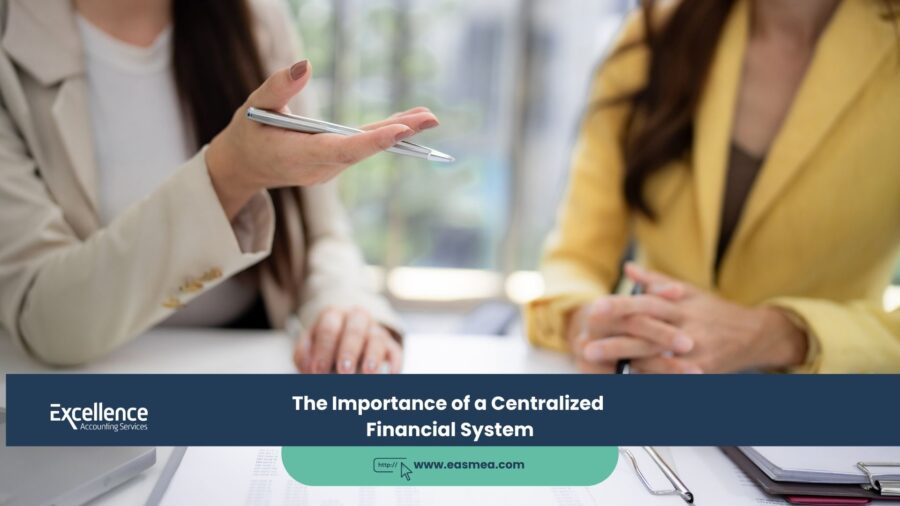
Beyond the Silos: The Strategic Imperative of a Centralized Financial System
In today’s hyper-competitive market, modern businesses are drowning in data. It flows in from CRM platforms, e-commerce sites, payroll portals, procurement software, and countless departmental spreadsheets. The single greatest risk facing a modern CFO is not a lack of information, but a lack of cohesion. When data lives in disconnected silos, the result is a chaotic and dangerous “spreadsheet spaghetti”—a tangled web of conflicting versions, manual reconciliations, and hidden errors.
- Beyond the Silos: The Strategic Imperative of a Centralized Financial System
- What is a Centralized Financial System (And What It Is Not)?
- The Compliance Imperative: Your First Line of Defense
- The Efficiency ROI: Slashing Costs and Empowering Teams
- The Strategic ROI: From Historical Reporter to Future Predictor
- What Excellence Accounting Services (EAS) Can Offer
- Frequently Asked Questions (FAQs) on Financial Centralization
- Ready to Move from Silos to Strategy?
This decentralized nightmare is more than an operational headache; it’s a profound strategic liability. It breeds inefficiency, as finance teams spend 80% of their time just finding and cleaning data instead of analyzing it. It creates unacceptable risks, with no clear audit trail or internal controls. And most critically, it makes agile, data-driven decision-making impossible. How can you forecast your cash flow if your sales data doesn’t talk to your expense data? How can you prove your tax position when your records are scattered across five different systems?
For businesses in the UAE, the stakes have been raised dramatically. The introduction of Corporate Tax and the ongoing scrutiny of VAT compliance demand a “Single Source of Truth” (SSOT). This article explores the critical importance of a centralized financial system, moving the conversation from a back-office “IT project” to a board-level strategic imperative. This is the blueprint for moving from financial chaos to financial clarity.
Key Takeaways
- A Single Source of Truth (SSOT) is the Goal: A centralized system ensures all financial decisions are based on one, undisputed set of data.
- Compliance is a Prerequisite: A centralized system with a clear audit trail is essential for meeting UAE Corporate Tax and VAT obligations and surviving an FTA audit.
- Massive Efficiency Gains: Centralization automates manual, error-prone tasks like data entry and reconciliation, slashing the time to close the books.
- Unlocks Strategic Insights: By integrating all financial data (sales, costs, payroll, cash), a centralized system provides real-time business intelligence for forecasting and decision-making.
- Reduces Risk: It dramatically reduces the risk of human error, data breaches, and internal fraud by enforcing consistent controls and permissions in one place.
What is a Centralized Financial System (And What It Is Not)?
A common misconception is that a “centralized financial system” simply means having one accounting software. While that is the core, the true concept is an *architecture* and a *philosophy* built around a Single Source of Truth.
A centralized system is NOT:
- Just a single piece of software.
- A complex system only affordable for multinationals.
- The finance team all sitting in one office.
- A static database.
A true centralized financial system IS:
- The Core: A robust General Ledger (GL) that acts as the master record. For most businesses in the UAE, this is a modern, cloud-based accounting platform like Zoho Books, which is scalable, secure, and accessible.
- The Integrations (APIs): A series of secure connections (APIs) that automatically feed data *into* the core.
- The Data Sources:
- Sales: CRM (e.g., Salesforce) or E-commerce (e.g., Shopify) data flows in to create invoices in Accounts Receivable.
- Procurement: Purchase orders from a procurement system flow in to create bills in Accounts Payable.
- Payroll: Approved payroll journals from a payroll system flow into the GL as expense entries.
- Banking: Live bank feeds automatically import transactions for reconciliation.
- The Output: A single, unified source for all financial reporting and Business Intelligence (BI) tools, allowing the CFO to see the full, real-time picture.
In contrast, a decentralized system relies on the finance team to manually export CSVs from all these sources, copy-paste them into Excel, perform VLOOKUPs, and *hope* the numbers match. The centralized model automates this entire process, ensuring data integrity from start to finish.
The Compliance Imperative: Your First Line of Defense
In the post-tax UAE, compliance is not optional. A centralized system is no longer a “nice to have”; it is a prerequisite for survival. The FTA operates on a “show me, don’t tell me” basis, and your audit trail is your only defense.
UAE Corporate Tax & VAT
When the FTA selects you for an FTA audit, they will ask you to substantiate the figures on your tax return.
- In a Decentralized System: You must hunt for a PO in a manager’s email, a scanned invoice on a shared drive, and a bank statement in a separate PDF file. The process is manual, slow, and leaves a high chance of missing documentation.
- In a Centralized System: The auditor can click on the expense line in the GL. That entry is digitally linked to the approved PO, the three-way-matched invoice, and the reconciled bank payment. The entire audit trail is available in seconds.
This is particularly crucial for high-scrutiny areas like UAE Corporate Tax, where you must prove expense deductibility, and for VAT return filing, where you must reconcile revenue from all sales channels.
Audit Trail and Internal Controls
A centralized system is the foundation of strong internal controls, which is the focus of any internal audit.
In a decentralized “Excel-based” system, controls are non-existent. Anyone can change a formula. There is no log of who altered a number. This is a high-risk environment for both accidental errors and deliberate fraud. A centralized, cloud-based system like Zoho Books has one user permission model. It creates an immutable log. You can control who can *create* a bill, who can *approve* a payment, and who can *reconcile* an account. This segregation of duties is impossible in a siloed environment and is a best-practice defense that will satisfy any external auditor, often reducing your audit fees and timeline.
The Efficiency ROI: Slashing Costs and Empowering Teams
For a CFO, the most immediate ROI of centralization is the dramatic reduction in “financial friction”—the wasted time, money, and human effort spent on manual, non-value-added tasks.
Automating the “Grunt Work”
The “cost” of a decentralized system is the payroll hours spent on tasks that a computer can do instantly:
- The Month-End Close: In a decentralized world, the close can take 15-20 days of painful manual reconciliation. In a centralized system, where transactions are reconciled daily, the close can be reduced to 3-5 days.
- Manual Data Entry: The risk of a finance professional re-typing an invoice number incorrectly is high. A centralized system uses automation (like OCR in Zoho) to read and enter bill data, eliminating human error.
- Bank Reconciliations: This task can take days. With live bank feeds, it becomes a 30-minute daily task of approving matches.
Empowering the Finance Team
When you automate the “grunt work,” you don’t just save money; you transform the role of your finance team. They are freed from being “data entry clerks” and empowered to become “data analysts.” Instead of spending weeks figuring out *what* happened last month, they can spend their time analyzing *why* it happened and *what* to do next. This is how a professional accounting and bookkeeping service adds strategic value.
Enabling Modern Work Models
The remote work trend (as discussed in our previous article on remote work ROI) is supported by centralized, cloud-based systems. A decentralized model often relies on physical paper, in-person approvals, and access to a local server, making it impossible to manage a distributed workforce effectively.
The Strategic ROI: From Historical Reporter to Future Predictor
The most profound impact of a centralized system is strategic. It changes the entire function of finance from a historical scorekeeper to a predictive, forward-looking partner to the CEO.
Real-Time, Trustworthy Data
When all data flows into one SSOT, the “CFO dashboard” becomes a powerful tool. At any moment, the leadership team can see:
- Real-time cash position.
- Sales-to-date vs. forecast.
- Departmental expenses vs. budget.
- Key performance indicators (KPIs) like Days Sales Outstanding (DSO) or Customer Acquisition Cost (CAC).
This “live” data allows for agile decision-making. You no longer have to wait 20 days after the month ends to find out you have a cash flow problem.
Predictive Forecasting and Modeling
This is the holy grail for a strategic CFO. When your CRM (sales pipeline) is integrated with your GL (costs), you can build a dynamic, predictive forecast. You can run scenarios in real-time:
- “What happens to our P&L and cash if we increase our marketing budget by 10%?”
- “What if 30% of our ‘pipeline’ deals are delayed by one month?”
In a decentralized, Excel-based model, these questions would take a week to answer. In a centralized system, they can be answered in a meeting. This level of foresight is the difference between surviving a market shift and leading it. It’s the same data-driven foundation required for a credible feasibility study or a high-stakes business valuation.
What Excellence Accounting Services (EAS) Can Offer
Moving from silos to a single source of truth is a complex but critical journey. At EAS, we are not just accountants; we are system architects who specialize in building robust, centralized financial environments for UAE businesses.
- Diagnosis and Strategy: Our accounting review and business consultancy services act as the diagnostic step. We map your current processes, identify data silos, and design a future-state architecture.
- System Implementation: We are certified partners and experts in accounting system implementation, with a special focus on powerful, scalable cloud platforms like Zoho Books.
- Data Migration & Clean-up: We manage the most painful part of the process—cleaning, validating, and migrating your historical data from old spreadsheets and systems.
- Outsourced Management: Our outsourced accounting and CFO services can run the entire centralized system for you, ensuring data integrity, world-class reporting, and full compliance.
- Compliance-First Build: We build every system with Corporate Tax and VAT compliance at its core, ensuring your audit trail is perfect from day one.
As certified Zoho Books partners, we believe it’s one of the best core platforms for UAE businesses. You can start your journey with a free trial.
Frequently Asked Questions (FAQs) on Financial Centralization
No, it’s actually *more* important for small businesses. “Excel” is the definition of a decentralized, high-risk system. A centralized system for an SME isn’t a complex ERP; it’s a modern, affordable, cloud-based platform like Zoho Books. It centralizes your invoicing, expenses, and bank feeds in one place, giving you the same power as a large corporation, right from the start.
An Enterprise Resource Planning (ERP) platform (like NetSuite or SAP) is one *type* of centralized system, often a very large, all-in-one solution. However, a “centralized system” can also be a “best-of-breed” model, where a core accounting platform (like Zoho) is integrated with other specialized apps (like a separate CRM or HR tool). The key is that all systems feed into the core GL, creating a single source of truth.
There are three: 1) **Data Migration:** Cleaning and importing your old, “dirty” data from spreadsheets is difficult. 2) **Employee Adoption:** You must train your team and, more importantly, break their old habits of “just using my own spreadsheet.” 3) **Process Re-engineering:** The new system will force you to improve your old, broken workflows. This change can be uncomfortable but is ultimately the entire point.
Through integration. The “Single Source of Truth” means the *master* data lives in one place. For example, the “Customer” record is mastered in Salesforce. When a deal is “Closed-Won,” the integration *automatically* creates that customer in Zoho and generates a draft invoice. Finance doesn’t re-type the data. This is a perfect example of a modern, centralized, best-of-breed system.
It massively improves it. A decentralized model (100s of critical spreadsheets on 100s of laptops) is a security nightmare. A centralized, cloud-based system reduces your attack surface to one. It’s managed by experts (like Zoho or Microsoft), has baked-in user permissions, two-factor authentication, and a full audit log of who touched what data, when.
No. The total cost is: 1) Software licenses (recurring opex), 2) Implementation & consulting fees (one-time project cost), and 3) Internal training time. However, the *cost of not* centralizing is far higher. It is the cost of fines from non-compliance, the cost of bad decisions made on bad data, and the cost of wasted payroll on manual data entry.
A centralized, auditable financial system can dramatically increase your business valuation. When a potential buyer begins due diligence, they will be able to verify your numbers with confidence. A messy, decentralized “shoebox” of Excel files is a massive red flag that screams “risk” and will lead to a lower offer, if not kill the deal entirely.
It integrates your HR and payroll systems. When an employee’s expense claim is approved in the HR portal, it flows to finance for payment and to the GL as an expense, all without re-typing. When payroll is run, the full journal entry (salaries, benefits, liabilities) posts to the GL automatically, giving you a real-time view of your largest expense.
You have centralized the *function*, which is the most important first step! You now have one expert team managing your books. The next step, which we can help with, is to centralize the *systems* that feed our team. This means implementing tools like automated bank feeds, Dext for invoice capture, and integrations with your sales platforms. This makes our work for you faster, more accurate, and more strategic.
A diagnostic review. You cannot build the new system until you understand the old one. The first step is to engage an expert (like EAS) for an accounting review. We will map your current data flows, identify all the silos and risks, and present a phased roadmap for centralization.
Conclusion: From Financial Silos to Strategic Advantage
A centralized financial system is no longer a luxury for large corporations. In the new economic landscape of the UAE, with its new tax regime, global competition, and remote workforces, it is the essential foundation for compliance, efficiency, and strategy. The “cost” of your current, decentralized system is not just in wasted time; it’s in the risks you are exposed to and the strategic opportunities you are missing.
The journey from data chaos to a single source of truth is a transformative one. It shifts your finance function from a reactive, historical scorekeeper to a proactive, predictive partner that drives business growth. The question is no longer *if* your business needs to centralize, but *how quickly* you can make it happen.