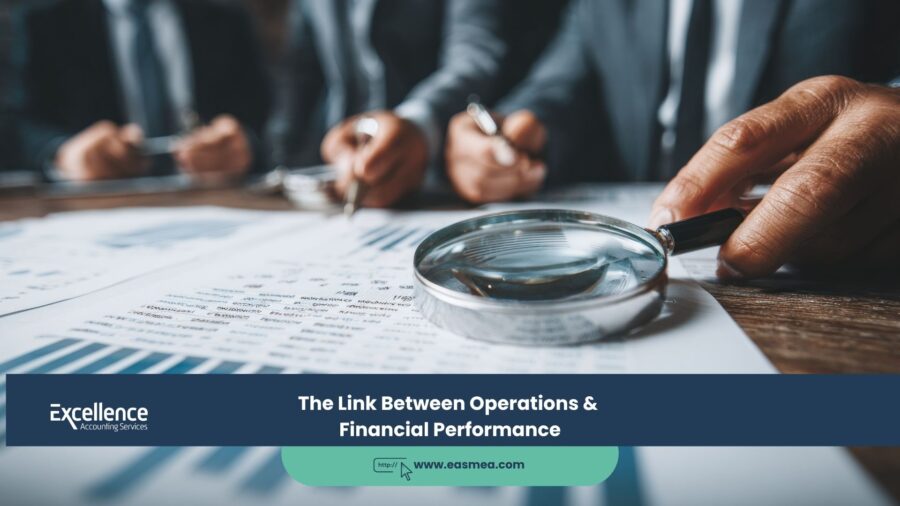
The Link Between Operations & Financial Performance: A Strategic Guide for UAE Businesses
For many growing businesses in the UAE, a dangerous disconnect exists between the “shop floor” and the “balance sheet.” The sales team focuses on the top-line revenue, the finance team reports on the bottom-line profit, and the operations team is busy in the middle, managing procurement, production, and delivery. All three functions often operate in silos, speaking different languages and measuring different KPIs. This siloed approach is the single greatest barrier to sustainable profitability. The truth is, your financial statements are not just a historical record; they are a direct reflection of your operational efficiency.
- The Link Between Operations & Financial Performance: A Strategic Guide for UAE Businesses
- Part 1: The Core Principle - Lagging vs. Leading Indicators
- Part 2: The Direct Line to Profit - Procurement and Gross Margin
- Part 3: The Cash Flow Engine - Inventory and the Cash Conversion Cycle (CCC)
- Part 4: The Hidden Links - Quality, Service, and Administration
- Part 5: The Bridge - Technology and Data
- EAS: Your Partner in Building an Operationally-Driven Finance Function
- Frequently Asked Questions (FAQs) on the Ops-Finance Link
- Are Your Operations Driving Your Profitability?
A business cannot simply “will” itself to higher profits by looking at a P&L statement. Profit is not created in the finance department; it is *created* in the day-to-day operations and *preserved* through smart financial management. Every dirham saved in procurement, every hour of machine downtime eliminated, every order fulfilled accurately, and every unit of inventory optimized has a direct, quantifiable impact on your company’s margins and cash flow. Understanding this link is the key to moving from a reactive, score-keeping finance function to a proactive, value-driving business strategy. This guide will explore the critical links between your daily operations and your financial performance, showing you how to turn operational efficiency into a powerful engine for profit and growth.
Key Takeaways on the Ops-Finance Link
- Finance is a Lagging Indicator: Your P&L and Balance Sheet report the *results* of your operational effectiveness. To change the results, you must change the operations.
- Gross Margin is an Ops Metric: Your gross margin is dictated by your operational efficiency in procurement, production, and waste management.
- Cash Flow is an Ops Metric: Your Cash Conversion Cycle is determined by your operational speed in inventory management (DIO) and order fulfillment (which impacts DSO).
- Efficiency Drives Profit: Reducing waste, rework, and idle time in your production or service delivery process flows directly to your operating margin.
- Data is the Bridge: A modern accounting system acts as the bridge, translating operational actions (like a completed job) into financial data (like job-costing) in real-time.
- Alignment is Key: Profitability is maximized when your finance and operations teams speak the same language and work from a shared set of data to achieve shared goals.
Part 1: The Core Principle – Lagging vs. Leading Indicators
To understand the ops-finance link, we must first reframe how we view our financial reports. Think of your financial statements (P&L, Balance Sheet, Cash Flow) as the dashboard of a car. It tells you your speed (revenue), your fuel level (cash), and your engine temperature (profitability). These are all *lagging indicators*—they report what has *already happened*.
Your operations, on the other hand, are the engine itself. The pressure you put on the accelerator, the gear you are in, and the efficiency of your fuel combustion—these are the *leading indicators* that *determine* what the dashboard will show. You cannot make the car go faster by just staring at the speedometer; you must take an operational action, like pressing the accelerator.
In business, this means:
- A high Accounts Receivable balance (a financial result) is often caused by a poor operational process, like incorrect invoicing or slow dispute resolution.
- A low Gross Margin (a financial result) is caused by operational issues, like high material waste or inefficient procurement.
- A poor Cash Flow (a financial result) is often caused by an operational failure, like poor inventory forecasting.
A strategic finance function, therefore, does not just *report* the financial results. It works with operations to understand the *drivers* behind them. This is the core of effective business consultancy.
Part 2: The Direct Line to Profit – Procurement and Gross Margin
The Gross Margin is one of the most important indicators of a company’s fundamental health. It is the profit left over after paying for the direct costs of creating your product or service (Cost of Goods Sold, or COGS).
Gross Margin % = (Revenue – COGS) / Revenue
Your procurement and supply chain operation has the single biggest impact on this number. A 5% reduction in your COGS can often have the same impact on your net profit as a 20-30% increase in sales. Operations teams impact this daily:
How Operations Control Gross Margin:
- Supplier Negotiation: The price your procurement team negotiates for raw materials is the first and largest component of COGS.
- Logistics and Freight: The cost of shipping raw materials to your factory or warehouse (freight-in) is a direct part of COGS. Optimizing shipping routes and carriers is a purely operational task with a direct financial result.
- Waste and Spoilage: Every unit of raw material that is wasted, spoiled, or scrapped due to poor handling or production processes is a 100% loss that inflates your COGS and erodes your margin.
- Production Efficiency: For manufacturers, the direct labor and factory overhead (electricity, water) used in production are part of COGS. A more efficient production line that uses less energy and labor per unit directly increases the gross margin on every product sold.
An internal audit of your procurement-to-pay process can often uncover significant inefficiencies and cost-saving opportunities here.
Part 3: The Cash Flow Engine – Inventory and the Cash Conversion Cycle (CCC)
This is the area where the ops-finance disconnect is most damaging. It’s the reason a company can be “profitable on paper” but have no cash in the bank. The problem lies in working capital, and operations hold the keys.
The Cash Conversion Cycle (CCC) measures the number of days it takes for your company to convert its investments in inventory into cash. You want this number to be as low as possible.
CCC = DIO (Days Inventory Outstanding) + DSO (Days Sales Outstanding) – DPO (Days Payables Outstanding)
1. Days Inventory Outstanding (DIO): An Operations Metric
DIO measures how many days, on average, your cash is trapped in the form of inventory. This is almost *entirely* an operational metric driven by supply chain and production planning.
- Poor Forecasting (Ops): Leads to over-ordering “just-in-case,” resulting in piles of unsold inventory (high DIO) tying up cash.
- Inefficient Production (Ops): Long production lead times mean goods sit as “work-in-progress” for longer, increasing DIO.
- Poor Storage (Ops): Leads to spoilage and obsolescence, making inventory worthless.
2. Days Sales Outstanding (DSO): An Ops-Finance Metric
DSO measures how many days it takes for you to collect cash from customers after a sale is made. While this is managed by the accounts receivable team, the root cause of delays is often operational.
- Inaccurate Invoicing (Ops/Finance): An invoice is sent with the wrong quantity, price, or PO number. The customer disputes it, and the payment clock stops. This is an operational failure in the order-to-cash process.
- Slow Fulfillment (Ops): If it takes your team 5 days to process and ship an order, that’s 5 days you could have been waiting for payment.
3. Days Payables Outstanding (DPO): An Ops-Finance Metric
DPO measures how many days you take to pay your own suppliers. A well-run operations team builds strong supplier relationships, which allows the finance team to negotiate better payment terms (e.g., 60 days instead of 30). This allows you to “fund” your operations using your suppliers’ cash for longer, improving your CCC. This is a core part of managing accounts payable strategically.
Part 4: The Hidden Links – Quality, Service, and Administration
The ops-finance link extends beyond the factory floor. Every part of your business operations has a financial consequence.
Cost of Poor Quality (COPQ)
This is a critical operational metric that is often hidden in the P&L. COPQ is the cost you incur from *not* doing things right the first time.
- Rework: Having to fix a faulty product or redo a service. This costs you double in labor and materials, directly hitting COGS.
- Warranty Claims: The cost of replacing a product that failed in the field.
- Product Returns: The revenue you have to give back, plus the logistics cost of the return.
These are all operational failures that destroy your profitability.
Customer Service & Retention
Customer service is an operation. Its efficiency is measured by metrics like “time to resolution” or “customer satisfaction.” The financial impact is measured by Customer Lifetime Value (LTV). Good service (an operational strength) leads to high retention, which creates a high LTV (a financial result). This makes your business more valuable and scalable.
Administrative Operations
Even your back-office operations have a financial impact. An inefficient HR and payroll-services process can lead to errors, unhappy employees, and higher turnover, which in turn increases recruitment and training costs (an OpEx item).
Part 5: The Bridge – Technology and Data
How do you connect the engine room (operations) to the dashboard (finance)? The bridge is built with data, and that data lives in your core business systems. A modern cloud accounting platform is the single most important tool for forging this link.
A system like Zoho Books is no longer just an accounting ledger; it’s an operational tool.
- Real-Time Inventory Module: Your ops team can see stock levels, and your finance team can see the *value* of that stock and your DIO in real-time.
- Job and Project Costing: This is the ultimate ops-finance link for service or construction businesses. You can track the *actual* labor hours and material costs (operational inputs) against a project’s budget and revenue (financial results). This tells you *which* of your operations are profitable and which are not.
- Integrated Invoicing and Payments: When an order is marked as fulfilled by the ops team, the finance system can automatically generate a correct invoice, which is then tracked by the AR team. This seamless workflow is how you shorten your DSO.
A professional accounting system implementation is not just a finance upgrade; it’s an operational one.
EAS: Your Partner in Building an Operationally-Driven Finance Function
Excellence Accounting Services (EAS) specializes in bridging the gap between your operational realities and your financial goals. We help you build a finance function that provides insight, not just reports.
- Strategic CFO Services: Our CFO services are the key. We work *with* your operations managers to build the KPIs, dashboards, and variance analyses that connect their daily actions to your P&L.
- Foundation of Clean Data: Our accounting and bookkeeping services ensure the data coming from your operations is captured accurately, providing a reliable foundation for analysis.
- Process Improvement: We leverage our internal audit and business consultancy expertise to review your key operational processes (like procure-to-pay and order-to-cash) to identify inefficiencies and risks.
- Technology Implementation: We are experts in accounting system implementation, ensuring your technology stack is configured to capture the operational data you need, such as project costs and inventory turnover.
Frequently Asked Questions (FAQs) on the Ops-Finance Link
The classic sign is being “profit-rich and cash-poor.” Your P&L shows a healthy profit, but you are constantly struggling to make payroll or pay suppliers. This is almost always an operational problem—your cash is trapped in slow-moving inventory (a forecasting failure) or uncollected receivables (an invoicing/fulfillment failure).
It’s the number of days from the moment you pay for your raw materials (cash out) to the moment you collect the cash from your customer (cash in). A shorter cycle is better. A cycle of 30 days means your business “funds itself” for 30 days. A cycle of 120 days means you have to find external financing to survive.
Every dirham they save on procurement (a component of COGS) flows directly down the P&L. If your net profit margin is 5%, a AED 10,000 saving in procurement is equivalent to achieving AED 200,000 in new sales (AED 200,000 * 5% = AED 10,000). Savings are often easier to achieve than new sales.
For a service business, your “inventory” is your employees’ time. The key operational metrics are:
– Utilization Rate: (Billable Hours Logged / Total Available Hours) * 100.
– Project Margin: Revenue from a project minus the direct costs (salaries of staff on that project).
– Billable vs. Non-Billable Hours: High non-billable “bench” time is an operational inefficiency that kills profitability.
This is a key report that bridges finance and ops. The finance team creates a budget (e.g., “we will spend AED 50,000 on materials”). At month-end, the actual spend was AED 60,000 (a AED 10,000 variance). The ops team must then provide the *reason* for the variance (e.g., “the price from our supplier went up,” or “we had a 20% scrap rate on Line 1”). This is the feedback loop in action.
Don’t give them financial metrics; give them *operational* metrics that you can prove *link* to financial outcomes. Instead of “our gross margin is down,” say “our scrap rate went from 5% to 8%, which cost us AED 50,000.” Give them data they can control. Reward them based on these operational KPIs.
COPQ is the sum of all costs associated with *not* getting things right the first time. This includes internal failures (rework, scrap) and external failures (warranty claims, returns, complaint handling). You track it by creating specific expense accounts in your accounting system to capture these costs, rather than letting them get buried in general COGS.
An Operations Manager is responsible for the *execution* of daily tasks to produce a product or service. A strategic CFO is responsible for *allocating capital* to those tasks in the most efficient way and *analyzing* their financial results to guide future strategy. They should be partners, not adversaries.
Yes, 100%. A modern system with a strong inventory module prevents stock-outs (which cause production downtime) and over-stocking (which ties up cash). It provides real-time data to the factory manager so they can make data-driven decisions on purchasing and production scheduling.
Get them to agree on a “single source of truth.” This is almost always a shared, cloud-based accounting and operations system. When both teams are looking at the same real-time data (on sales, inventory, and expenses), the arguments and silos begin to disappear, replaced by collaborative problem-solving.
Conclusion: From Silos to Synergy
A business cannot achieve sustainable profitability when its functions operate in isolation. Your financial statements are the final report card, but your operations are where the work is done to earn the grade. By recognizing that every operational action—from purchasing to production to customer service—has a direct and measurable financial consequence, you can begin to break down the walls between your teams. The businesses that will thrive in the competitive UAE market are those that build a bridge of data and communication between their “engine room” and their “dashboard,” creating a virtuous cycle of operational improvement and financial performance.