

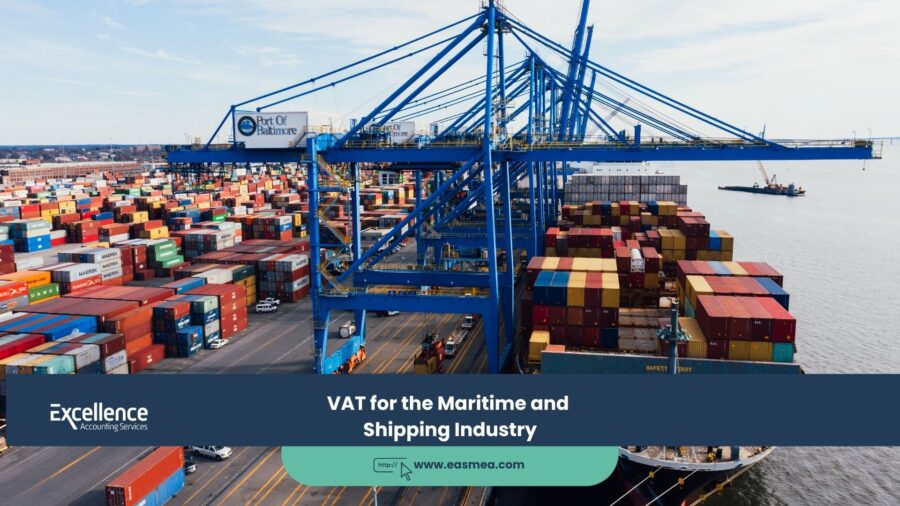
VAT for the Maritime and Shipping Industry: A Comprehensive Compliance Guide
The UAE’s strategic location has cemented its status as a global epicenter for maritime trade and logistics. Ports like Jebel Ali and Khalifa Port are not just regional hubs but critical nodes in the world’s supply chain. Given the inherently international nature of this industry, applying a domestic consumption tax like VAT presents unique challenges and complexities. The UAE’s VAT legislation acknowledges this by providing significant relief through the zero-rating of many key services. However, this relief is not automatic; it is governed by a strict set of rules, conditions, and documentation requirements.
- VAT for the Maritime and Shipping Industry: A Comprehensive Compliance Guide
- Part 1: The Cornerstone - Zero-Rating of International Transportation
- Part 2: Defining a "Qualifying Means of Transport"
- Part 3: The Ecosystem of Zero-Rated Services
- Part 4: The Importance of Documentation and Systems
- Specialized VAT Guidance for the Maritime Sector: How EAS Can Help
- Frequently Asked Questions (FAQs) for the Maritime Industry
- Is Your Maritime Business VAT Compliant?
For shipping lines, freight forwarders, port operators, and service providers, navigating these rules is a critical aspect of financial management. Misinterpreting the difference between a zero-rated international voyage and a standard-rated domestic one, or failing to distinguish between a “qualifying” commercial vessel and a non-qualifying pleasure craft, can lead to significant VAT liabilities, penalties, and cash flow disruption. This guide provides a deep dive into the specific VAT treatments for the maritime and shipping industry. We will dissect the rules for international transportation, the definition of qualifying means of transport, the VAT treatment of associated services, and the crucial documentation needed to support a zero-rated position. It is an essential roadmap for any business operating in this dynamic and vital sector.
Key Takeaways for the Maritime Sector
- International Transport is Zero-Rated: The service of transporting goods or passengers from the UAE to a place outside the UAE (or vice versa) is subject to VAT at 0%.
- Domestic Transport is Standard-Rated: Transporting goods or passengers between two points within the UAE is subject to VAT at 5%.
- “Qualifying Means of Transport”: The supply (sale, lease, charter) of a commercial vessel that is not used for recreation or sport is zero-rated.
- Zero-Rated Services: A broad range of services supplied in connection with a qualifying vessel or an international transport service are also zero-rated, including port services, maintenance, and fuel supply.
- Documentation is Paramount: To apply the zero rate, businesses must maintain robust documentary evidence, such as bills of lading, charter agreements, and export declarations, to prove the international nature of the transport.
- Input VAT Recovery: The key benefit of zero-rating (vs. exemption) is that businesses can still recover the input VAT they incur on their costs, protecting their profit margins.
Part 1: The Cornerstone – Zero-Rating of International Transportation
The fundamental principle underpinning VAT for the shipping industry is the zero-rating of international transport services. Article 45 of the VAT Decree-Law specifies that the following are subject to VAT at 0%:
- The supply of international transport services for passengers and goods.
- The supply of services directly in connection with the international transport of goods or passengers.
- The supply of a “qualifying means of transport” (e.g., a ship, boat) used for commercial purposes.
What Constitutes “International Transportation”?
The law defines this as any transport service that meets one of the following conditions:
- Starts in the UAE and ends outside the UAE.
- Starts outside the UAE and ends in the UAE.
- Passes through the territory of the UAE as part of a journey between two points outside the UAE (transit).
Crucially, the transportation of goods or passengers between two points within the UAE (e.g., from Jebel Ali Port to Abu Dhabi) is considered a domestic supply and is subject to the standard 5% VAT rate. The distinction is absolute and requires careful review of transport documentation.
Part 2: Defining a “Qualifying Means of Transport”
Beyond the service of transport itself, the actual supply of the vessel can also be zero-rated, provided it meets the definition of a “qualifying means of transport.” This applies to the sale, lease, or charter of the vessel.
The Conditions for a Qualifying Vessel
For a ship, boat, or other vessel to qualify, it must meet two essential criteria:
- It must be designed or adapted for use in a commercial capacity.
- It must NOT be designed or adapted for recreation, pleasure, or any sporting purpose.
This creates a clear dividing line between the commercial shipping world and the leisure marine industry.
| Qualifying Means of Transport (Zero-Rated Supply) | Non-Qualifying Means of Transport (Standard-Rated Supply) |
|---|---|
| Container ships, bulk carriers, oil tankers | Private yachts, pleasure boats |
| Commercial fishing boats | Jet skis, recreational watercraft |
| Tugs, pilot boats, dredgers used for commercial port operations | Houseboats used for residential/leisure purposes |
| Ferries used for public transport | Floating restaurants primarily for entertainment |
The VAT treatment of any transaction involving a vessel—be it its sale, repair, or provisioning—hinges entirely on which category it falls into.
Part 3: The Ecosystem of Zero-Rated Services
The VAT legislation recognizes that a transport service does not happen in a vacuum. A wide range of ancillary services are essential to facilitate the movement of goods and vessels. Therefore, many of these services are also zero-rated, provided they are supplied in connection with either an international transport service or a qualifying means of transport.
Key Zero-Rated Ancillary Services:
- Port and Harbour Services: This includes pilotage, towage, mooring, berthing, port entry fees, and stevedoring (loading, unloading, and stowing cargo).
- Container Services: Terminal handling charges (THC), storage, and other services related to containers used for international transport.
- Navigation and Safety Services: Air traffic control, maritime navigation services, and rescue services.
- Maintenance and Repair: Any repair, maintenance, or modification services performed on a qualifying means of transport.
- Provisioning and Fuelling: The supply of goods for use on board a qualifying vessel, including fuel (bunkering), water, and other consumable supplies.
- Chartering: The supply of a qualifying vessel on a charter basis (e.g., time charter, voyage charter, bareboat charter) is zero-rated.
The Critical Link: The zero-rating of these services is contingent on their connection to a qualifying activity. For example, repairing a container ship is zero-rated, but performing the exact same repair on a private superyacht is subject to 5% VAT. Similarly, stevedoring services for a shipment arriving from China are zero-rated, but for a shipment moving from Dubai to Sharjah, they are standard-rated.
Part 4: The Importance of Documentation and Systems
The burden of proof to justify applying a zero rate lies with the supplier. The FTA can and will challenge the VAT treatment if it is not supported by adequate, credible documentation. Failure to provide this proof can result in the FTA reclassifying the supply as standard-rated and demanding payment of the 5% VAT, plus penalties.
Essential Documentation Includes:
- Transport Documents: Bills of Lading, Sea Waybills, Air Waybills, or other consignment notes clearly showing the international nature of the journey.
- Commercial Invoices: Linking the service provided to the specific international shipment.
- Export/Import Declarations: Customs documents (e.g., Bills of Entry) that confirm the movement of goods across borders.
- Charter Party Agreements: For the supply of chartered vessels, the agreement should specify the commercial use.
- Vessel Registration Documents: To prove the nature and commercial status of a qualifying vessel.
Managing this level of documentation and ensuring the correct VAT rate is applied to thousands of transactions requires a sophisticated accounting system. A platform like Zoho Books is indispensable. Its capabilities allow businesses to:
- Create Custom VAT Rates: Set up specific tax rates for domestic transport (5%) and international transport (0%) to ensure correct invoicing.
- Attach Documents to Transactions: Digitally link a copy of the Bill of Lading or other proof directly to the sales invoice, creating a clear audit trail.
- Project Accounting: Track revenues and costs associated with specific voyages or shipments to manage profitability accurately.
Specialized VAT Guidance for the Maritime Sector: How EAS Can Help
The nuances of VAT for the shipping industry require specialized expertise. Excellence Accounting Services (EAS) provides targeted support to help your maritime business navigate these complex waters.
- VAT Advisory for Shipping: We provide expert opinions on complex scenarios, helping you determine the correct VAT treatment for different types of services, vessels, and contracts, a core part of our VAT consultancy.
- VAT Return Filing: We manage your end-to-end VAT return filing process, ensuring that zero-rated supplies are correctly reported and that you recover all eligible input tax.
- VAT Implementation and System Review: We help you set up your accounting systems and processes to correctly capture and document zero-rated transactions, leveraging our expertise in VAT implementation.
- Strategic CFO Services: Our CFO services can help you manage the cash flow implications of VAT and ensure that your pricing and contracting strategies are VAT-efficient.
- Internal Audit: We conduct reviews of your VAT processes to identify areas of risk and ensure that your documentation practices will stand up to FTA scrutiny, a key service within our internal audit offerings.
Frequently Asked Questions (FAQs) for the Maritime Industry
No. This is a domestic transport service as both the start and end points are within the UAE. This service is subject to VAT at the standard rate of 5%.
Yes, but it is zero-rated. An oil tanker is a “qualifying means of transport” as it is used for commercial purposes and not for recreation. Therefore, its sale is subject to VAT at 0%.
No. A luxury yacht is used for pleasure and recreation, so it is not a “qualifying means of transport.” Your maintenance services are subject to VAT at the standard rate of 5%.
Yes. The supply of services directly in connection with international transport is zero-rated. Since you are arranging a zero-rated transport service, your fee for this arrangement is also zero-rated.
This can likely be treated as a “disbursement” and kept outside the scope of VAT, provided you meet certain conditions: you must have paid the amount as an agent of the client, it must be their liability, and you must invoice them for the exact amount without any markup. Proper documentation is essential.
Yes. The supply of fuel and other provisions for consumption on board a qualifying means of transport is zero-rated. A container ship qualifies, so the fuel supply is subject to VAT at 0%.
The key difference is input tax recovery. If you make zero-rated supplies, you can still recover the VAT you paid on your business costs. If you make exempt supplies, you generally cannot recover the VAT on your costs. This makes zero-rating much more favorable for businesses.
The VAT treatment depends on the use of the container. If the lease is for the purpose of being used in an international transport service, the lease is zero-rated. If it is leased for domestic use (e.g., as on-site storage), the lease is standard-rated at 5%.
Yes. The supply of insurance and reinsurance relating to the international transportation of goods is also specified as a zero-rated supply.
This is considered a single, continuous international journey. Even though there is a domestic leg (Dubai to Sharjah), it is part of an overall international transport service. Therefore, the entire service from Dubai to Mumbai is zero-rated, provided it is supplied under a single contract.
Conclusion: Charting a Course for Compliance
The UAE’s VAT law is designed to support the country’s position as a premier logistics hub by ensuring the international movement of goods remains competitive. The extensive use of zero-rating for the maritime sector is a testament to this. However, this favorable treatment comes with a significant compliance obligation. Businesses must have robust systems and processes to correctly identify the VAT treatment of each supply, supported by a clear and accessible documentation trail. Proactive management and access to expert advice are the best ways to ensure that you navigate these complex rules successfully, avoiding the turbulent waters of non-compliance.