

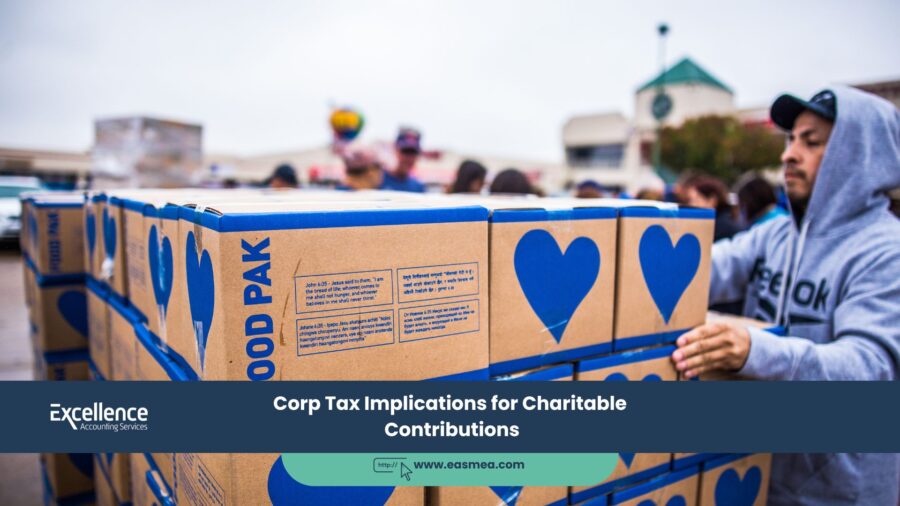
A Business Guide to the Corp Tax Implications of Charitable Contributions in the UAE
Corporate Social Responsibility (CSR) has evolved from a peripheral activity to a core component of modern business strategy in the UAE. As companies increasingly seek to create a positive societal impact, charitable giving has become a prominent feature of the corporate landscape. The introduction of the UAE Corporate Tax regime has added a new, critical dimension to this practice. Now, businesses must not only consider the philanthropic value of their contributions but also navigate the specific tax rules that govern their deductibility. This intersection of altruism and tax law presents both opportunities for financial efficiency and risks of non-compliance.
- A Business Guide to the Corp Tax Implications of Charitable Contributions in the UAE
- Part 1: The Principle of Deductibility for Donations
- Part 2: The Cornerstone Concept: Qualifying Public Benefit Entities (QPBEs)
- Part 3: The Deduction Cap - Understanding the Limits
- Part 4: Donations vs. Sponsorships - A Critical Tax Distinction
- How Excellence Accounting Services (EAS) Guides Your Philanthropic Strategy
- Frequently Asked Questions (FAQs) on Charitable Contributions
- Ensure Your Generosity is Recognized by the Law
The UAE Corporate Tax Law provides a clear, yet conditional, pathway for businesses to claim deductions for their generosity. However, this is not an open-ended provision. Deductions are strictly limited to donations made to a specific list of government-approved “Qualifying Public Benefit Entities,” and even then, they are subject to a cap. Understanding these rules is crucial. A misstep—such as donating to a non-approved charity or failing to distinguish a donation from a sponsorship—can result in the disallowance of the deduction, leading to a higher tax bill and potential penalties. This guide provides a detailed roadmap for businesses to structure their charitable activities in a way that is both impactful and tax-compliant.
Key Takeaways on Charitable Contributions and Corporate Tax
- Deductibility is Conditional: Donations and gifts are only deductible for Corporate Tax purposes if they are made to a “Qualifying Public Benefit Entity” (QPBE).
- Official List is Key: QPBEs are specific UAE-based entities listed in a Cabinet Decision. Donations to non-listed entities, including foreign charities, are not deductible.
- Deduction Cap Applies: There is a limit on the total amount of deductible donations a business can claim in a tax period.
- Donations vs. Sponsorships: A donation is a gift without expecting a return benefit. A sponsorship is a payment for marketing/advertising and is treated as a regular business expense, fully deductible if it meets the “wholly and exclusively” test.
- Documentation is Mandatory: Businesses must maintain meticulous records, including official receipts and payment proof from the QPBE, to substantiate their claims during an FTA audit.
Part 1: The Principle of Deductibility for Donations
Under the UAE Corporate Tax Law, for an expense to be deductible, it must be incurred “wholly and exclusively” for the purposes of the taxpayer’s business. Charitable donations, by their nature, do not typically generate direct business revenue, so they require a special provision to be deductible.
The law explicitly allows for the deduction of donations and gifts made to Qualifying Public Benefit Entities. This provision acknowledges the importance of corporate philanthropy and provides a tax incentive for businesses to support community welfare. However, it’s a specific exception with strict boundaries. Unlike general business expenses like rent or salaries, the deductibility of donations is not automatic and is governed by a separate, more stringent set of rules.
Part 2: The Cornerstone Concept: Qualifying Public Benefit Entities (QPBEs)
The entire framework for tax-deductible donations hinges on one critical concept: the Qualifying Public Benefit Entity (QPBE). A business can donate millions of dirhams to worthy causes, but if the recipients are not officially recognized as QPBEs, the entire amount will be disallowed as a deduction for Corporate Tax purposes.
What is a QPBE?
A QPBE is an entity that has been officially approved by the UAE Cabinet and is listed in a formal Cabinet Decision. These are typically non-profit bodies established for public welfare.
Categories of entities that are generally included on the QPBE list:
- Charitable and Humanitarian Bodies: Well-known organizations focused on social welfare, disaster relief, and supporting vulnerable communities.
- Religious Institutions: Bodies established for religious purposes and community services.
- Educational and Scientific Institutions: Universities, research centers, and other organizations promoting knowledge and science for the public good.
- Governmental and Public Authorities: Certain government or semi-government entities that perform functions in the public interest.
Actionable Step: Verify Before You Donate. Before making any donation, it is the business’s absolute responsibility to check the latest Cabinet Decision and confirm that the intended recipient is on the official list of QPBEs. A simple search on the Ministry of Finance or Federal Tax Authority website for the relevant decision is a crucial step in the due diligence process. A due diligence review by a professional can also confirm this.
Part 3: The Deduction Cap – Understanding the Limits
Even when a donation is made to a QPBE, the deductible amount is not unlimited. The law places a cap on the total deduction to prevent potential abuse and ensure a baseline of tax revenue. The allowable deduction for qualifying donations is the lower of:
- The total amount of the donations paid during the tax period.
- A specific percentage of the Taxable Income for that period, calculated *before* deducting the charitable contributions.
While the exact percentage is specified in the legislation, let’s use a hypothetical example of 10% for illustrative purposes.
Practical Example of the Deduction Cap
Let’s consider a company with the following financials:
- Accounting Profit: AED 2,000,000
- Non-deductible expenses to be added back: AED 100,000
- Taxable Income (before donations): AED 2,100,000
- Donation made to a listed QPBE: AED 300,000
Calculation Steps:
- Calculate the Deduction Cap:
10% of Taxable Income (before donations) = 10% * AED 2,100,000 = AED 210,000 - Determine the Allowable Deduction:
Compare the actual donation (AED 300,000) with the cap (AED 210,000). The allowable deduction is the lower amount, which is AED 210,000. - Calculate the Final Taxable Income:
Taxable Income (before donations) – Allowable Deduction = AED 2,100,000 – AED 210,000 = AED 1,890,000
In this case, even though the company donated AED 300,000, it can only deduct AED 210,000 from its taxable income. The remaining AED 90,000 is a non-deductible expense for tax purposes.
Part 4: Donations vs. Sponsorships – A Critical Tax Distinction
Many businesses confuse donations with sponsorships, but for tax purposes, they are fundamentally different. The correct classification is essential as it dictates the tax treatment.
| Feature | Donation | Sponsorship |
|---|---|---|
| Purpose | Purely philanthropic; a gift with no expectation of a commercial return. | Commercial in nature; payment is made to receive a tangible business benefit (e.g., brand exposure, advertising). |
| Recipient | Must be a QPBE to be deductible. | Can be any entity (e.g., sports team, event organizer, conference). |
| Deductibility Test | Subject to specific QPBE rules and the deduction cap. | Treated as a regular business expense (e.g., marketing). Deductible if “wholly and exclusively” for the business. |
| Deduction Limit | Capped at a percentage of taxable income. | 100% deductible if it meets the business purpose test. No specific cap applies. |
Example: A company gives AED 50,000 to a local, unlisted charity to fund a community event. This is a non-deductible donation. If, however, the company pays AED 50,000 to the same entity to have its logo prominently displayed on all event banners and marketing materials, this is a sponsorship. It can be fully deducted as a marketing expense, provided the cost is reasonable for the advertising benefit received. Accurate accounting and bookkeeping is vital to correctly categorize these payments from the outset.
Tracking for Clarity and Compliance
Maintaining separate general ledger accounts for “Charitable Donations” and “Sponsorship & Marketing Expenses” is a must. This is where an efficient accounting system like Zoho Books becomes invaluable. It allows you to tag transactions correctly, attach supporting documents (like receipts and sponsorship agreements) directly to entries, and pull accurate reports at year-end. This level of organization simplifies the preparation of your tax return and provides a clear, defensible audit trail for the FTA.
How Excellence Accounting Services (EAS) Guides Your Philanthropic Strategy
Aligning your company’s charitable goals with the UAE’s tax laws requires expert guidance. EAS provides strategic advisory to ensure your contributions are both meaningful and tax-efficient.
- Corporate Tax Advisory: Our UAE Corporate Tax experts provide clear advice on the deductibility of donations, helping you understand the rules for QPBEs and the deduction cap.
- CSR Tax Structuring: We offer business consultancy to help you design CSR programs that differentiate between donations and sponsorships to maximize tax benefits.
- Verification and Due Diligence: We assist in verifying the status of charitable organizations against the official QPBE list, protecting you from making non-deductible contributions.
- Compliance and Record-Keeping: Our accounting teams ensure your financial records are impeccable, with clear documentation to support every charitable claim in the event of an FTA audit.
- Feasibility Studies: For major philanthropic projects, our feasibility study services can assess the financial and social impact, aligning them with your corporate objectives.
Frequently Asked Questions (FAQs) on Charitable Contributions
No. The law is explicit that to be deductible, the donation must be made to a Qualifying Public Benefit Entity listed in the UAE Cabinet Decision. Donations to foreign charities are not deductible, even if they have a local representative office (unless that local office is itself a listed QPBE).
In-kind donations to QPBEs are also potentially deductible. The value of the deduction would be the market value of the goods or services at the time of the donation. You would need robust documentation to support this valuation, such as independent appraisals or records of recent sales of similar goods.
The list is published in a Cabinet Decision. This document is typically available on the official websites of the UAE Ministry of Finance or the Federal Tax Authority. It is crucial to refer to the most current version of this decision.
The amount of the donation that exceeds the cap for a given tax period is simply lost for tax deduction purposes. The UAE Corporate Tax Law does not currently provide for carrying forward excess charitable contributions to be used in future tax years.
This is a mixed-purpose expense. The portion of the payment that represents the market value of the dinner and entertainment you received is not a donation. Any amount paid *in excess* of this market value could potentially be considered a donation, but it would only be deductible if the charity is a QPBE and you have a receipt clearly separating the donation component.
It depends entirely on the nature of the payment. If the payment is a gift to a QPBE, it falls under the donation rules. If it’s a payment to a company to, for example, offset your carbon footprint, it would likely be considered a regular business operating expense, deductible under the “wholly and exclusively” rule.
No, pre-approval is not required. The onus is on the business to ensure the recipient is a listed QPBE, the payment is documented, and the deduction claimed on the tax return is calculated correctly according to the cap.
Yes, any business can make donations. However, for a Free Zone Person paying 0% tax on their Qualifying Income, a tax deduction has no practical benefit as their tax liability is already nil. The rules for deductibility would only become relevant if they have income that is subject to the standard 9% rate.
While not strictly mandated, it is highly advisable. A direct bank transfer from the company’s official account to the QPBE’s official account is the cleanest and most easily verifiable evidence of the transaction for the FTA.
You must obtain an official, stamped receipt from the Qualifying Public Benefit Entity. This receipt should clearly state your company’s name, the date, the amount of the donation, and the charity’s full name and registration details that confirm its status as a QPBE.
Conclusion: Strategic Philanthropy in the Tax Era
Charitable giving remains a noble and vital part of the UAE’s business culture. The new Corporate Tax regime does not discourage this; it simply formalizes the process for tax purposes. By being strategic, diligent, and well-informed, businesses can continue to make a significant positive impact on society while ensuring their philanthropic efforts are recognized appropriately under the law. The key lies in shifting from unstructured giving to a planned CSR strategy that prioritizes verified, qualifying entities and meticulous record-keeping. This approach ensures that every dirham contributed is not only socially impactful but also fully compliant.