

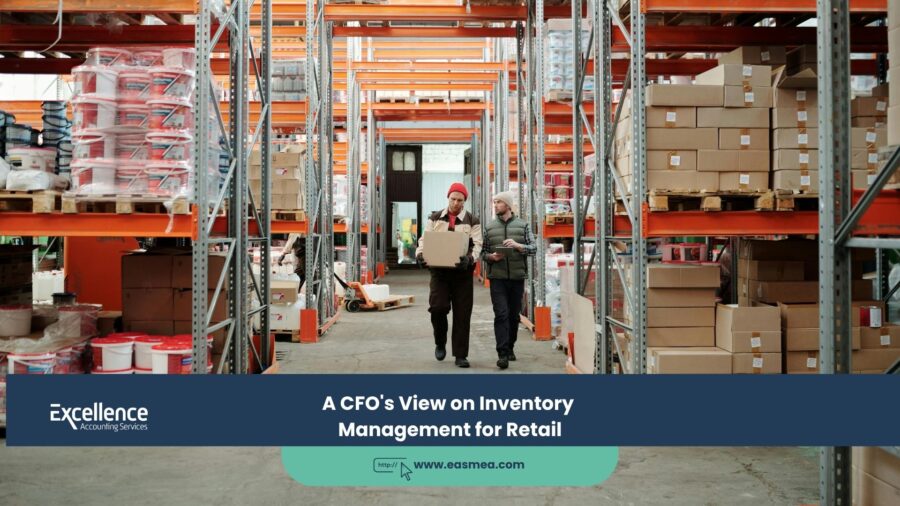
A CFO’s View on Inventory Management for Retail: Beyond Stock Levels to Strategic Profitability
To a retail operations manager, inventory is product. To a merchandising manager, it’s an assortment. But to a Chief Financial Officer (CFO), inventory is, first and foremost, cash. It is one of the largest and most critical assets on a retailer’s balance sheet, representing a massive investment of the company’s working capital. Every item sitting on a shelf, in a stockroom, or in a warehouse is capital that cannot be used to pay salaries, invest in marketing, or open new stores. In the fast-paced retail environment of the UAE, managing this asset effectively is often the single most important factor that separates a high-growth, profitable business from a cash-strapped one.
- A CFO's View on Inventory Management for Retail: Beyond Stock Levels to Strategic Profitability
- Part 1: Inventory as Working Capital - The Cash Conversion Cycle
- Part 2: The Metrics That Matter - Moving Beyond Simple Margin
- Part 3: The Financial Statement Impact - Inventory as a P&L Risk
- Part 4: The Technology - Why Spreadsheets are a CFO's Nightmare
- From Stock-Taker to Strategist: How EAS Implements a CFO-Led Inventory Approach
- Frequently Asked Questions (FAQs) from a CFO's Perspective
- Is Your Inventory Working for You, or Against You?
The traditional view of inventory management focuses on operations: reorder points, bin locations, and fulfillment speed. The CFO’s view is strategic. It focuses on the financial implications of every inventory decision. How quickly can we convert this investment back into cash? What is the *true* cost of holding this product? How much profit does our inventory investment generate, and how does it compare to other potential uses of that capital? Poor inventory management is a silent killer of profitability, leading to margin-eroding markdowns, costly write-offs due to obsolescence, and crippling cash flow crises. This guide provides a CFO’s perspective on inventory management, moving beyond simple stock-keeping to a strategic framework for maximizing capital efficiency and driving sustainable profit.
Key Takeaways for a CFO’s View on Inventory
- Inventory is Trapped Cash: The primary goal is to minimize the time inventory sits as an asset and convert it back into cash as quickly as possible.
- The Cash Conversion Cycle (CCC): This is the CFO’s master metric. It measures the time from paying for inventory to collecting cash from its sale.
- GMROI is the Ultimate Metric: Gross Margin Return on Investment (GMROI) is more important than margin alone. It answers: “For every AED invested in inventory, how many AEDs of gross profit did we earn?”
- Valuation is a P&L Risk: How you value inventory (FIFO vs. Weighted Average) and when you write it down (NRV) has a direct and significant impact on your taxable profit.
- Tax Implications: Paying 5% VAT on imported inventory up-front is a major cash flow consideration. Inventory valuation methods also directly impact your Corporate Tax liability.
- Technology is Non-Negotiable: You cannot manage inventory strategically using spreadsheets. A real-time, integrated system is essential for a CFO to have the visibility they need.
Part 1: Inventory as Working Capital – The Cash Conversion Cycle
A CFO’s primary concern is liquidity and capital efficiency. The P&L can show a healthy profit, but if that profit is perpetually trapped in inventory, the business can fail. This is why the CFO’s favorite metric is the Cash Conversion Cycle (CCC).
The CCC measures the number of days it takes for a company to convert its resource inputs into cash. For a retailer, the formula is:
CCC = Days Inventory Outstanding (DIO) + Days Sales Outstanding (DSO) – Days Payables Outstanding (DPO)
- Days Inventory Outstanding (DIO): The average number of days your inventory sits on the shelf before being sold. This is the central focus.
- Days Sales Outstanding (DSO): The average number of days it takes to collect cash from customers. (For most B2C retailers, this is near zero, as they collect cash at the point of sale).
- Days Payables Outstanding (DPO): The average number of days you take to pay your suppliers.
CFO’s Strategic Goal: A shorter CCC is always better. The CFO’s strategy is to shorten DIO (sell faster), shorten DSO (collect faster), and lengthen DPO (pay suppliers slower).
Imagine a retailer with a DIO of 90 days and a DPO of 30 days. This means they have to pay their supplier 60 days *before* they even sell the product. This “cash gap” of 60 days must be funded, either from profits or debt. A smart CFO’s goal is to negotiate 90-day DPO terms, creating a “zero-funding” inventory model where supplier credit finances the entire inventory holding period. This is a core component of strategic CFO services.
Part 2: The Metrics That Matter – Moving Beyond Simple Margin
A merchandiser might be happy with a 50% gross margin on a product. A CFO will ask, “…but how fast does it sell, and what’s our return on the capital we invested in it?”
1. Inventory Turnover Ratio
This is the most fundamental measure of inventory speed. It shows how many times a company has sold and replaced its inventory during a given period.
Formula: Cost of Goods Sold (COGS) / Average Inventory
- A high turnover is generally good, indicating efficient sales and fresh stock.
- A low turnover is a major red flag. It implies poor sales, overstocking, and, most dangerously, that your cash is stagnant.
2. Days Inventory Outstanding (DIO)
This is just the inverse of turnover, expressed in days. It’s often more intuitive.
Formula: (Average Inventory / COGS) * 365 Days
A DIO of 120 days means that, on average, an item sits on your shelf for four months. This is four months of your cash being tied up.
3. Gross Margin Return on Investment (GMROI) – The King of Metrics
This is the CFO’s ultimate inventory metric because it connects profitability (Gross Margin) directly to the inventory investment. It answers the question: “How much profit did we earn for every dirham we invested in inventory?”
Formula: Gross Margin / Average Inventory Cost
Example: Which product is better?
- Product A (Luxury Watch): Sells for AED 20,000, costs AED 10,000. Gross Margin = 50% (or AED 10,000). You sell one per year.
- Product B (Fast-Moving Goods): Sells for AED 20, costs AED 10. Gross Margin = 50% (or AED 10). You sell 1,000 per year.
A merchandiser might say they are “equally profitable” (50% margin). A CFO sees it differently.
- Watch GMROI: AED 10,000 Gross Margin / AED 10,000 Avg. Inventory = 1.0
- Goods GMROI: (AED 10 x 1,000) Gross Margin / AED 10 Avg. Inventory = 1,000.0
The fast-moving goods generated a 1000x return on the capital invested in it, while the watch only returned 1x its value. This analysis guides capital allocation.
Part 3: The Financial Statement Impact – Inventory as a P&L Risk
Inventory is an asset on the Balance Sheet. But the way it is managed creates significant risks for the Income Statement (P&L).
1. Inventory Valuation Methods (FIFO vs. Weighted Average)
The method you choose to value your inventory has a direct, legal impact on your COGS, your Gross Profit, and ultimately, your Corporate Tax bill.
- FIFO (First-In, First-Out): Assumes the first items you bought are the first ones you sold. In an inflationary environment (where inventory costs are rising), FIFO results in a lower COGS, and therefore a *higher* gross profit and *higher* taxable income.
- Weighted Average Cost: Calculates a “blended” average cost for all inventory items. This method smooths out price fluctuations and is often simpler to manage.
Choosing the right method is a critical decision that requires a deep understanding of both your business and accounting standards, a core part of our accounting and bookkeeping advisory.
2. The Inevitable Write-Down: Lower of Cost or Net Realizable Value (NRV)
This is a fundamental accounting rule (under IFRS, which is law in the UAE) that creates a major financial risk. It states that inventory must be recorded on the balance sheet at whichever is *lower*: its original cost OR its “Net Realizable Value.”
Net Realizable Value (NRV) = The estimated selling price in the ordinary course of business, *minus* any estimated costs of completion and costs necessary to make the sale (e.g., marketing, shipping).
Example: The Fashion Retailer
A retailer buys 1,000 dresses for AED 100 each (Total Asset = AED 100,000). The season ends, and 200 dresses are left. They are now out of fashion and can only be sold at a clearance price of AED 60.
- Cost: AED 100
- NRV: AED 60
The retailer *must* write down the value of this inventory. The difference (AED 100 – AED 60 = AED 40) is an *obsolescence expense*.
Financial Impact: 200 dresses x AED 40 write-down = AED 8,000 expense. This AED 8,000 is a direct hit to the Gross Margin and reduces the company’s profit for the period.
A CFO’s strategy for inventory management is therefore also a *risk management* strategy, designed to sell products quickly and avoid these profit-destroying write-downs.
Part 4: The Technology – Why Spreadsheets are a CFO’s Nightmare
You cannot calculate GMROI, DIO, or real-time NRV if your data is sitting in disparate, manually-updated spreadsheets. For a CFO, data integrity and real-time visibility are non-negotiable.
A modern, integrated system is essential. This is where a platform like Zoho Books, combined with Zoho Inventory, becomes a critical tool for the finance department.
- Single Source of Truth: The Point-of-Sale (POS) system, the inventory management system, and the accounting ledger are all integrated. A sale in the store automatically updates inventory levels and records the revenue and COGS in the accounting system.
- Real-Time Metrics: A CFO can log in and see the current inventory valuation, the turnover ratio, and the gross margin *today*, not 30 days after the month ends.
- Automated Valuation: The system automatically calculates inventory value based on your chosen method (FIFO/Weighted Avg), saving hundreds of hours and reducing errors.
- Better Forecasting: With clean, historical data, you can build far more accurate demand forecasts, which is the first step in preventing overstocking.
From Stock-Taker to Strategist: How EAS Implements a CFO-Led Inventory Approach
Transforming your inventory from a capital drain into a profit engine requires strategic financial leadership. Excellence Accounting Services (EAS) provides the expertise to make this shift.
- Outsourced CFO Services: Our CFOs will analyze your inventory from a financial perspective. We will implement and track key metrics like CCC, DIO, and GMROI, build cash flow forecasts, and advise on optimal capital allocation.
- Internal Audit and Process Improvement: Our internal audit team will review your entire inventory lifecycle, from purchasing to sales, to identify and mitigate risks of shrinkage, obsolescence, and fraud.
- Accounting System Implementation: We are experts in implementing integrated systems like Zoho Books and Zoho Inventory, ensuring your technology provides the real-time data you need.
- Corporate Tax & VAT Advisory: We provide critical guidance on how your inventory valuation methods will impact your Corporate Tax liability and how to manage the cash flow impact of VAT on imported goods.
- Business Consultancy: We provide business consultancy to help you develop sophisticated demand forecasting models and optimize supplier payment terms.
Frequently Asked Questions (FAQs) from a CFO’s Perspective
Inventory Turnover (COGS / Avg. Inventory) measures the speed for your *entire* inventory over a year. Sell-Through Rate ([Units Sold / Units Received] * 100) is a more specific, short-term metric, usually measured monthly for a specific product or category, to see how fast a particular batch of inventory is selling.
A high margin is useless if the product never sells (low turnover). GMROI combines margin *and* turnover to show the true profitability of your investment. It’s better to have a 30% margin on a product that turns over 12 times a year than a 60% margin on a product that turns over once.
Holding cost (or carrying cost) is the total cost of storing unsold inventory. It includes capital costs (the money tied up), storage costs (warehouse rent, utilities, insurance), and risk costs (obsolescence, shrinkage, damage). It’s often estimated to be 20-30% of the inventory’s value per year.
When you write down inventory, you record an expense, typically in the COGS section of your P&L, called “Inventory Obsolescence” or “Provision for Slow-Moving Stock.” This directly reduces your Gross Profit and, therefore, your Net Profit for the period.
The UAE Corporate Tax law is based on IFRS (International Financial Reporting Standards) for financial statements. IFRS does not permit the use of LIFO because it can distort profitability. Therefore, UAE companies must use either FIFO or the Weighted Average Cost method.
Not always. This is the business model for luxury goods (e.g., high-end jewelry, art, supercars). The low turnover is acceptable because the GMROI on each sale is enormous, and the holding costs are a small percentage of the item’s value. This is a very different model from a supermarket, which has low margins but incredibly high turnover.
Safety stock is the extra inventory held to mitigate the risk of a stockout caused by supply chain delays or unexpected demand. An operations manager loves safety stock. A CFO sees it as a necessary evil—it is “insurance” that you are paying for by tying up cash. The goal is to use data and better forecasting to keep safety stock at the absolute minimum required level.
An outsourced CFO doesn’t count your boxes. They build the *systems* to manage the inventory. They create the financial models, set the target KPIs (DIO, GMROI), analyze the reports from your inventory system, identify which product categories are underperforming, and lead the strategic conversation about pricing, ordering, and risk.
A periodic system is an old method where you only know your inventory level when you do a physical count. A perpetual system (which modern software enables) updates inventory levels in real-time with every sale and purchase. A CFO demands a perpetual system because it’s the only way to have accurate, timely data.
From a CFO’s view, consignment is a fantastic tool. Because you don’t *own* the inventory, it does not appear as an asset on your balance sheet. It doesn’t tie up your cash. You only record the purchase (COGS) at the moment you sell the item to the end customer. This can dramatically improve your cash conversion cycle and GMROI.
Conclusion: Inventory as a Strategic Weapon, Not a Financial Drain
A retailer’s inventory is the engine of its business, but that engine can either consume cash or generate it. The CFO’s perspective re-frames inventory management from a simple operational task to a high-stakes financial strategy. It’s a continuous balancing act between liquidity, profitability, and risk. By moving beyond basic stock-keeping and embracing the metrics of capital efficiency—like the Cash Conversion Cycle and GMROI—you can transform your largest asset from a financial drain into a strategic weapon, driving both cash flow and profitability in the competitive UAE retail market.