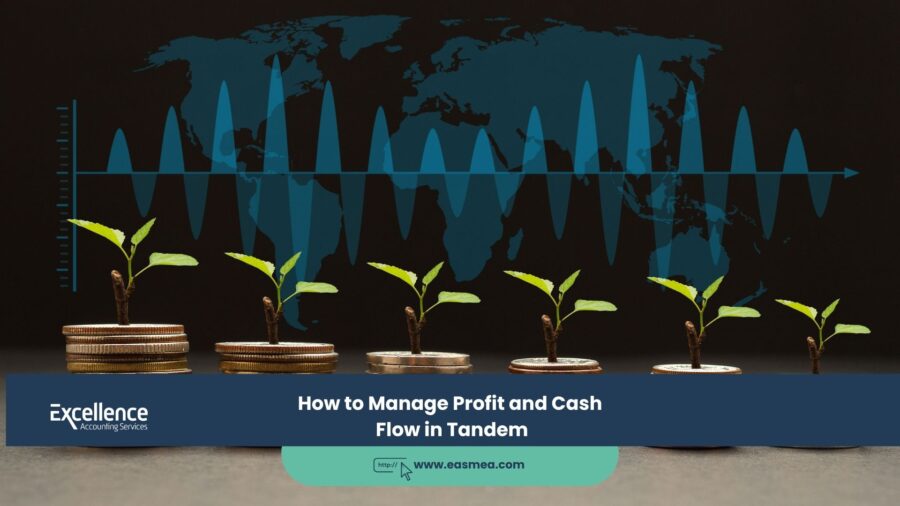
How to Manage Profit and Cash Flow in Tandem: The Dual Engine of Business Success
In the world of business, there is no greater—or more dangerous—misconception than the belief that “profit equals cash.” This single error in understanding has led to the downfall of countless otherwise successful enterprises. Business owners, fixated on a healthy income statement showing robust profits, are often blindsided when they suddenly find themselves unable to make payroll or pay their suppliers. This is the “Profit-Cash Flow Paradox,” and mastering it is the key to sustainable success.
- How to Manage Profit and Cash Flow in Tandem: The Dual Engine of Business Success
- Part 1: The Great Divide - Understanding Profit vs. Cash Flow
- Part 2: Why Do "Profitable" Businesses Run Out of Cash? The Culprits
- Part 3: The Strategic Toolkit - How to Manage Profit and Cash Flow in Tandem
- How Excellence Accounting Services (EAS) Aligns Your Profit and Cash Flow
- Frequently Asked Questions (FAQs) on Profit and Cash Flow
- Stop Choosing Between Profit and Cash. Master Both.
Profit, as calculated on your Income Statement, is a measure of your business’s viability and efficiency over a period. Cash flow, as tracked in your Cash Flow Statement, is the measure of your business’s liquidity and its ability to survive. You need both. Profit is the goal, but cash is the fuel that keeps the engine running. A business can survive for a short time without profit (e.g., a funded startup), but it cannot survive a single day without cash.
This in-depth guide is designed for business leaders who want to move beyond this dangerous misconception. We will dissect the fundamental differences between these two critical metrics, explore the common traps that cause profitable companies to fail, and provide a strategic framework for managing profit and cash flow in tandem. This is the blueprint for building a business that is not just profitable on paper, but resilient and healthy in reality.
Key Takeaways
- Profit is an Opinion, Cash is a Fact: Profit is an accounting construct based on accrual rules (like IFRS). Cash is the hard money in your bank account.
- The Profit-Cash Flow Paradox: A business can be highly profitable but cash-poor due to rapid growth, slow-collecting receivables, high inventory, or large debt repayments.
- Working Capital is the Key Culprit: The gap between profit and cash is almost always hidden in your working capital—Accounts Receivable (AR), Accounts Payable (AP), and Inventory.
- The Cash Conversion Cycle (CCC): This metric measures the time it takes to turn your investments in inventory and resources into cash. A shorter cycle is always better.
- The 3-Statement Model: You cannot manage profit and cash in tandem without an integrated 3-statement financial forecast (P&L, Balance Sheet, Cash Flow Statement).
- A 13-Week Cash Flow Forecast: This tactical tool is the ultimate early warning system, predicting your weekly cash position and preventing liquidity surprises.
Part 1: The Great Divide – Understanding Profit vs. Cash Flow
To manage them together, you must first understand them separately. They are two different lenses for viewing your business’s health.
What is Profit? (The Accrual View)
Profit, also known as Net Income, is the final number on your Income Statement (P&L). It is calculated using the accrual method of accounting, as mandated by IFRS.
Formula: `Revenue – Cost of Goods Sold (COGS) – Operating Expenses = Profit`
Under the accrual basis, revenue is “recognized” when it is earned, not when the cash is received. If you sell AED 100,000 of goods to a customer on 90-day credit terms, you book AED 100,000 of revenue *today*. Your P&L looks great, showing a healthy profit from this sale. However, you have zero cash to show for it.
What is Cash Flow? (The Cash View)
Cash flow is the net movement of cash into and out of your business. It is tracked on the Statement of Cash Flows, which has three sections:
- Operating Cash Flow (OCF): Cash generated from your core business activities. This is the most important number.
- Investing Cash Flow (ICF): Cash used to buy or sell long-term assets (like equipment or property).
- Financing Cash Flow (FCF): Cash from investors or lenders, or cash paid out for loans and dividends.
In the AED 100,000 sale example, your Operating Cash Flow for that transaction is AED 0. In fact, it’s probably negative, because you had to spend cash on the COGS to produce those goods in the first place.
A business’s survival depends on maintaining a positive Operating Cash Flow over the long term. A robust financial reporting system makes these distinctions clear.
Part 2: Why Do “Profitable” Businesses Run Out of Cash? The Culprits
When a company’s Operating Cash Flow is consistently lower than its Net Income, it’s a sign of trouble. The cash is “stuck” somewhere. Here are the most common culprits:
1. The Working Capital Trap (The “Cash Gap”)
Working capital is the cash tied up in your daily operations. It’s the difference between your current assets and current liabilities. The main components are:
- Accounts Receivable (AR): This is the most common trap. You’ve made the sale, booked the profit, but your customer hasn’t paid you. You are effectively providing a zero-interest loan to your customers. Poor management of accounts receivable is a primary cause of cash-flow failure.
- Inventory:** Every dirham of inventory on your shelf—whether raw materials or finished goods—is cash you’ve spent that you haven’t yet converted back into cash from a sale. Overstocking or slow-moving inventory is a direct drain on liquidity.
- Accounts Payable (AP): This is the other side of the coin. This is the money you owe your suppliers. Delaying your payments (within reason) is a form of financing, as it allows you to hold onto your cash longer. Poor management of accounts payable (i.e., paying too quickly) can hurt cash flow.
2. The “Growth” Trap (Growing Too Fast)
This is the most dangerous paradox. A rapidly growing business is often the most cash-hungry. Why? Because to fund AED 10M in new sales, you must first spend cash on AED 5M of new inventory and fund a larger AR balance. This investment happens *before* you see a single dirham of cash from those new sales. The business can literally “grow itself” into bankruptcy by outstripping its available cash.
3. High Capital Expenditures (CapEx)
You decide to buy a new AED 500,000 machine to improve efficiency. On your P&L, this isn’t a AED 500,000 expense; it’s a small depreciation expense spread over 10 years. But on your Cash Flow Statement, it’s a massive AED 500,000 cash outflow *today*. This investment in the future can drain the cash needed for today’s operations.
4. Debt Repayment
When you take a loan, you get a large cash inflow. But when you repay it, only the *interest* portion of your payment is an expense on your P&L. The *principal* repayment is not. If your loan payment is AED 10,000 (AED 2,000 interest, AED 8,000 principal), your profit only decreases by AED 2,000, but your cash has decreased by AED 10,000. This disparity can quickly empty a bank account.
Part 3: The Strategic Toolkit – How to Manage Profit and Cash Flow in Tandem
A business leader must fly the plane with two dashboards: one for profit and one for cash. Here are the tools to manage both.
1. The 3-Statement Financial Model (The Strategic View)
You cannot manage what you do not measure. A 3-Statement Forecast (P&L, Balance Sheet, Cash Flow Statement) is the master tool. It’s a dynamic model where all three statements are interlinked. This allows you to see the “what-if” scenarios: “What happens to my cash balance in 6 months if I hire 5 new people (P&L) and buy a new server (CapEx) while my AR days increase (Balance Sheet)?” This is the core of strategic financial management, often provided by a CFO service.
2. Master Your Cash Conversion Cycle (CCC) (The Tactical View)
The CCC is a metric that measures the number of days it takes for your company to convert its investments in inventory and other resources into cash from sales.
Formula: `CCC = DIO (Days Inventory Outstanding) + DSO (Days Sales Outstanding) – DPO (Days Payables Outstanding)`
Your goal is to make this number as small as possible.
- Reduce DIO: Improve inventory management. Don’t overstock.
- Reduce DSO: Collect your receivables faster. Invoice immediately. Offer early payment discounts (e.g., 2/10 net 30). Enforce credit limits.
- Increase DPO: Negotiate longer payment terms with your suppliers. Pay on the last day, not the first day.
3. The 13-Week Rolling Cash Flow Forecast (The Survival View)
While the 3-statement model is your long-term map, the 13-week (i.e., one quarter) rolling cash flow forecast is your tactical GPS. It’s a simple, spreadsheet-based forecast of all your cash inflows and outflows, week by week.
It answers questions like: “Will I have enough cash in Week 8 to make payroll after paying my rent in Week 7?”
This tool is the ultimate early warning system, giving you 3 months’ notice to secure a credit line, chase a customer for payment, or delay a purchase. This is a non-negotiable tool for any serious business.
4. Focus on Profit *Quality*
Not all profit is created equal.
- Low-Quality Profit: AED 100,000 in profit from a single customer on 120-day credit terms.
- High-Quality Profit: AED 80,000 in profit from 10 different customers who all pay in 30 days.
Always aim for high-quality, high-cash-conversion profit. This may mean offering a 2% discount to turn a 120-day customer into a 10-day customer. This slightly reduces your “profit” but dramatically increases your cash flow and reduces your risk. A thorough accounting review can help identify the quality of your profits.
How Excellence Accounting Services (EAS) Aligns Your Profit and Cash Flow
Managing the dual engines of profit and cash flow is the defining challenge of financial management. At EAS, we specialize in building the systems and providing the insights to ensure you master both.
- Outsourced CFO Services: Our CFO services provide the strategic, forward-looking guidance you need. We build and maintain your 3-statement financial models and 13-week cash flow forecasts, acting as your partner in navigating these complex waters.
- Impeccable Accounting & Reporting: Our core accounting and bookkeeping and financial reporting services ensure your data is accurate, timely, and perfectly segregated, so you can trust the numbers you’re using to make decisions.
- Working Capital Management: We provide hands-on support to manage your cash conversion cycle, with dedicated services for accounts receivable and accounts payable optimization.
- Data Integrity: We ensure your financial data is flawless from the ground up with our meticulous account reconciliation services, giving you a single source of truth.
Frequently Asked Questions (FAQs) on Profit and Cash Flow
Profit is what you’ve *earned* on paper during a period (e.g., in a month). Cash Flow is the change in your actual bank balance during that same period. You can earn a profit (e.g., make a big sale on credit) while seeing your bank balance go down (because you paid for the goods for that sale).
Working capital is the money your business needs to fund its everyday operations. It’s calculated as `Current Assets (like AR and inventory) – Current Liabilities (like AP)`. If it takes you 60 days to get paid by customers but you have to pay your suppliers in 30 days, you have a 30-day “gap” that you must fund with your own cash. This is working capital.
The CCC is a metric that measures the number of days it takes for your company to convert its investments in inventory (by buying from suppliers) into cash (by collecting from customers). A lower number is better. For example, a CCC of 45 days means that from the day you spend cash, it takes you 45 days to get that cash back plus your profit.
This is the classic paradox. Look at your Balance Sheet: 1) Are your Accounts Receivable (AR) growing? This means your customers are paying you slowly. 2) Is your Inventory balance increasing? This means your cash is tied up in unsold stock. 3) Are you making large loan principal repayments? This is a cash outflow that doesn’t reduce your profit.
The Income Statement (P&L) shows your profitability based on accrual accounting (revenue when earned, expenses when incurred). The Statement of Cash Flows shows the actual cash that moved in and out of your bank account, categorized into Operating, Investing, and Financing activities. It “reconciles” the P&L’s profit with the actual change in cash.
Depreciation is a non-cash expense. It’s an accounting concept to spread the cost of a large asset (like a machine) over its useful life. You don’t write a check for “depreciation.” On the P&L, it’s an expense that reduces profit. On the Cash Flow Statement, it’s “added back” to profit (in the OCF section) to show that this cash never actually left the building.
Focus on your working capital. 1) Collect your receivables faster. Offer a 2% discount for payment in 10 days instead of 60. 2) Manage your inventory better. Don’t buy 6 months of stock when you only need 1 month. 3. Negotiate better payment terms with your suppliers. If you get 60 days to pay them, you can use their money to fund your operations.
Not necessarily. It depends on *why* it’s negative. A negative *Operating Cash Flow* (OCF) is usually a bad sign, as it means your core business is losing cash. However, a company can have a negative *total* cash flow and still be healthy if its OCF is positive, but its *Investing Cash Flow* is negative (e.g., it spent a lot of cash on new equipment for growth).
It’s a weekly forecast of all your cash inflows and outflows for the next 13 weeks (one quarter). As each week passes, you add a new week at the end, so it’s always “rolling.” Yes, you absolutely need one. It’s the only tool that gives you advance warning of a future cash shortfall, allowing you time to react.
The UAE Corporate Tax is calculated on your *profit* (your taxable income), not your cash flow. This creates a new, very important cash flow “trap.” You may have a highly profitable year (on paper) and therefore have a large tax bill. But if your cash is tied up in AR or inventory, you may not have the actual cash on hand to pay your tax bill when it’s due. This makes managing cash flow even more critical. You must forecast your tax *payments* as a major cash outflow. This requires expert UAE Corporate Tax planning.
Conclusion: Mastering the Dual Engines of Your Business
Profit and cash flow are the two engines of your business. Running on profit alone is like flying a plane with one engine; you might stay in the air for a while, but you’re in a perilous position. True financial mastery is about managing both engines in tandem, understanding how one affects the other, and making strategic decisions that support both. By moving from a reactive, profit-only mindset to a proactive, 3-statement view, you are not just building a more compliant business; you are building a more resilient, sustainable, and ultimately more valuable one.