

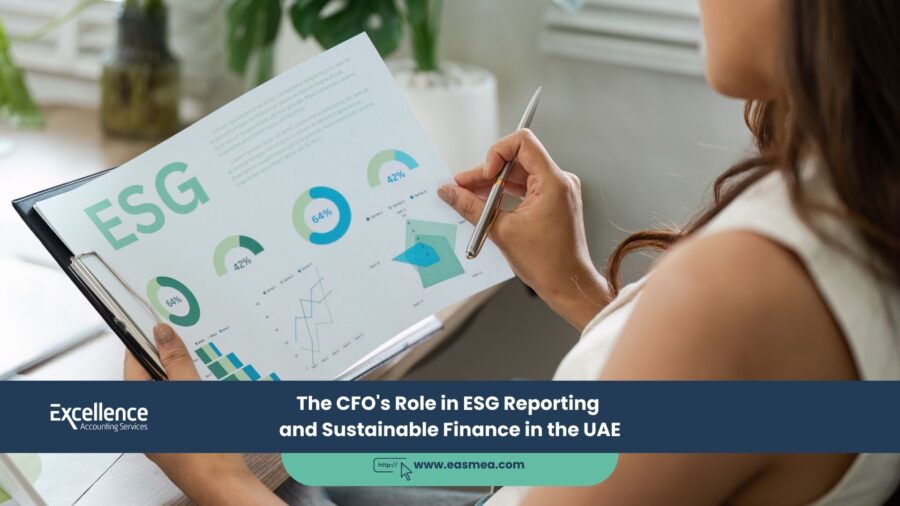
The CFO’s Role in ESG Reporting and Sustainable Finance in the UAE
For decades, the Chief Financial Officer (CFO) has been the steward of a company’s financial capital. Today, in the face of global shifts and the UAE’s ambitious sustainability goals, that role is expanding dramatically. The modern CFO is now also becoming the steward of the company’s natural and social capital, leading the charge in **Environmental, Social, and Governance (ESG)** reporting and the strategic pursuit of **sustainable finance**.
- The CFO's Role in ESG Reporting and Sustainable Finance in the UAE
- Why ESG Has Moved to the CFO's Desk
- The CFO's Strategic Roles in the ESG Era
- Your Partner in Sustainable Value Creation: Excellence Accounting Services (EAS)
- Frequently Asked Questions (FAQs)
- Is Your Financial Strategy Aligned with a Sustainable Future?
ESG is no longer a peripheral corporate social responsibility (CSR) activity managed by the marketing department. It has moved firmly into the boardroom and the office of the CFO. Investors, lenders, regulators, and customers in the UAE and globally are demanding greater transparency and accountability on non-financial performance. They understand that a company’s long-term value is intrinsically linked to its management of environmental risks, its impact on society, and the quality of its governance.
This guide explores the pivotal new role of the CFO as a leader in ESG and sustainable finance. We will examine why the CFO is uniquely positioned to integrate sustainability into corporate strategy, ensure the integrity of ESG data, and leverage new financial instruments to fund a greener, more responsible future.
Key Takeaways
- ESG is a Financial Issue: ESG performance directly impacts a company’s risk profile, access to capital, and long-term valuation. It is now a core concern for the CFO.
- The CFO as ESG Strategist: The modern CFO’s role is to integrate ESG considerations into the company’s financial planning, budgeting, and investment decisions.
- Data Integrity is Paramount: CFOs are responsible for ensuring that ESG data is as robust, accurate, and auditable as financial data, bringing a new level of rigor to sustainability reporting.
- Sustainable Finance is a New Frontier: CFOs can now access new pools of capital through instruments like green bonds and sustainability-linked loans to fund sustainable projects.
- From Value Protection to Value Creation: A strategic CFO uses ESG not just as a risk management tool, but as a driver of innovation, efficiency, and long-term value creation. This is a key focus of modern CFO services.
Why ESG Has Moved to the CFO’s Desk
The shift of ESG from a CSR function to a core finance function is driven by one key factor: risk and opportunity. Stakeholders now clearly understand the financial implications of ESG performance.
- Investors: Global investors are increasingly using ESG metrics to screen investments, believing that companies with strong ESG performance are better managed and less risky in the long run.
- Lenders: Banks in the UAE are integrating ESG risk into their credit analysis. A poor environmental record or weak governance can make it harder and more expensive to secure financing.
- Regulators: Regulators like the Securities and Commodities Authority (SCA) are mandating ESG disclosures for listed companies, a trend that is expected to broaden.
- Customers and Talent: Top talent and modern consumers are increasingly choosing to work for and buy from companies that demonstrate a genuine commitment to sustainability and ethical practices.
The CFO, who speaks the language of risk, return, and value, is the natural leader to translate these external pressures into a coherent internal strategy.
The modern CFO’s job is to prove that sustainability and profitability are not competing objectives, but two sides of the same coin.
The CFO’s Strategic Roles in the ESG Era
A forward-thinking CFO adds value across the entire ESG lifecycle.
1. The ESG Strategist and Integrator
The CFO ensures that ESG is not a standalone report but is woven into the fabric of the corporate strategy.
- Financial Planning: Integrating ESG-related costs (e.g., investment in energy-efficient technology) and opportunities (e.g., revenue from green products) into the company’s budget and long-term financial plan.
- Capital Allocation: Applying an “ESG lens” to all capital expenditure decisions. For example, favoring an investment with a slightly lower financial ROI but a significantly better environmental impact.
- Performance Management: Helping to develop and track ESG-related Key Performance Indicators (KPIs) for business units and management.
2. The Steward of ESG Data
This is perhaps the most critical new role. The CFO brings the same rigor and discipline to non-financial data as they do to financial data.
- Establishing Controls: Implementing robust internal controls and processes for collecting, verifying, and managing ESG data to ensure it is accurate, consistent, and auditable.
- Technology and Systems: Overseeing the implementation of software systems needed to track complex ESG data across the organization.
- Assurance and Reporting: Managing the ESG reporting process and often engaging external auditors to provide assurance on the non-financial data, just as they do for financial statements.
3. The Architect of Sustainable Finance
The CFO is the gateway to new and innovative forms of financing that are tied to sustainability performance.
- Green Bonds and Loans: Leading the issuance of green bonds or securing green loans, where the proceeds are specifically earmarked for eligible environmental projects (e.g., renewable energy, green buildings).
- Sustainability-Linked Loans (SLLs): Negotiating SLLs, where the interest rate on the loan is tied to the company’s achievement of pre-defined ESG targets. Better performance means a lower interest rate.
Your Partner in Sustainable Value Creation: Excellence Accounting Services (EAS)
Integrating ESG into your financial strategy requires specialized knowledge and a forward-looking perspective. EAS provides the strategic financial leadership to guide your sustainability journey.
- Strategic CFO Services: Our outsourced CFOs are equipped to lead your ESG strategy, helping you build the business case for sustainability, integrate ESG into your financial planning, and manage your reporting process.
- ESG Reporting and Assurance Support: We help you navigate the complex landscape of ESG reporting frameworks (like GRI and SASB) and prepare your data for internal and external assurance.
- Sustainable Finance Advisory: As part of our business consultancy, we can advise on the feasibility of accessing sustainable finance instruments and support you in discussions with lenders.
- Data and Systems Implementation: We can assist with the implementation of systems to ensure you can effectively track and report on both your financial and non-financial performance.
Frequently Asked Questions (FAQs)
CSR is often focused on philanthropy and community engagement—”doing good.” ESG is a broader, data-driven framework that is directly linked to a company’s core strategy and is used by investors to assess risk and long-term value creation.
It is currently mandatory for publicly listed companies on exchanges like the DFM and ADX. While not yet mandatory for all private companies, the expectation from banks, investors, and large customers is rapidly growing, making it a “de facto” requirement for many.
The ROI can be significant. It can come from cost savings (e.g., lower energy consumption), access to cheaper capital (through sustainable finance), attracting and retaining top talent, and enhancing brand reputation, which can lead to increased customer loyalty and sales.
The most common global frameworks are the Global Reporting Initiative (GRI), which is comprehensive, and the Sustainability Accounting Standards Board (SASB), which is industry-specific and focused on financially material issues.
A green bond is a type of fixed-income instrument where the proceeds are exclusively used to finance or re-finance projects with clear environmental benefits, such as renewable energy, energy efficiency, or clean transportation.
Start simple. Begin by measuring a few key, relevant metrics. For an office-based business, this could be electricity and water consumption (Environmental), employee turnover and training hours (Social), and having a formal code of conduct (Governance). The key is to start measuring and then improve over time.
This is a critical first step in ESG strategy. It’s the process of identifying and prioritizing the ESG topics that are most significant to your business and your stakeholders. This ensures your ESG efforts are focused on the issues that matter most.
They are key partners. The CSO typically leads the sustainability strategy and operations, while the CFO is responsible for the financial integration, data integrity, reporting, and linking the strategy to value creation. The CFO brings the financial rigor to the CSO’s strategic vision.
Unlike green loans, the proceeds from an SLL can be used for general corporate purposes. However, the interest rate on the loan is linked to the borrower’s performance against specific, pre-agreed ESG targets. If the company meets its targets, the interest rate goes down.
Yes, increasingly so. Acquirers and investors are now conducting ESG due diligence. A company with strong ESG performance is seen as having better risk management, more resilient operations, and a stronger brand, all of which can lead to a higher business valuation.
Conclusion: The CFO as the Architect of Sustainable Value
The role of the CFO has reached a critical inflection point. In the face of global challenges and the UAE’s clear vision for a sustainable future, financial leadership is no longer just about profit; it’s about purpose and long-term resilience. The CFO who embraces the role of ESG strategist, data steward, and sustainable financier will not only navigate the risks of this new landscape but will be the architect of a more valuable, respected, and enduring enterprise.
Is Your Financial Strategy Aligned with a Sustainable Future?
Contact Excellence Accounting Services to learn how our strategic CFO services can guide your ESG and sustainable finance journey.