
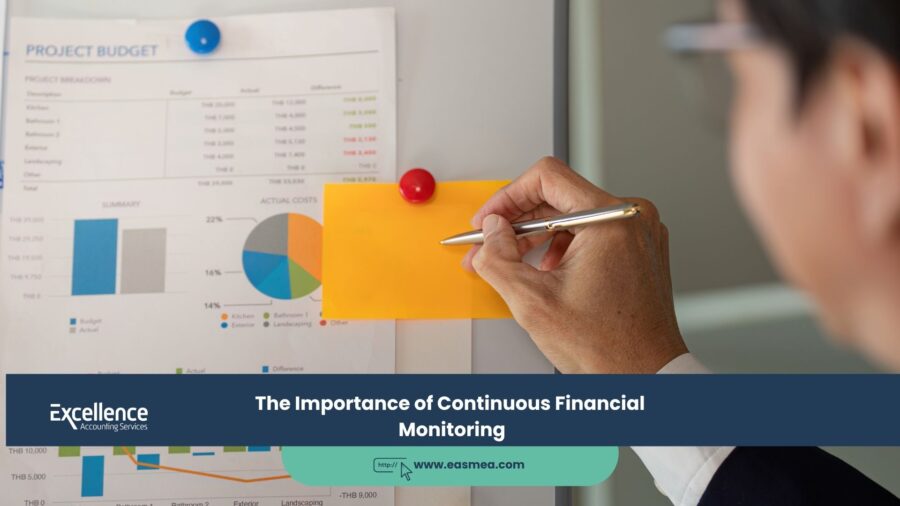
The Financial Command Center: Why Continuous Monitoring is Non-Negotiable for Business Success
For generations, the rhythm of business finance was the same: for 30 days, the business operated in a fog of gut-feel and instinct. Then, for a frantic week, the finance team would close the books, producing a set of reports that landed on the CEO’s desk 15 days into the *next* month. This was “financial management.” In reality, it was “financial history.” It was a report card, not a guide. It was a financial autopsy that explained, with perfect clarity, exactly why the patient (your profitability) had died six weeks earlier.
- The Financial Command Center: Why Continuous Monitoring is Non-Negotiable for Business Success
- The Fatal Flaw of the "Rearview Mirror": Why Static Reporting Fails
- The Strategic Imperative: The Benefits of a "Command Center" Approach
- The 4 Pillars of a Continuous Monitoring Framework
- Monitoring & The New UAE Tax Reality
- What Excellence Accounting Services (EAS) Can Offer
- Frequently Asked Questions (FAQs) on Financial Monitoring
- Stop Driving Blind. Build Your Command Center.
In today’s hyper-volatile, post-pandemic, and digitally-accelerated economy—an economy now shaped by new realities like inflation and the UAE Corporate Tax—this rearview-mirror approach is not just outdated; it is a direct threat to survival. The single greatest strategic shift a modern business can make is the move from static, historical reporting to **continuous financial monitoring**. This is the evolution from a monthly report to a real-time command center. It’s the difference between flying blind and flying with a full, data-driven instrument panel.
This comprehensive guide will explain the strategic importance of this shift, outline the practical pillars of a continuous monitoring system, and show why it’s the new non-negotiable for any business that intends to be profitable, resilient, and compliant in the years ahead.
Key Takeaways
- From Autopsy to Diagnosis: Static monthly reports are financial autopsies. Continuous monitoring is a real-time diagnostic tool, allowing you to treat problems when they are small.
- Cash is King: Continuous monitoring’s #1 benefit is proactive cash flow management. It spots a potential cash crunch 13 weeks away, not 13 days away.
- Agility is the New Superpower: This system allows you to make data-driven decisions in days, not months. It is the engine of business agility.
- Beyond Budgets: It replaces the rigid, outdated annual budget with a dynamic “rolling forecast” that adapts to new information.
- Compliance Becomes a Byproduct: A real-time system makes VAT and Corporate Tax compliance an automatic, stress-free output of your daily operations, not a year-end panic.
The Fatal Flaw of the “Rearview Mirror”: Why Static Reporting Fails
The traditional “month-end close” is a relic of a slower-moving industrial age. Its fundamental flaws are now exposed in a digital world.
1. It’s Too Slow
By the time you get your reports for January, it’s mid-February. If the report shows a critical margin erosion on your key product, you have already “leaked” that margin for 45 days. The financial damage is done. In a continuous monitoring system, you would see that margin erosion *the week it happens*, allowing you to investigate and fix it immediately.
2. It’s a “Financial Autopsy”
The report tells you, “We lost money.” It doesn’t tell you, “We are *about to* lose money.” It is 100% historical. It has zero predictive power. This is useless for making *future* decisions. You are constantly reacting to the past, not building the future.
3. It Creates a “Data Black Hole”
For the first 25 days of the month, the entire company (sales, operations, marketing) operates on instinct, with no real-time financial feedback loop. They are “flying blind,” making pricing, spending, and hiring decisions without knowing the immediate financial impact. This is where CFO-level guidance becomes critical, bridging this gap.
4. It Hides the “Why”
A static P&L shows a single, blended “Revenue” or “COGS” number. It doesn’t tell you that Client A is wildly profitable while Client B (who takes up all your time) is a massive drain. It doesn’t show you that Product X has a 60% margin while Product Y is at 5%. Static reports hide the granular truth you need to make smart, surgical decisions.
The Strategic Imperative: The Benefits of a “Command Center” Approach
Continuous monitoring is a system—a combination of technology, process, and people—that provides a real-time, forward-looking pulse on the health of your business. The benefits are transformative.
1. Proactive Crisis Management (Spotting Icebergs)
The #1 killer of businesses is not a lack of profit; it’s a lack of cash. A continuous monitoring system, built on a 13-Week Cash Flow Forecast, is your early-warning radar. It forces you to look at every single dirham coming in (from AR) and every dirham going out (to AP, payroll, rent). You will see a potential cash shortfall 10 weeks from now, giving you ample time to react by delaying a purchase, pushing on collections, or securing a credit line. The static model shows you *after* you’ve bounced a payment.
2. Real-Time, Data-Driven Decision Making
A “command center” approach allows you to answer critical questions *now*, not next month.
- Sales asks: “Can we offer a 20% discount to win this huge new client?”
Monitoring answers: “Yes, but only if they agree to 15-day payment terms. Our cash flow is the priority.” - Ops asks: “Can we hire two new people for the operations team?”
Monitoring answers: “Our revenue-per-employee is trending down. Let’s try a one-month consultancy contract first and prove the ROI.”
This is the core of business consultancy: linking every operational decision to its financial impact.
3. Active Profitability & Margin Defense
In an inflationary world, your costs are changing weekly. If you review prices annually, you are guaranteed to lose. A continuous monitoring system tracks your Gross Margin by product or service in real-time. The instant a supplier price hike hits your bookkeeping, your dashboard flashes red, showing the margin on “Product A” just fell. This immediately triggers a pricing review or a renegotiation with the supplier. You defend your profit daily, not annually.
4. Drives a Culture of Accountability
When financial data is shared in real-time (in a simplified way), it transforms company culture.
- The **Sales Team** sees the live DSO number, understanding that a sale isn’t a “win” until the cash is in the bank.
- The **Operations Team** sees the project profitability dashboard, understanding that “scope creep” isn’t a small favor, it’s a direct hit to the company’s bottom line.
- **Management** is held accountable to a “rolling forecast,” not an outdated 12-month-old budget.
This creates alignment. Everyone starts to understand how their daily actions move the company’s financial dials.
The 4 Pillars of a Continuous Monitoring Framework
This isn’t a mythical system. It is a practical, achievable framework built on four pillars.
Pillar 1: The Foundation – A “Single Source of Truth”
Your data must be clean, centralized, and in the cloud. This is non-negotiable. You cannot have one set of numbers in an Excel sheet, another in the bank, and a third on the operations platform.
- Cloud Accounting: This is the hub. A system like Zoho Books, Xero, or Quickbooks Online. This is where a professional accounting system implementation is crucial.
- Daily Reconciliation: Your bank feeds must be connected, and transactions must be categorized daily. An account reconciliation service ensures this is done flawlessly.
- Integrated Stack: Your payroll, CRM, and inventory systems should “talk” to your accounting system, ensuring data flows automatically without manual, error-prone entry.
Pillar 2: The “Vital Signs” – A Real-Time KPI Dashboard
You don’t need 100 metrics. You need the 5-10 “vital signs” that tell you 90% of the story. A good financial reporting dashboard will be on your screen at all times.
Liquidity Vitals:
- Cash on Hand: The number from your bank, today.
- 13-Week Cash Flow Forecast: Your most important predictive tool.
- Days Sales Outstanding (DSO): How long it takes you to get paid.
Profitability Vitals:
- Gross Profit Margin (%): Tracked daily or weekly.
- Net Profit Margin (%): Tracked as a “rolling 30-day” figure.
- Project/Client Profitability: A simple “Top 5” and “Bottom 5” list.
Efficiency Vitals:
- Cash Conversion Cycle (CCC): The time it takes to turn an investment into cash.
- (For Services) Billable Utilization Rate: Are your most expensive assets (people) busy on paid work?
Pillar 3: The Process – A New Cadence of Accountability
The technology and dashboards are useless without a human process to act on them. This new “cadence” replaces the old month-end scramble.
- The Daily Huddle (5 Mins): For the core finance/ops team. “What cash came in? What’s going out? Any surprises?”
- The Weekly Pulse (30 Mins): For the management team. Review the KPI dashboard. Identify any “red” or “yellow” numbers. Is sales pipeline strong enough? Is DSO creeping up?
- The Monthly Strategic Review (60-90 Mins): A deeper dive. “Why did we miss our forecast? What do we know now that we didn’t know 30 days ago? Let’s update the rolling forecast for the next 12 months.”
Pillar 4: The Expertise – From Data to Decisions
This is the most crucial pillar. Data is just noise; information is data that has been interpreted. Insight is information that can be acted upon. You need an expert who can look at the dashboard and move from “what” to “so what” and “now what.”
This is the modern role of the CFO or an outsourced CFO service. They are not historical record-keepers. They are forward-looking strategic pilots who interpret the instrument panel and help you steer the ship.
Monitoring & The New UAE Tax Reality
Continuous monitoring has become a critical compliance tool in the UAE. The FTA does not care about your “gut feel.” They care about data.
- FTA Audit Defense: The FTA will use industry benchmarks to find outliers. If your filed tax return shows a 2% profit margin when your industry average is 15%, you are a prime audit target. A continuous monitoring system helps you track your performance against these benchmarks and, crucially, gives you the detailed documentation (e.g., project-level losses) to defend *why* your numbers are different. An internal audit function can help build this defense.
- No More Tax Surprises: A continuous monitoring system accrues for your VAT and Corporate Tax liabilities in real-time. At any point, you know *exactly* how much you owe. This prevents the year-end panic where you suddenly discover a massive tax bill you haven’t reserved the cash for.
- Transfer Pricing: For businesses with related parties, monitoring these transactions continuously is essential for proving to the FTA that they are being conducted at “arm’s length.”
What Excellence Accounting Services (EAS) Can Offer
Building this “Financial Command Center” is a journey. Excellence Accounting Services acts as your mission control, providing the technology, processes, and expertise to get you there.
- Outsourced CFO Services: Our CFOs are the expert pilots. We design your KPI dashboard, run your weekly pulse meetings, interpret the data, and provide the high-level strategic guidance you need to make smart decisions.
- Accounting & Bookkeeping: We are the engine room. Our team builds your “single source of truth” with flawless, IFRS-compliant bookkeeping and daily reconciliation.
- Financial Reporting & System Implementation: We build the command center itself, from implementing your cloud accounting system to designing and running the real-time financial dashboards.
- Tax & Compliance: Our tax and VAT teams ensure your monitoring system is perfectly aligned with all FTA requirements, making compliance an effortless byproduct of good management.
Frequently Asked Questions (FAQs) on Financial Monitoring
Financial reporting is *historical*. It’s a static “report card” of what happened last month or last quarter. Financial monitoring is *real-time and forward-looking*. It’s a “live dashboard” of what is happening right now and a “GPS” (like a cash flow forecast) of where you are headed.
It’s the opposite. A large corporation can absorb a surprise bad month. A small business can be bankrupted by one. For an SME, continuous monitoring is *more* critical. It can be simpler (a well-managed cloud accounting software and a weekly Excel cash flow forecast), but the principle of having a real-time pulse is vital for survival and growth.
The **13-Week Cash Flow Forecast**. This is the one report that predicts your ability to survive. It is the most powerful tool a business owner has. It forces you to look at your real, hard cash in and cash out, week by week, for the next 90 days.
A static budget is created once a year (e.g., in December) and is “locked” for 12 months. It’s often obsolete by March. A “rolling forecast” is a dynamic 12-month plan. At the end of *every month*, you review your performance, and add a new forecast month 12 months out. This means you are *always* looking 12 months into the future based on the most current information.
You cannot build a command center on a broken foundation. The first step is an accounting review. You bring in professionals to clean up your historical data, set up a proper cloud accounting system, and give you a “clean” starting point. From that day forward, you build the new process.
The core stack is simple: 1) A cloud accounting software (like Zoho Books or Xero). 2) Microsoft Excel or Google Sheets for your 13-week cash flow model. 3) As you grow, a Business Intelligence (BI) tool (like Power BI or Tableau) that sits on top of your data to create visual dashboards.
When you walk into a bank with a real-time KPI dashboard, a documented 13-week cash flow forecast, and 3-year “rolling” projections, you are instantly in the top 1% of loan applicants. It screams “low-risk” and “well-managed.” The bank is far more likely to approve your loan and give you better terms.
It’s a simple spreadsheet that lists 13 columns (for 13 weeks). You start with your current cash balance. Then, for each week, you list all the *cash you expect to receive* (e.g., specific client invoices) and all the *cash you must pay* (e.g., payroll, rent, supplier bills). This gives you a predicted bank balance for each of the next 13 weeks.
Dramatically. A potential buyer will pay a massive premium for a business with predictable, well-managed finances. When you can provide them with 3-5 years of clean, monitored data, a real-time dashboard, and a proven system for forecasting, you have de-risked their purchase. This predictability is one of the biggest drivers of a high business valuation.
An outsourced CFO is the expert who implements this entire system for you. They don’t just “do the books”; they: 1) Design your KPI dashboard. 2) Build your cash flow models. 3) Run your weekly “pulse” meetings. 4) Provide the strategic interpretation of the data, telling you *what* to do next to improve profit and cash flow.
Conclusion: From Flying Blind to Flying with Precision
The days of running a business on gut-feel and historical reports are over. The new standard for high-performance, resilient business is continuous financial monitoring. It is the strategic framework that provides clarity in chaos, predictability in volatility, and the agility to act on opportunities before your competitors even see them.
Building this financial command center is not a one-time project; it’s a new way of operating. It is the ultimate investment in your company’s stability and a non-negotiable step toward building a truly data-driven, profitable, and scalable enterprise.