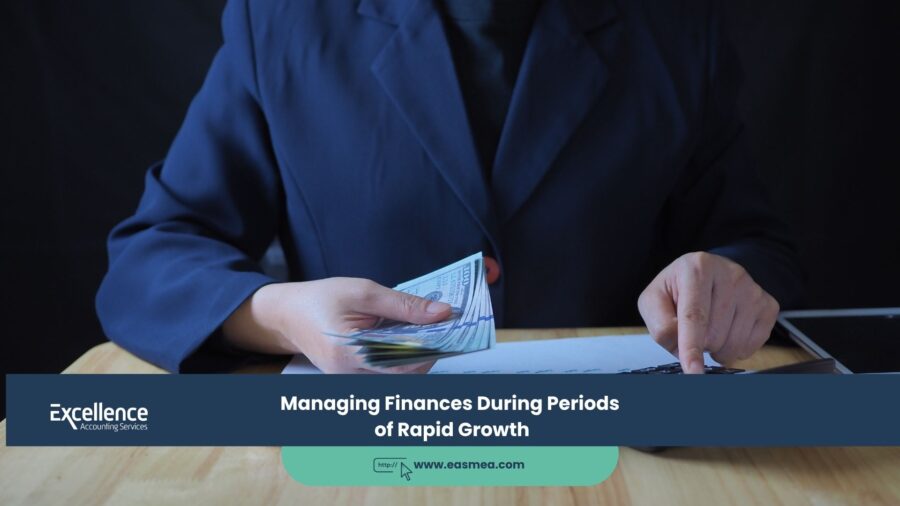
Managing Finances During Periods of Rapid Growth: A Strategic Survival Guide for UAE Businesses
Rapid growth is the dream for every entrepreneur in the dynamic UAE market. Landing that game-changing client, seeing sales double quarter-over-quarter, hiring new staff—these are the markers of success. But this success hides a dangerous paradox: fast growth is one of the most common reasons businesses fail. Scaling a company is like flying a plane at takeoff; it’s the moment of maximum stress, maximum fuel consumption, and maximum risk. Without astute financial management, the very success you’ve strived for can lead you to “grow broke.”
- Managing Finances During Periods of Rapid Growth: A Strategic Survival Guide for UAE Businesses
- The Growth Trap: Why "Growing Broke" is a Real Danger
- Pillar 1: Fortify Your Cash Flow (The Tactical Survival Tool)
- Pillar 2: Master Your Working Capital (The Cash Conversion Cycle)
- Pillar 3: Dynamic Forecasting & Scalable Systems
- Pillar 4: Protecting Profitability & Managing Compliance
- How Excellence Accounting Services (EAS) Powers Your Growth
- Frequently Asked Questions (FAQs) for High-Growth Companies
- Don't Let Your Success Become Your Downfall.
When revenue skyrockets, it often masks deep-seated problems. Your systems, built for a smaller company, begin to crack. Your spreadsheets crash. Your team is overwhelmed. Most dangerously, your cash—the lifeblood of your business—is consumed at an alarming rate. You must spend money on inventory, new hires, and marketing *today* to support sales that you may not receive cash for in 90 or 120 days. This creates a “cash flow gap” that can bankrupt an otherwise profitable company.
This comprehensive guide is a strategic framework for managing your finances during a period of high growth. It’s not just about surviving the scaling process; it’s about building a resilient, sustainable, and truly profitable enterprise for the long term. We will cover the essential pillars of financial control, from tactical cash flow forecasting to scaling your systems, managing working capital, and staying compliant in an increasingly complex tax environment.
Key Takeaways
- Cash is King, Not Profit: Rapid growth consumes cash. You must shift your focus from your P&L to your cash flow forecast. You can be profitable and bankrupt simultaneously.
- The 13-Week Cash Flow Forecast is Your GPS: Annual budgets are obsolete in a high-growth phase. A rolling 13-week (quarterly) cash forecast is your most critical tool for survival.
- Master Your Cash Conversion Cycle: Your survival depends on shortening the time it takes to turn spending into cash. This means aggressively managing receivables (AR), optimizing inventory, and leveraging payables (AP).
- Scale Your Systems & People: The accounting systems and team that got you here will not get you to the next level. Investing in scalable cloud platforms and expert financial oversight (like an outsourced CFO) is critical.
- Growth Creates New Tax Burdens: Scaling quickly will push you past the AED 375,000 Corporate Tax threshold and increase your VAT compliance risk. Tax planning becomes non-negotiable.
The Growth Trap: Why “Growing Broke” is a Real Danger
The “Growth Trap” is a classic business scenario. A company’s sales (revenue) increase at a much faster rate than its cash collection. The resulting “cash gap” must be funded, either from reserves or from financing. This is easiest to see in working capital.
Imagine you land a massive AED 2 million order:
- Day 1: You need to spend AED 500,000 in cash on raw materials and hire two new staff to fulfill the order.
- Day 30: You deliver the order and send an invoice for AED 2 million. Your P&L looks incredible! You’ve booked a huge profit.
- Day 60: Your supplier’s 60-day invoice for the materials is now due. You must pay them AED 500,000. You’ve also paid two months of new salaries.
- Day 90-120: Your customer finally pays your AED 2 million invoice.
In this scenario, your company was “profitable” on Day 30, but it was dangerously low on cash for 60-90 days, needing to fund operations out of pocket. Now multiply this scenario by ten or twenty new clients, and you see how a company can literally run out of cash to pay its suppliers and staff, all while holding a P&L statement showing record profits.
Pillar 1: Fortify Your Cash Flow (The Tactical Survival Tool)
When you’re scaling, your annual budget is irrelevant. Your strategic focus must become tactical. The single most important report in a high-growth company is the **13-Week Rolling Cash Flow Forecast.**
The 13-Week Forecast: Your New GPS
This is a simple (usually spreadsheet-based) tool that projects your weekly cash inflows and outflows for the next quarter. It is not an accounting report; it is an operational tool.
- Inflows: A realistic, customer-by-customer projection of *when* you will collect cash. This is not based on your sales forecast; it’s based on your accounts receivable aging report and your collections team’s promises.
- Outflows: All cash payments you *must* make. This is broken down into:
- Non-Discretionary: Payroll (link to payroll services), rent, utilities, loan repayments, supplier payments that are due (link to accounts payable).
- Discretionary: New hires, marketing spend, bonuses, new equipment.
At the end of each week, you update “Week 1” with your actual numbers and add a new “Week 13” at the end. This “rolling” view gives you a 3-month early warning system. It answers critical questions like, “If Client X pays 30 days late, will we be able to make payroll in Week 9?” This allows you to delay discretionary spending, chase AR, or draw on a credit line *before* it’s an emergency.
Pillar 2: Master Your Working Capital (The Cash Conversion Cycle)
Your cash flow forecast will show you the *symptoms*. Your working capital management is how you *cure* the disease. The goal is to shorten your **Cash Conversion Cycle (CCC)**, the time it takes to turn an AED spent on resources into an AED of cash in your bank.
CCC = DSO (Days Sales Outstanding) + DIO (Days Inventory Outstanding) – DPO (Days Payables Outstanding)
Your goal is to make this number as small as possible. Here’s how:
1. Aggressively Reduce DSO (Get Paid Faster)
Your accounts receivable is not a savings account; it’s a pile of zero-interest loans to your customers.
- Invoice Immediately & Accurately: Don’t wait until the end of the month. Invoice the *moment* the service is delivered. Ensure the invoice is 100% correct to avoid payment delays.
- Tighten Credit Terms: Stop offering 90-day terms just to win a sale. Move to 60 or 30 days.
- Offer Early-Pay Discounts: A “2/10 net 30” (2% discount if paid in 10 days, full amount due in 30) can be a powerful incentive.
- Dedicated Collections: Make collections a proactive, professional function, not an angry call when you’re desperate.
2. Optimize DIO (Hold Less Inventory)
Every item in your warehouse is cash you can’t spend.
- Demand Forecasting: Use your new sales data to build better forecasts. Avoid over-stocking “just in case.”
- Negotiate with Suppliers: Can you get faster delivery times? Can they hold consignment stock for you?
- Liquidate Slow-Moving Stock: Have a sale. Get rid of obsolete inventory. It’s better to have 50% of its value in cash than 100% of its value sitting in a box.
3. Lengthen DPO (Pay Slower, Strategically)
Your accounts payable is, in effect, a free line of credit from your suppliers.
- Negotiate Longer Terms: If you’re a high-growth customer, you have leverage. Ask for 60 or 90-day terms from your key suppliers.
- Use the Full Term: Don’t pay a 60-day invoice on Day 10 (unless there’s a significant early-pay discount). Pay it on Day 59 or 60.
- Communicate: If you *are* going to be late, be proactive. Call your supplier. This maintains the relationship.
Pillar 3: Dynamic Forecasting & Scalable Systems
The financial systems that served your startup will break under the strain of growth. You must upgrade your tools and your thinking.
From Static Budgets to Rolling Forecasts
The annual budget you wrote last year is a historical document. It’s useless for managing a high-growth company. You must shift to a **12-Month Rolling Financial Forecast**.
This is a full 3-statement model (P&L, Balance Sheet, Cash Flow) that you update every single month. When May’s actuals are in, you re-forecast the next 12 months (June to next May). This becomes your new “budget” and strategic plan. This is a core function of a CFO service and is essential for making smart decisions.
Scalable Technology is Non-Negotiable
Spreadsheets will crash. Data will be corrupted. Your team will spend 90% of its time just trying to get the numbers to tie out. You must invest in a scalable, cloud-based accounting system or ERP.
A modern system (e.g., Zoho Books, NetSuite, Xero) will:
- Automate invoicing, bank reconciliations, and expense tracking.
- Provide real-time dashboards on key metrics (DSO, DPO, margins).
- Act as a “single source of truth” for your entire company.
- Be the foundation for all your forecasting and reporting.
Investing in a professional accounting system implementation is not a cost; it’s an investment in your ability to scale.
Pillar 4: Protecting Profitability & Managing Compliance
The “growth at all costs” mindset is a trap. It’s easy to buy revenue with deep discounts or by taking on unprofitable clients. You must protect your margins.
Watch Your Margins Like a Hawk
You must know your *Gross Margin* and *Unit Economics* on every product line or service. Are you actually making money on these new sales? An accounting review can help you analyze this. This is where you connect your P&L back to your cash flow. High-margin, fast-paying clients are gold. Low-margin, slow-paying clients can be toxic, no matter how big the sale.
The New Tax & Compliance Burden
Growth is a magnet for regulatory scrutiny.
- UAE Corporate Tax: Your rapid growth will almost certainly push your profits over the AED 375,000 threshold. You must have a proactive tax plan. Your tax bill is based on *profit*, not cash. You can have a AED 1 million tax liability and an empty bank account. You must forecast this tax payment as a major cash outflow. (Link to UAE Corporate Tax).
- VAT Compliance: Higher sales volume means higher VAT volume. The risk of errors in your VAT return filing grows exponentially. An FTA audit on a high-growth company can be painful if the records are messy.
- Internal Controls: When you’re hiring fast, who has the company credit card? Who can approve a 100,000 AED payment? You must implement internal controls. An internal audit can help design and test these controls to prevent fraud and waste.
How Excellence Accounting Services (EAS) Powers Your Growth
Rapid growth is the time when you need expert financial partners the most. At EAS, we are structured to scale *with* you, providing the systems and strategic guidance to manage your success.
- Outsourced CFO Services: Get the strategic, high-level financial leadership you need without the cost of a full-time executive. Our CFO services will build your 13-week cash forecast, manage bank relationships, and guide your strategy.
- Scalable Accounting & Bookkeeping: We manage your day-to-day accounting and bookkeeping on robust platforms, ensuring your data is accurate and available in real-time.
- Working Capital Management: We provide dedicated teams for accounts receivable and accounts payable to optimize your cash conversion cycle.
- Tax & Compliance Assurance: Our specialists handle your complex Corporate Tax planning and VAT compliance, protecting you from risks.
- Funding & Strategic Planning: We prepare you to seek funding by conducting business valuations, preparing feasibility studies for new ventures, and performing due diligence for acquisitions.
Frequently Asked Questions (FAQs) for High-Growth Companies
The most common sign is a shrinking cash balance in your bank account, even though you are reporting record-high sales and profits. You feel “cash-poor.” You start to worry about making your next payroll, or you find yourself delaying supplier payments. This is the “cash gap” in action.
The CCC is a metric that measures the number of days it takes for your company to convert its investments in inventory (by buying from suppliers) into cash (by collecting from customers). The formula is: Days Inventory Outstanding (DIO) + Days Sales Outstanding (DSO) – Days Payables Outstanding (DPO). The lower the number, the better your cash flow.
There’s no single answer. **Debt** (like a revolving credit line) is often best for funding temporary working capital gaps, as you don’t give up ownership. However, you must have the cash flow to make the interest payments. **Equity** (from investors) is often better for funding large, long-term strategic leaps (like opening a new factory or launching in a new country), as it’s cash you don’t have to pay back. The cost is dilution of your ownership and control.
This is a critical, company-threatening problem. Every day you delay invoicing is a day you are giving your customer a free loan. If you invoice 14 days late on 60-day terms, you will not get paid for 74 days. This directly extends your DSO and suffocates your cash flow. Invoicing must be automated and instantaneous upon delivery.
A **budget** is a static, annual plan. It’s what you *thought* would happen at the beginning of the year. A **rolling forecast** is a dynamic, living document. It takes your *actual* performance from this month and projects the *new* expected outcome for the next 12 months. In a high-growth phase, you manage the business using the rolling forecast, not the static budget.
An accountant or bookkeeper records what *has* happened (historical). A CFO, or Outsourced CFO, focuses on what *will* happen (the future). They build your financial forecasts, manage your 13-week cash plan, create your strategy for funding growth, negotiate with banks, and provide strategic advice to the CEO. They are your financial co-pilot.
This is a common trap, as tax is on *profit*, not cash. The solution is forecasting. Your 13-week cash flow forecast and your 12-month rolling forecast must include “Corporate Tax Payment” as a large, lumpy cash outflow. You must set this cash aside as you earn the profit, just as you would with VAT. An expert tax advisor can help you plan for this.
Invoice factoring is when you “sell” your unpaid invoices to a finance company at a discount. They give you 80-90% of the cash immediately and pay you the rest (minus their fee) when your customer pays them. It is a fast way to unlock cash from your AR. The downside is that it can be expensive, and some customers see it as a sign your business is in trouble. It’s a useful tool, but often a last resort if you can’t get a traditional line of credit.
The moment your business has more than one person, more than 50 transactions a month, or any inventory. In a high-growth phase, spreadsheets are not an option. They are a liability. The risk of data corruption, version control issues, and catastrophic manual errors is 100%. A scalable, cloud-based system is a foundational requirement for growth.
This requires implementing basic internal controls. 1) **Budgets:** Even a rolling forecast has a budget for each department. 2) **Purchase Orders (POs):** Implement a simple PO system. No one can spend over a certain amount (e.g., AED 1,000) without an approved PO. 3) **Approval Workflows:** Define who can approve what. The CEO shouldn’t be approving AED 100 stationery bills, but the marketing intern shouldn’t be signing a AED 50,000 agency contract.
Conclusion: From Surviving Growth to Scaling Sustainably
Rapid growth is an exhilarating test of your business’s foundations. It will expose every weakness in your financial processes, systems, and strategy. Success is not measured by how fast you can grow your revenue, but by whether you can build a sustainable, profitable, and cash-positive business on the other side. By shifting your mindset from profit to cash, implementing rigorous forecasting, and investing in scalable systems and partners, you can navigate the turbulence of high growth and build an enterprise that is truly built to last.