

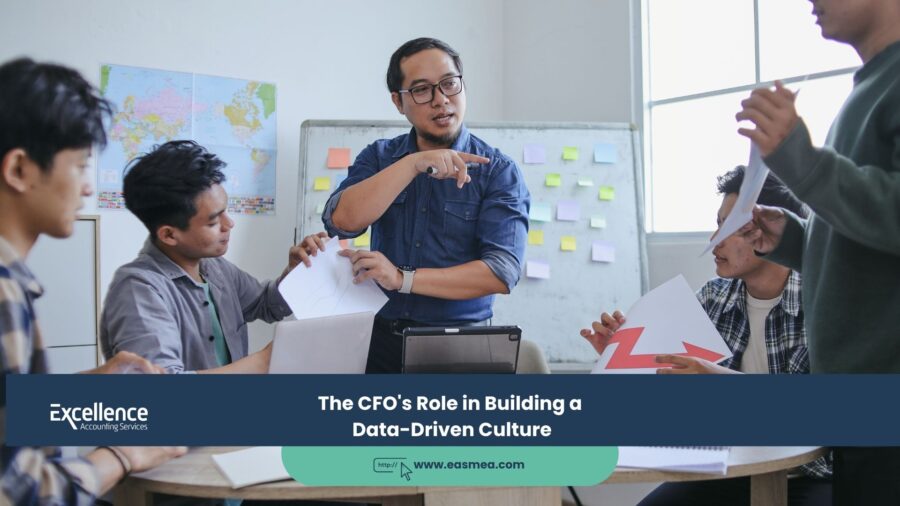
The Data-Driven CFO: Architect of a New Corporate Culture
The role of the Chief Financial Officer (CFO) is undergoing one of the most profound transformations in its history. For decades, the finance function was viewed as the corporate historian, the official scorekeeper, and the “no” person in the room—a department focused almost exclusively on historical reporting, cost control, and managing risk. Today, that model is obsolete.
- The Data-Driven CFO: Architect of a New Corporate Culture
- Section 1: Why the CFO? The Mandate for Change
- Section 2: The CFO's Playbook: Four Pillars of a Data-Driven Culture
- How Excellence Accounting Services (EAS) Partners with Data-Driven CFOs
- Frequently Asked Questions (FAQs)
- Ready to Build Your Data-Driven Finance Function?
In a world of accelerating change, digital transformation, and unprecedented data availability, the modern CFO is being recast as the organization’s chief data architect. The mandate is no longer just to report on what happened; it is to use data to predict what will happen and to prescribe what the business should do next. This requires a seismic shift—not just in technology, but in people, processes, and, most importantly, culture. The CFO is uniquely positioned to lead this charge, transforming the finance function from a cost center into a strategic value-creation engine.
This comprehensive guide explores the strategic and practical role of the CFO in championing, building, and scaling a data-driven culture. We will examine why the CFO is the natural leader for this transformation, the pillars required to build it, and how to overcome the inevitable challenges. This is the playbook for the data-driven CFO.
Key Takeaways
- A New Mandate: The CFO is evolving from the chief scorekeeper to the chief data architect, responsible for leveraging data as a strategic asset.
- Beyond Finance: A data-driven culture breaks down organizational silos, integrating financial data with operational, sales, and marketing data for a holistic view of the business.
- From Past to Future: The goal is to shift the finance function from historical reporting (what happened) to predictive analytics and strategic, forward-looking guidance (what will happen and why).
- It’s a “People” Problem: Technology (like BI tools and modern ERPs) is an enabler, but the real challenge is cultural. The CFO must champion data literacy and a mindset of data-backed decision-making across the entire company.
- The Single Source of Truth: The CFO is ultimately responsible for establishing a “single source of truth” for data, ensuring all departments are working from the same trusted information.
Section 1: Why the CFO? The Mandate for Change
While other C-suite roles, like the CIO or a Chief Data Officer, are critical to the technology and infrastructure, the CFO is the natural, indispensable leader for the cultural transformation. Here’s why:
1. The Steward of the “Single Source of Truth”
The finance department is already the organization’s “single source of truth.” For decades, it has been the only function with the mandate to consolidate data from every corner of the business, verify its accuracy, and produce a single, auditable set of numbers (the financial statements) upon which the company’s entire external reputation rests. Extending this mandate internally—from just financial data to all key performance data—is a natural evolution of this core responsibility.
2. The Link to Value Creation (ROI)
A data initiative without a clear link to financial outcomes is just an expensive science project. The CFO is the only executive who can credibly connect investments in data, analytics, and technology to measurable business value, whether it’s margin improvement, cost reduction, or optimized working capital. The CFO can ask and answer the critical question: “How will this data initiative make us more profitable?”
3. The Objective Cross-Functional Arbiter
Data often lives in silos, with each department (Sales, Marketing, Operations) protecting its own numbers. This leads to the all-too-common meeting where teams argue over “whose data is right.” The CFO, as an objective and cross-functional leader, is uniquely positioned to break down these silos. Their role is to champion a single, unified data model that serves the entire business, not just one department.
Section 2: The CFO’s Playbook: Four Pillars of a Data-Driven Culture
Building a data-driven culture is a long-term journey. The CFO must act as the architect, building the following four pillars:
Pillar 1: Invest in the Right Technology Foundation
You cannot build a skyscraper on a foundation of spreadsheets. A data-driven culture must be powered by a modern, integrated technology stack. The CFO must champion the business case for investing in:
- Modern Cloud Accounting/ERP Systems: The days of manual data entry and batch processing are over. A modern system (a core part of our accounting system implementation) acts as the transactional heart of the business, capturing clean, real-time data.
- Business Intelligence (BI) & Visualization Tools: Tools like Microsoft Power BI or Tableau are essential. They connect to various data sources and transform raw numbers into interactive, user-friendly dashboards that anyone can understand.
- Data Warehousing: A central repository that brings data from all systems (e.g., your ERP, your CRM, your payroll system) into one place for analysis.
Pillar 2: Champion Data Governance and Quality
Data is a strategic asset, but it becomes a liability if it’s wrong. “Garbage in, garbage out” is the mortal enemy of a data-driven culture. The CFO must establish a strong governance framework:
- Data Ownership: Assign clear owners for each key data set.
- Data Integrity: Implement processes to ensure data is accurate, complete, and consistent. This is where finance’s core disciplines of accounting and bookkeeping and account reconciliation are critical.
- Data Audits: Use tools like an internal audit or a periodic accounting review to actively test data quality and find errors before they pollute your analysis.
Pillar 3: Democratize Data & Foster Data Literacy
Data that is locked in the finance department’s “ivory tower” is useless. A true data-driven culture “democratizes” data, putting the right information in the hands of the people who make daily decisions.
- Shift from “Gatekeeper” to “Enabler”: The CFO must lead the finance team to evolve from “gatekeepers” who hoard data to “enablers” who provide self-service access to dashboards and reports.
- Invest in People & Training: The finance team itself needs to upskill, moving from data entry to data analysis. Beyond finance, the CFO must champion data literacy training for all department heads. This can be a joint effort with HR.
- Make Data Visible: A data-driven culture is one where performance is visible. The CFO should push for key dashboards to be on screens in every department, making performance a shared, transparent reality.
Pillar 4: Shift from Historical Reporting to Predictive Insights
This is the ultimate goal. A data-driven culture uses the past to predict the future. The CFO must lead this shift in focus.
- From Lagging to Leading: A traditional finance team reports on “lagging” indicators (e.g., last quarter’s revenue). A data-driven finance team, like a fractional CFO service, builds models using “leading” indicators (e.g., sales pipeline conversion rates, website traffic) to *predict* next quarter’s revenue.
- Integrate Operational & Financial Data: The real “a-ha” moments come when you merge data sets. For example, by linking accounts receivable data with sales team performance, you can identify which salespeople are bringing in “good” revenue versus “bad” revenue (i.e., from clients who don’t pay).
- Power Strategic Decisions: This new, integrated data becomes the engine for all high-stakes decisions, from feasibility studies for new products to due diligence in an acquisition.
How Excellence Accounting Services (EAS) Partners with Data-Driven CFOs
A CFO cannot build this culture alone. They need partners who can provide the foundation, the tools, and the expertise. EAS is built to be that partner.
- Fractional CFO Services: Our CFO services provide the strategic leadership to help you design and execute your data-driven roadmap.
- Modern System Implementation: We are experts in accounting system implementation, ensuring you have the modern tech foundation to capture clean data.
- The Data-Quality Engine: Our accounting and bookkeeping and account reconciliation services ensure your “single source of truth” is accurate, reliable, and up-to-date.
- Data Governance and Assurance: We use internal audit and accounting review processes to test your data integrity and internal controls, giving you confidence in your numbers.
- Actionable Financial Reporting: We move beyond basic statements to provide insightful, customized financial reporting and dashboards that highlight the KPIs that truly matter.
- Strategic Business Consultancy: Our business consultancy team can help you build the ROI-driven business case you need to get board approval for your data initiatives.
Frequently Asked Questions (FAQs)
It’s a critical partnership. The CIO (Chief Information Officer) or CTO (Chief Technology Officer) is responsible for the “pipes”—the infrastructure, the systems, and the technology. The CFO is responsible for ensuring the data flowing through those pipes is accurate, governed, and, most importantly, translated into actionable insights that create measurable business value.
Start small and show a “quick win.” Don’t try to boil the ocean. Pick one high-visibility, high-pain-point process (like sales forecasting or expense reporting). Work with a small team to build a simple BI dashboard for it. When other departments see the result, they will be lining up to be next.
This is about demonstrating “what’s in it for them.” Show them how modern tools can automate the 80% of their job that is low-value data entry and reconciliation. This frees them up to spend 80% of their time on high-value, strategic analysis—the work that is more engaging and builds their careers. Invest in their training on new BI tools.
Data is the raw fact: “Sales in Q3 were AED 5 million.” An insight is the actionable, contextual story that data tells: “Sales in Q3 were AED 5 million, but 40% of that came from a low-margin product that is consuming 60% of our support costs. We should consider raising its price or discontinuing it.” The CFO’s job is to lead the hunt for insights, not just report data.
Immensely. A company with a “single source of truth,” a modern ERP, and clean, reconciled data will have a far smoother and less painful audit. When the FTA asks for a supporting document, you can retrieve it in seconds, not days. A strong data culture is a powerful risk-mitigation tool for tax compliance.
A data-driven CFO will obsess over linking non-financial KPIs to the P&L. Examples include: Customer Acquisition Cost (CAC), Customer Lifetime Value (LTV), Sales Pipeline Velocity, Customer Churn Rate, and Employee Turnover Rate. They understand that these operational metrics are the leading indicators of future financial performance.
A data-driven CFO can perform much more effective due diligence. They won’t just look at the target’s audited financials; they will demand access to the target’s raw operational data to assess its quality and uncover risks or synergies that are not visible on the surface. A business valuation in this context becomes much more accurate.
Absolutely. By integrating payroll data from HR with financial and operational data, the CFO can perform a strategic workforce analysis. You can answer questions like: “What is the real, all-in cost per employee by department?” or “What is the revenue per employee, and how does that compare to our competitors?”
A “data silo” is when data is locked within one department’s system (e.g., the marketing team’s email platform, the sales team’s CRM). It’s the CFO’s problem because they cannot create a single, unified view of the business. For example, the CFO can’t see the full “lead-to-cash” journey if the marketing data on leads doesn’t connect to the sales data on conversions, which in turn doesn’t connect to the finance data on revenue recognition.
You measure it by the improved outcomes of the decisions you make. The ROI is found in: 1) Increased forecast accuracy (leading to better cash management). 2) Reduced “days to close” the monthly books (freeing up the finance team). 3) Optimized working capital (from better AR/AP analysis). 4) Higher margins (from data-backed pricing decisions). 5) Cost savings (from identifying operational inefficiencies).
Conclusion: The New Standard for Financial Leadership
The transformation of the CFO into the chief architect of a data-driven culture is not a trend; it is the new standard for strategic financial leadership. The CFOs who cling to the historical “scorekeeper” model will become obsolete, while those who embrace their role as a data champion will unlock unprecedented value for their organizations.
This journey is complex, requiring a unique blend of financial acumen, technological savvy, and strong cultural leadership. But for the CFO who is willing to lead this charge, the opportunity is immense: to move beyond the spreadsheet, to break down silos, and to cement the finance function as the true, data-driven, strategic heart of the modern enterprise.